
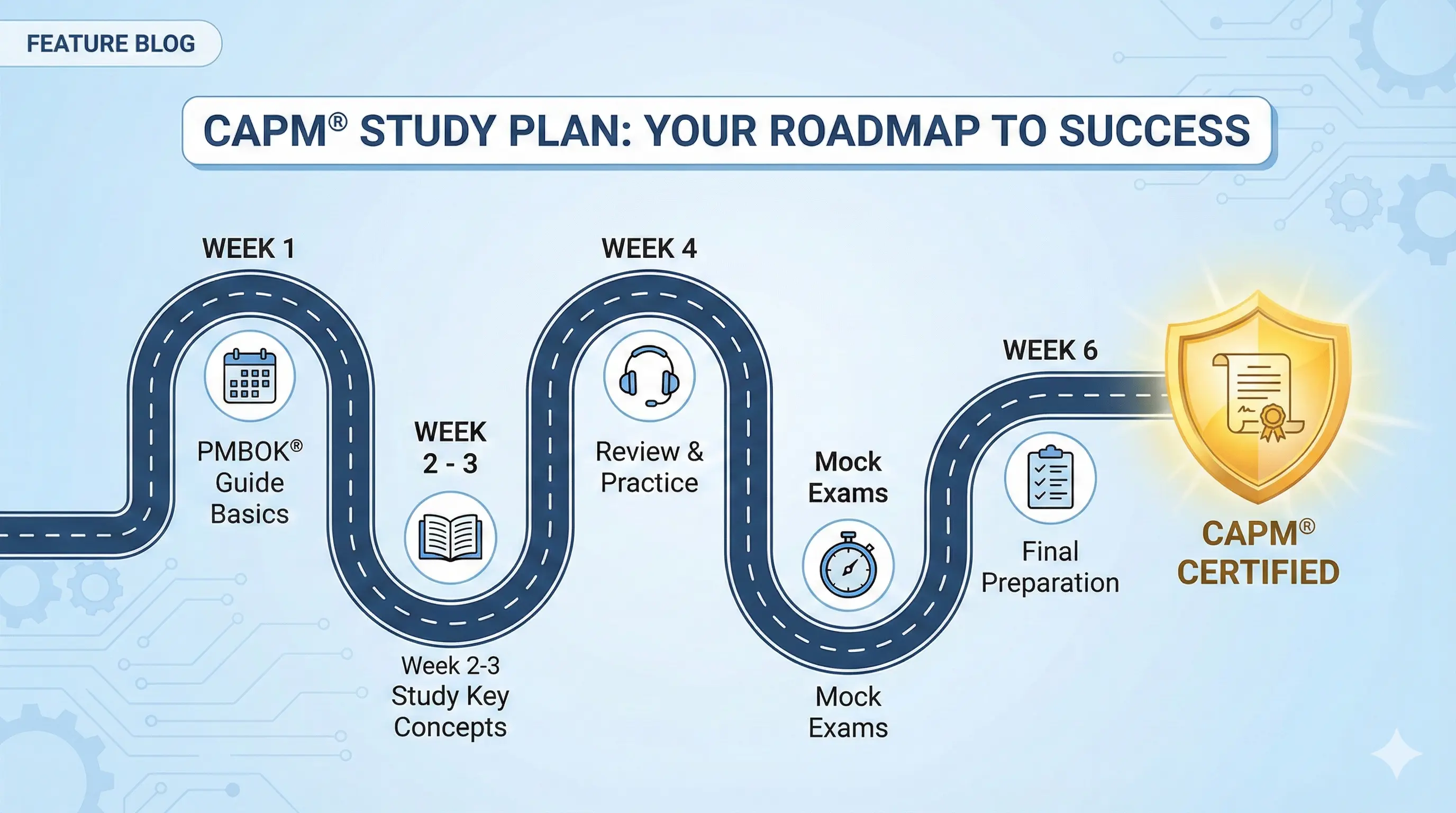
A structured study plan is often the difference between passing the CAPM exam and falling short. Without a roadmap, it's easy to spend too much time on topics you already understand while neglecting areas that need work. The right plan keeps you on track, builds momentum, and ensures you're ready when exam day arrives.
This guide provides three proven study schedules based on your timeline and starting point. For a complete overview of the certification, see our CAPM Certification Guide.
How Long Should You Study?
Most candidates need 40-80 hours of study time spread over 4-8 weeks to pass the CAPM exam. That's a wide range because the right timeline depends on several factors:
Your background matters:
- Do you work in a project-related role? You'll recognize many concepts and move faster.
- Are you completely new to project management? Budget extra time for foundational concepts.
- Have you completed your 23 hours of PM education recently? That content is fresh.
Your schedule matters:
- Can you dedicate 2-3 hours daily? A 4-week plan is realistic.
- Limited to evenings and weekends? Spread it over 6-8 weeks.
- Inconsistent availability? Build buffer time into your plan.
Self-assessment questions:
Before choosing a timeline, ask yourself:
- Can I explain what a project life cycle is?
- Do I know the difference between predictive and agile methodologies?
- Am I familiar with terms like stakeholder, scope, and work breakdown structure?
If you answered yes to most of these, you have a foundation to build on. If these terms are unfamiliar, plan for the longer timeline.
The 4-Week Intensive Plan
Best for: Candidates with some PM exposure, recent graduates of PM courses, or those with dedicated study time available.
Daily commitment: 2-3 hours
Week 1: Build the Foundation
Focus on completing or reviewing your 23-hour PM education course. This is your primary study material for the week. Take notes on key concepts, especially anything that's new to you.
- Complete education course content
- Create a glossary of PM terms as you go
- Take the diagnostic quiz in your course (if available)
- Identify your weakest domain based on initial exposure
Week 2: Deep Dive Into Domains
Shift focus to understanding the four exam domains. Spend roughly equal time on each, adjusting based on the domain weights and your comfort level.
- Study Project Management Fundamentals (36% of exam)
- Study Business Analysis concepts (27% of exam)
- Study Agile Frameworks (20% of exam)
- Study Predictive Methodologies (17% of exam)
- Begin daily practice questions (20-30 per day)
Week 3: Practice and Refine
This week is about active recall and identifying gaps. Practice questions become your primary study tool.
- Complete 40-50 practice questions daily
- Review explanations for every question—right or wrong
- Return to study materials for consistently missed topics
- Take your first full-length practice exam mid-week
- Analyze results by domain and adjust focus
Week 4: Final Review and Confidence Building
Taper your studying and focus on reinforcement. Avoid cramming new material.
- Take 1-2 more full-length practice exams
- Review flagged questions and weak areas
- Light review of key concepts and terminology
- Rest the day before your exam
- Schedule exam for mid-to-late week
The 6-Week Balanced Plan
Best for: Working professionals balancing study with job responsibilities, or those who prefer a moderate daily commitment.
Daily commitment: 1-2 hours (with longer weekend sessions)
Weeks 1-2: Education and Fundamentals
Use these two weeks to complete your PM education requirement and establish your baseline knowledge.
- Week 1: Complete first half of 23-hour education course
- Week 2: Complete second half of education course
- Take notes and highlight unfamiliar concepts
- Begin light practice questions in Week 2 (10-15 per day)
- Weekend: Review notes and create summary sheets
Weeks 3-4: Domain Mastery
Dedicate focused time to each exam domain, using practice questions to reinforce learning.
- Week 3: Focus on PM Fundamentals and Business Analysis (the two largest domains)
- Week 4: Focus on Agile Frameworks and Predictive Methodologies
- Daily practice: 25-35 questions
- Weekend: Longer study sessions (2-3 hours) for deep review
- Take first practice exam at end of Week 4
Week 5: Intensive Practice
Shift your ratio toward more practice, less passive studying.
- Daily practice: 40-50 questions
- Review all explanations thoroughly
- Identify patterns in missed questions
- Take second practice exam mid-week
- Target specific weak areas based on results
Week 6: Polish and Prepare
Final refinement and confidence building.
- Take 1-2 more practice exams
- Light review only—no new material
- Focus on your highest-impact weak areas
- Reduce study intensity toward end of week
- Schedule exam for late in the week
The 8-Week Comprehensive Plan
Best for: Complete beginners to project management, those with limited daily study time, or candidates who prefer a thorough approach.
Daily commitment: 1 hour (with flexibility for catch-up)
Weeks 1-3: Foundation Building
Take your time absorbing the fundamentals. There's no rush.
- Weeks 1-2: Work through 23-hour education course at a comfortable pace
- Week 3: Complete education course and review all notes
- Focus on understanding, not memorization
- Begin vocabulary building with PM terminology
- Light practice questions in Week 3 (10 per day)
Weeks 4-5: Domain Deep Dives
Explore each domain thoroughly, spending extra time on challenging concepts.
- Week 4: PM Fundamentals and Predictive Methodologies
- Week 5: Business Analysis and Agile Frameworks
- Daily practice: 15-25 questions
- Use weekends for review and catch-up
- Don't rush—understanding beats speed
Weeks 6-7: Practice Intensification
Ramp up your practice question volume and start simulating exam conditions.
- Daily practice: 30-40 questions
- Take first practice exam in Week 6
- Analyze results and identify weak domains
- Take second practice exam in Week 7
- Create focused review sheets for problem areas
Week 8: Final Preparation
Consolidate your knowledge and build confidence.
- Take 1-2 final practice exams
- Review missed questions from all practice tests
- Light study only—trust your preparation
- Rest and relax the day before
- Schedule exam for mid-week
Essential Study Resources
Regardless of which timeline you choose, you'll need these core resources:
23-Hour PM Education Course (Required)
This fulfills your eligibility requirement and serves as your primary study material. Choose a course that covers CAPM exam content specifically, not just general project management.
Practice Questions (Essential)
Practice questions are non-negotiable. They're how you reinforce concepts, identify weak areas, and build the pattern recognition needed for exam success. Aim for 500-1,000+ practice questions before your exam.
PMBOK Guide (Optional Reference)
The PMBOK Guide is PMI's foundational standard, and the CAPM exam is based on its concepts. However, you don't need to read it cover-to-cover. Use it as a reference when you need deeper explanation of specific topics. Your education course should cover the essential content.
Flashcards and Summaries (Helpful)
Quick-reference materials help with memorization of terms, formulas, and process relationships. Many candidates create their own as a study exercise, which reinforces learning.
How to Use Practice Questions Effectively
Simply answering questions isn't enough. How you practice matters as much as how much you practice.
Review every explanation:
Read the explanation for every question—even the ones you got right. You might have guessed correctly or chosen the right answer for the wrong reason. Understanding why an answer is correct builds deeper knowledge than just knowing that it's correct.
Track your weak areas:
Note which domains or topics give you trouble. If you're consistently missing Business Analysis questions, that's a signal to spend more study time there. Most practice platforms track this automatically.
Don't memorize questions:
The goal is understanding concepts, not recognizing specific questions. If you've seen a practice question before, focus on whether you can explain the reasoning, not just recall the answer.
Simulate exam conditions:
As you get closer to your exam date, take full-length practice tests under timed conditions. This builds stamina and helps you calibrate your pacing.
Signs You're Ready to Schedule Your Exam
How do you know when you've studied enough? Look for these indicators:
Consistent practice scores: You're scoring 70% or higher on practice exams consistently, not just once. One good score could be luck; three in a row shows readiness.
Domain balance: You're performing reasonably well across all four domains, not just acing two while struggling with the others.
Conceptual understanding: You can explain why an answer is correct, not just recognize it. If someone asked you to teach a concept, you could do it.
Diminishing returns: Your practice scores have plateaued. Additional studying isn't moving the needle much. This usually means you've absorbed the material.
Confidence without cockiness: You feel prepared but respectful of the exam. Overconfidence can lead to careless mistakes; appropriate confidence means you've done the work.
Build Your Confidence Now
The best study plan is one you'll actually follow. Choose the timeline that fits your life, gather your resources, and commit to consistent daily progress. Small steps compound into exam readiness.
For a detailed breakdown of what you'll be tested on, see our guide to CAPM Exam Domains. Wondering about the difficulty level? Read Is the CAPM Exam Hard? for realistic expectations.
Ready to put your plan into action? Start practicing with free CAPM questions on PM Drills and track your progress across all four domains.