PMI-ACP and CSM are both popular agile certifications, but they serve different purposes. Understanding the differences will help you choose the right credential for your career goals.
Quick Comparison
PMI-ACP is offered by PMI and focuses on multiple agile frameworks. It requires 24 months of agile experience and 21 hours of agile training. The exam has 120 questions (100 scored) in 180 minutes. The passing score is not disclosed. The exam fee is $435 for PMI members or $495 for non-members. Renewal requires 30 PDUs every 3 years.
CSM is offered by Scrum Alliance and focuses on Scrum only. It requires no experience and includes a mandatory 16-hour course. The exam has 50 questions in 60 minutes with a 74% passing score. The cost ranges from $500-$2,000 which includes the training. Renewal requires 20 SEUs plus $100 every 2 years.
Total Cost Breakdown
The exam fees don't tell the whole story. Here's what each certification actually costs when you factor in training, preparation, and ongoing maintenance.
CSM Total Investment
CSM pricing is bundled. Your course fee includes the exam, so you pay one price for everything. Courses range from $500 to $2,000 or more depending on the trainer, format, and location.
Factors that affect CSM course pricing include trainer reputation and experience, in-person versus virtual delivery, geographic location for in-person courses, and class size and format.
Budget options exist. Virtual courses from lesser-known trainers can cost $500-$700. Premium in-person courses from well-known trainers in major cities can exceed $2,000.
Renewal costs $100 every two years plus earning 20 Scrum Education Units. SEUs can be earned for free through various activities, but tracking and reporting them takes time.
Realistic CSM budget over 5 years: $700-$2,200 for initial certification plus $200 for two renewal cycles, totaling $900-$2,400.
PMI-ACP Total Investment
PMI-ACP pricing is unbundled. You pay separately for training, exam, and PMI membership.
The exam costs $435 for PMI members or $495 for non-members. PMI membership costs $139 per year. If you're pursuing PMI certifications long-term, membership pays for itself.
Training for the required 21 agile hours ranges from free online resources to $1,500 or more for instructor-led courses. Most candidates spend $200-$500 on quality training.
Study materials like practice exams and prep books typically cost $50-$200. The PMI-ACP exam is challenging enough that most people invest in dedicated preparation resources.
Renewal costs $60 every three years plus earning 30 PDUs. PDUs can be earned for free through PMI's online resources and professional activities.
Realistic PMI-ACP budget over 5 years: $600-$1,200 for initial certification plus $120 for one renewal cycle, totaling $720-$1,320.
Cost Comparison Summary
CSM has higher upfront costs but includes everything bundled together. PMI-ACP has lower upfront costs but requires assembling your own training and materials. Over a 5-year period, total costs are often similar, though PMI-ACP tends to be slightly cheaper for self-directed learners who minimize training expenses.
Don't choose based on cost alone. The right certification for your career goals provides value that far exceeds the investment.
The Fundamental Difference
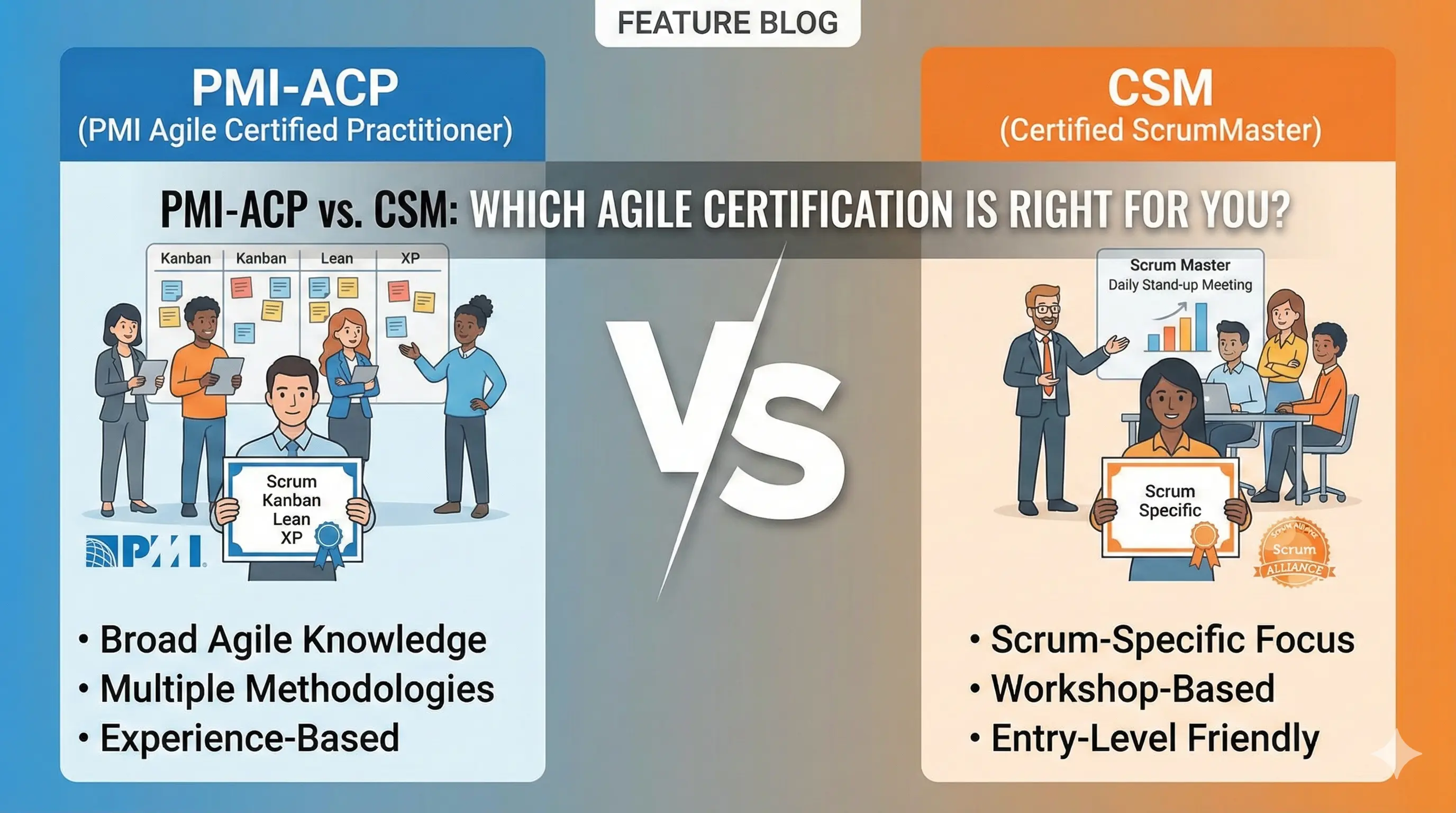
The biggest difference between PMI-ACP and CSM is scope.
CSM focuses exclusively on Scrum. You learn the Scrum framework—roles (Scrum Master, Product Owner, Developers), events (Sprint, Daily Scrum, etc.), and artifacts (Product Backlog, Sprint Backlog, Increment). It's deep but narrow.
PMI-ACP covers multiple agile methodologies: Scrum, Kanban, Lean, XP (Extreme Programming), and hybrid approaches. It's broader but doesn't go as deep into any single framework.
Think of it this way: CSM is a specialist certification for Scrum, while PMI-ACP is a generalist certification for agile.
What Each Exam Actually Tests
Understanding the exam content helps you gauge preparation requirements and decide which certification aligns with your knowledge.
CSM Exam Content
The CSM exam tests your understanding of the Scrum framework as taught in your mandatory course. Questions cover Scrum roles including the Scrum Master, Product Owner, and Developers. They cover Scrum events including Sprint, Sprint Planning, Daily Scrum, Sprint Review, and Sprint Retrospective. They cover Scrum artifacts including Product Backlog, Sprint Backlog, and Increment. They also cover Scrum values, the Scrum Master's responsibilities, and how Scrum teams work together.
The exam closely mirrors your training content. If you pay attention during your two-day course and review the materials, you'll recognize most questions. The 74% passing threshold with 50 questions means you can miss up to 13 questions and still pass.
CSM questions tend to be direct knowledge checks. You'll see questions like "What is the purpose of the Sprint Retrospective?" or "Who is responsible for managing the Product Backlog?"
PMI-ACP Exam Content
The PMI-ACP exam tests broader agile knowledge across multiple frameworks and methodologies. The seven domains are agile principles and mindset, value-driven delivery, stakeholder engagement, team performance, adaptive planning, problem detection and resolution, and continuous improvement.
Unlike CSM, PMI-ACP doesn't focus on one framework. You need to understand Scrum, Kanban, Lean, Extreme Programming (XP), and hybrid approaches. Questions test your ability to apply the right approach in different situations.
PMI-ACP questions are often scenario-based. You might see a situation description followed by "What should the team do?" with multiple reasonable-sounding answers. You need to identify the best response according to agile principles.
The exam also covers tools and techniques like user stories, story points, velocity, burndown charts, Kanban boards, work-in-progress limits, retrospectives, and more. You need practical knowledge, not just theoretical understanding.
Key Differences in Testing Approach
CSM tests whether you understand Scrum. PMI-ACP tests whether you can apply agile thinking across various situations and frameworks.
CSM is narrower but expects solid comprehension of that narrow scope. PMI-ACP is broader and expects you to synthesize knowledge from multiple sources.
If you've only worked with Scrum, PMI-ACP will require learning new frameworks. If you've worked with multiple agile approaches, PMI-ACP might feel more natural than deep-diving into Scrum details for CSM.
Who Should Get CSM?
CSM is ideal if you work (or want to work) specifically as a Scrum Master, your organization uses Scrum as its primary framework, you want a quick credential (2-day course plus easy exam), you're new to agile and want foundational knowledge, or you don't have significant agile project experience yet.
The CSM path is straightforward: attend a 16-hour course, pass a 50-question exam, and you're certified. No prior experience required.
Who Should Get PMI-ACP?
PMI-ACP is ideal if you work with multiple agile frameworks (not just Scrum), you're a project manager applying agile practices, you already have 2+ years of agile experience, you hold (or plan to pursue) PMP certification, or you want a credential that demonstrates broad agile expertise.
PMI-ACP requires documented agile experience, which means it's not an entry-level credential. It's designed for practitioners who have already been "doing agile" and want to validate their expertise.
Requirements Comparison
CSM requirements are simple: complete a 16-hour course from a Certified Scrum Trainer, then pass the exam. That's it—no experience needed.
PMI-ACP requirements include a secondary degree (high school diploma or equivalent), 24 months of agile project experience within the last 5 years, 21 hours of agile training, and passing the exam.
The PMI-ACP experience requirement is the main barrier. If you're early in your agile career, you may not qualify for PMI-ACP yet.
Meeting the PMI-ACP Experience Requirement
The 24-month agile experience requirement is the main barrier to PMI-ACP. Here's how to determine if you qualify and how to document your experience.
What Counts as Agile Experience
PMI defines agile project experience broadly. You don't need "Scrum Master" in your job title. Any role where you actively participated in agile projects counts.
Qualifying experience includes working on Scrum teams in any role, participating in Kanban workflows, contributing to iterative development projects, working on teams that use agile practices even without formal methodology, and hybrid projects that blend agile and traditional approaches.
The experience must be within the last five years. Agile work from seven years ago doesn't count toward current eligibility.
How to Calculate Your Hours
PMI requires 2,000 hours of agile project experience within the last five years, which works out to roughly 24 months of full-time agile work.
If you've worked on agile teams full-time for two or more years, you likely qualify. Part-time agile work takes longer to accumulate but still counts.
Be conservative in your estimates. PMI audits a percentage of applications, and you'll need to provide documentation if selected. Don't inflate your hours.
Documenting Your Experience
Your PMI-ACP application requires project details including project name and description, your role on the project, dates of involvement, and hours spent on agile activities.
Keep records of your agile work as you go. It's much easier to document projects while they're fresh than to reconstruct details years later.
Acceptable documentation includes project records, performance reviews mentioning agile work, emails referencing project participation, and supervisor verification if audited.
What If You Don't Qualify Yet?
If you don't have 24 months of agile experience, you have two options.
First, you can pursue CSM now since it has no experience requirement. Build your agile experience, then add PMI-ACP later once you qualify.
Second, you can wait and accumulate experience. Focus on getting onto agile projects at work. Volunteer for cross-functional teams using agile methods. The experience requirement exists for a reason, and having real agile experience makes the exam more meaningful.
Don't try to game the experience requirement. The knowledge tested on PMI-ACP assumes you've actually done agile work. Without that foundation, the exam will be significantly harder and the certification less valuable.
Exam Difficulty
The CSM exam has 50 questions and you need 37 correct (74%) to pass. You have 60 minutes and can reference the Scrum Guide. Most people find it straightforward after completing the required training. The pass rate is very high, estimated at 95%+.
The PMI-ACP exam has 120 questions (100 scored) and you have 3 hours. It's scenario-based, testing your ability to apply agile principles to real-world situations. Questions cover multiple frameworks, not just Scrum. The passing score isn't disclosed, but the exam is significantly more challenging than CSM. Most candidates need focused study beyond just work experience. The pass rate is lower than CSM, estimated at 70-80% for prepared candidates.
Career Value
Both certifications can boost your career, but in different ways.
CSM is valuable for landing Scrum Master roles, organizations that specifically use Scrum, demonstrating foundational agile knowledge, and networking through the Scrum Alliance community.
PMI-ACP is valuable for project managers working in agile environments, organizations using multiple methodologies, demonstrating breadth of agile expertise, and complementing a PMP certification.
If you're targeting Scrum Master roles specifically, CSM is the more recognized credential. If you're a project manager who uses agile practices, PMI-ACP may be more relevant.
Agile Career Paths: Where Each Certification Leads
Both certifications can advance your agile career, but they open different doors and lead to different trajectories.
CSM Career Trajectory
CSM is the entry point for Scrum Master roles. The typical career progression starts with CSM certification, then moves to Scrum Master for one or two teams, then Senior Scrum Master or Scrum Master for multiple teams, then Agile Coach or Release Train Engineer, and potentially Chief Scrum Master or enterprise agile leadership.
Job titles that commonly require or prefer CSM include Scrum Master, Agile Scrum Master, Scrum Coach, Iteration Manager, and Agile Team Facilitator.
The Scrum Alliance certification path continues with Advanced CSM (A-CSM) for experienced practitioners, then Certified Scrum Professional (CSP-SM) for experts, and Certified Enterprise Coach (CEC) or Certified Team Coach (CTC) for coaches.
CSM anchors your career in the Scrum ecosystem. If you want to specialize deeply in Scrum and build expertise within that framework, CSM starts you on that path.
PMI-ACP Career Trajectory
PMI-ACP positions you as a versatile agile practitioner rather than a Scrum specialist. The typical career progression starts with PMI-ACP certification, then moves to Agile Project Manager or Agile Team Lead, then Senior PM with agile expertise, then Program Manager for agile programs, and potentially PMO Director or VP of Delivery.
Job titles that commonly value PMI-ACP include Agile Project Manager, Delivery Manager, Technical Program Manager, Agile Coach with PM background, and Scrum Master in PMI-oriented organizations.
The PMI certification path connects to PMP for project management, PgMP for program management, and PMI-PBA for business analysis. PMI-ACP complements these credentials rather than competing with them.
PMI-ACP anchors your career in the PMI ecosystem. If you want to combine agile expertise with broader project and program management credentials, PMI-ACP fits that trajectory.
Which Path Fits Your Goals?
If you want to be a dedicated Scrum Master and go deep into Scrum coaching, start with CSM and continue up the Scrum Alliance path.
If you want to be an agile-fluent project manager who can work across methodologies, PMI-ACP aligns better with that generalist approach.
If you're unsure, consider where you want to be in five years. Look at job postings for those roles and see which certifications they mention. That tells you what the market values for your target positions.
Can You Get Both?
Yes, many agile practitioners hold both CSM and PMI-ACP. They complement each other: CSM provides deep Scrum knowledge and the Scrum Master community, while PMI-ACP validates broader agile expertise and connects to PMI's ecosystem.
If you're building a career in agile, starting with CSM (no experience required) and adding PMI-ACP later (once you have experience) is a common path.
Which Should You Choose?
Choose CSM if you don't have 24 months of agile experience, you want to become a Scrum Master specifically, you prefer structured instructor-led training, you want a quick accessible certification, or your organization primarily uses Scrum.
Choose PMI-ACP if you have 24+ months of documented agile experience, you work with multiple agile frameworks, you're a project manager applying agile methods, you want to complement your PMP certification, or you want to demonstrate broad agile competence.
Common Mistakes When Choosing
After working with thousands of agile practitioners, we see the same decision-making mistakes repeatedly.
Mistake 1: Pursuing PMI-ACP Without Real Agile Experience
Some candidates rush to PMI-ACP by creatively interpreting their experience to meet the 24-month requirement. This backfires in two ways.
First, if PMI audits your application and your experience doesn't hold up, your application is rejected and your exam fee is forfeited.
Second, even if you pass the audit, the exam tests practical agile judgment that's hard to develop without real experience. You'll struggle with scenario questions that experienced practitioners find straightforward.
If you don't have solid agile experience, start with CSM and build your foundation first.
Mistake 2: Choosing CSM Just Because It's Easier
Yes, the CSM exam is easier than PMI-ACP. That shouldn't be your primary decision factor.
If your career goal requires broad agile knowledge across multiple frameworks, CSM's Scrum-only focus won't serve you well. You'll have a credential that doesn't match your job requirements.
Choose based on career fit, not exam difficulty. Both certifications require genuine effort to earn and maintain.
Mistake 3: Ignoring the Community Difference
CSM connects you to Scrum Alliance, with local user groups, global conferences, and a community focused specifically on Scrum.
PMI-ACP connects you to PMI, with chapters worldwide, events covering all aspects of project management, and a community of project professionals who may or may not specialize in agile.
These communities have different cultures and networking opportunities. If community matters to you, research both organizations before deciding.
Mistake 4: Not Considering Your Existing Credentials
If you already hold PMP or plan to pursue it, PMI-ACP integrates naturally with your existing PMI credentials. You'll maintain everything through one organization with aligned renewal cycles.
If you have no PMI credentials and don't plan to get them, CSM might be simpler since you won't be managing credentials across multiple organizations.
Think about your total certification portfolio, not just this one decision.
Mistake 5: Overthinking the Decision
Both certifications are legitimate, respected, and valuable for agile careers. Successful agile practitioners hold one, the other, or both.
If you've been researching for weeks without deciding, just pick one and move forward. The certification matters less than what you learn and how you apply it. Either choice moves your career forward.
Frequently Asked Questions
Which certification is harder?
PMI-ACP is harder. It has more questions (120 versus 50), a longer time limit (180 versus 60 minutes), covers more frameworks, and uses scenario-based questions. CSM has a higher pass rate and a more straightforward exam format.
Can I take PMI-ACP without agile experience?
No. PMI requires 24 months (2,000 hours) of agile project experience within the last five years. This is verified during the application process and may be audited. If you don't have this experience, start with CSM instead.
Do I need to know Scrum for PMI-ACP?
Yes, but it's not enough. PMI-ACP tests Scrum plus Kanban, Lean, XP, and other agile approaches. If you only know Scrum, you'll need to study additional frameworks before taking PMI-ACP.
Is CSM recognized outside the United States?
Yes, CSM is recognized globally, though recognition varies by region. CSM is particularly strong in North America and growing in Asia and Latin America. PSM from Scrum.org is often more recognized in Europe. PMI-ACP has global recognition through PMI's worldwide presence.
How long does each certification last?
CSM lasts two years and requires 20 SEUs plus a $100 fee to renew. PMI-ACP lasts three years and requires 30 PDUs plus a $60 fee to renew. PMI-ACP has a longer cycle and lower renewal cost.
Can I get both certifications?
Yes, many agile practitioners hold both CSM and PMI-ACP. They complement each other since CSM demonstrates Scrum depth while PMI-ACP demonstrates agile breadth. However, maintaining both requires tracking two sets of continuing education requirements.
Which certification pays more?
Salary depends more on your role, experience, and location than on which certification you hold. That said, PMI-ACP holders often work in project management roles with higher base salaries, while CSM holders often work in dedicated Scrum Master roles. Both certifications can lead to six-figure salaries in the right markets.
Should I get CSM first and then PMI-ACP?
This is a common path. CSM has no experience requirement, so you can get it immediately. After two or more years of agile work, you'll qualify for PMI-ACP. The Scrum knowledge from CSM transfers directly to the Scrum portions of PMI-ACP.
What if my company only uses Scrum?
If your organization exclusively uses Scrum and you plan to stay there, CSM is the more relevant certification. However, learning multiple frameworks through PMI-ACP makes you more versatile if you change jobs or your company adopts additional methodologies.
Start Preparing Today
Whichever certification you choose, practice questions help you prepare effectively.
PM Drills offers realistic practice questions for both certifications with detailed explanations to help you understand the concepts—not just memorize answers.
Practice for the CSM exam or practice for the PMI-ACP exam today at PM Drills.