Choosing between PMP and CAPM is one of the most common questions for aspiring project managers. Both certifications come from PMI (Project Management Institute), but they serve different career stages and have different requirements.
This guide breaks down everything you need to know to make the right choice for your career.
Quick Comparison
PMP requires 3-5 years of project management experience, while CAPM requires none.
PMP requires 35 hours of PM training, while CAPM requires 23 hours.
The PMP exam has 180 questions in 230 minutes. The CAPM exam has 150 questions in 180 minutes.
PMP costs $405 for PMI members ($555 for non-members). CAPM costs $225 for members ($300 for non-members).
Both certifications are valid for 3 years. PMP requires 60 PDUs to renew, while CAPM requires 15 PDUs.
The PMP exam is significantly harder than the CAPM.
Cost: The Full Picture
The exam fees only tell part of the story. Here's what each certification actually costs when you factor in training, study materials, and ongoing maintenance.
CAPM Total Investment
The CAPM exam costs $225 for PMI members or $300 for non-members. PMI membership is $139 per year, so joining makes sense if you plan to stay in project management.
You'll also need 23 hours of project management education before you can apply. Options range from free online courses to paid boot camps costing $500-$1,500. Many candidates use PMI's own courses or affordable options on Udemy and LinkedIn Learning.
Study materials like practice exams and prep books typically run $50-$200 depending on what you choose.
Renewal costs $60 every three years plus earning 15 PDUs (professional development units), which can be done for free through PMI's online resources.
Realistic CAPM budget: $400-$800 total to get certified.
PMP Total Investment
The PMP exam costs $405 for PMI members or $555 for non-members. Again, membership pays for itself if you're a non-member.
The 35-hour training requirement is more substantial. Quality PMP prep courses range from $200 for self-paced online options to $2,000+ for instructor-led boot camps. Most candidates spend $300-$800 on training.
Study materials for PMP are more extensive—expect to spend $100-$300 on practice exams, prep books, and supplementary resources. The PMP exam is hard enough that most people invest in multiple resources.
Renewal costs $60 every three years plus earning 60 PDUs. That's four times as many PDUs as CAPM, though they can still be earned for free with some effort.
Realistic PMP budget: $700-$1,500 total to get certified.
The cost difference isn't dramatic when you consider the career impact. PMP's higher salary premium typically pays back the investment within weeks of landing a better role.
What is the CAPM?
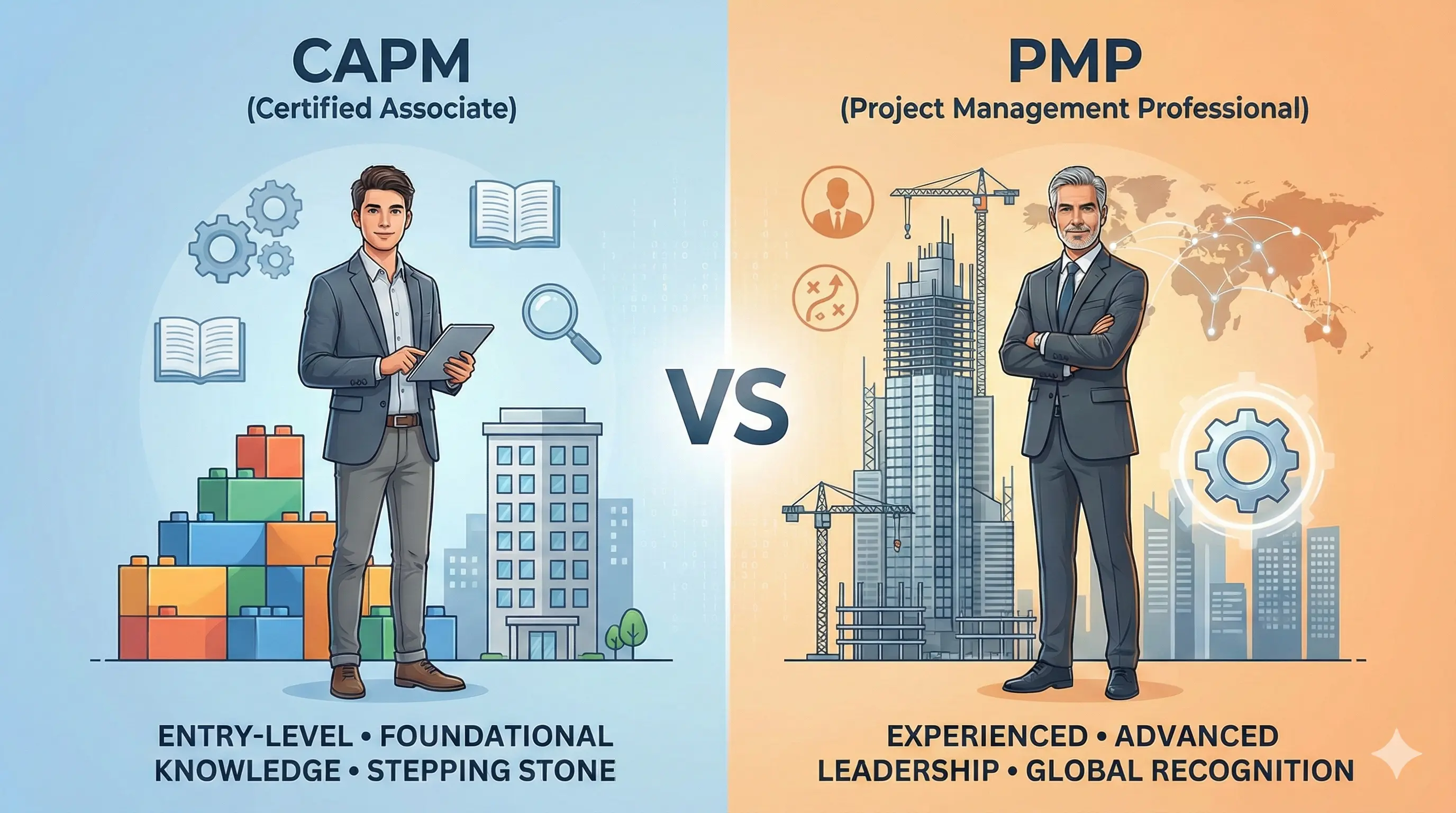
The Certified Associate in Project Management (CAPM) is PMI's entry-level certification. It's designed for people who are new to project management or want to formalize their knowledge before gaining significant experience.
CAPM is ideal if you have little or no project management experience, are a student or recent graduate, want to transition into project management from another field, or need a credential to land your first PM role.
CAPM Requirements: You need a high school diploma (or equivalent) and 23 hours of project management education. That's it. No experience required, making CAPM accessible to almost anyone interested in project management.
What is the PMP?
The Project Management Professional (PMP) is the gold standard certification for experienced project managers. It's recognized globally and often required (or strongly preferred) for senior PM roles.
PMP is ideal if you have 3+ years of project management experience, want to advance into senior or leadership PM roles, need a credential that's recognized worldwide, or want to maximize your earning potential.
PMP Requirements: You need either a four-year degree plus 3 years leading projects, or a high school diploma plus 5 years leading projects. You also need 35 hours of project management education.
The experience requirements are the main barrier—you need documented project leadership experience before you can even apply.
Exam Difficulty: How Hard Are They?
The CAPM tests your knowledge of project management fundamentals. Questions focus on terminology, concepts, and basic application. Most candidates find it manageable with 40-80 hours of focused study.
The exam has 150 questions (135 scored) and you have 3 hours to complete it. You need approximately 61% to pass.
The PMP is significantly more challenging. It tests your ability to apply project management concepts to complex, real-world scenarios. Questions often present situations where multiple answers seem correct, and you need to choose the best approach.
The exam has 180 questions (175 scored) and you have 3 hours and 50 minutes. The passing score isn't disclosed, but most experts recommend scoring 75%+ on practice exams before attempting the real thing.
The PMP also covers both predictive (waterfall) and agile/hybrid methodologies, adding to the breadth of knowledge required.
Exam Content: What You'll Need to Know
Understanding what each exam covers helps you gauge the preparation required—and whether your current knowledge gives you a head start.
CAPM Exam Domains
The CAPM exam tests four domains:
Project Management Fundamentals (36%) covers core PM concepts, terminology, and the role of the project manager. This is foundational knowledge that applies regardless of methodology.
Predictive Methodologies (17%) focuses on traditional waterfall approaches—sequential planning, formal change control, and documentation-heavy processes.
Agile Frameworks (20%) tests your understanding of Scrum, Kanban, and iterative approaches. Many candidates underestimate this section.
Business Analysis (27%) covers requirements gathering, stakeholder needs assessment, and ensuring deliverables align with business objectives.
The CAPM is broader than many expect. It's not just "waterfall project management"—you need solid agile and business analysis knowledge too.
PMP Exam Domains
The PMP exam tests three domains with a different emphasis:
People (42%) focuses on leadership, team management, conflict resolution, and stakeholder engagement. This is the largest domain and reflects PMI's emphasis on soft skills.
Process (50%) covers the technical aspects of managing projects—planning, executing, monitoring, and closing work across predictive, agile, and hybrid environments.
Business Environment (8%) addresses how projects connect to organizational strategy and deliver business value.
The PMP assumes you already know the fundamentals and tests whether you can apply them to complex scenarios. Questions often present situations where multiple answers seem reasonable, and you need to identify the best response according to PMI's methodology.
Key Difference
CAPM asks "What is the definition of X?" or "What happens during the planning phase?"
PMP asks "The project is behind schedule, stakeholders are upset, and the team is burned out. What should you do FIRST?"
This shift from knowledge recall to situational judgment is why PMP requires experience—you need real-world context to evaluate the scenarios effectively.
Career Impact and Salary
Both certifications can boost your career, but the impact differs.
CAPM holders typically see easier entry into project coordinator or junior PM roles, a credential that demonstrates commitment to the field, and a foundation for pursuing PMP later.
PMP holders typically see higher salaries (PMI reports a 33% salary premium on average), access to senior PM and program management roles, global recognition and mobility, and a stronger negotiating position for contracts and promotions.
If you're early in your career, CAPM can help you get your foot in the door. If you have the experience for PMP, it's generally the better long-term investment.
What Employers Actually Look For
Certifications matter, but context matters more. Here's how hiring managers typically view CAPM and PMP.
When CAPM Helps Most
CAPM is most valuable when you're applying for entry-level roles without PM experience. It signals that you've invested in learning the fundamentals and understand PMI's framework—even if you haven't led projects yet.
Job titles where CAPM adds value: Project Coordinator, Junior Project Manager, Project Analyst, PMO Analyst, Business Analyst (entry-level).
CAPM also helps career changers. If you're moving from another field into project management, CAPM demonstrates commitment and provides a knowledge foundation that compensates for limited PM-specific experience.
When PMP Matters Most
PMP is often listed as "required" or "preferred" for mid-to-senior project management roles. In some industries—government contracting, construction, healthcare IT—PMP isn't just preferred, it's mandatory for certain positions.
Job titles where PMP is expected: Project Manager, Senior Project Manager, Program Manager, IT Project Manager, Construction Project Manager.
PMP also matters for consultants and contractors. When you're selling your services, PMP provides instant credibility and often determines whether you're considered for opportunities.
The Honest Truth
For many roles, experience trumps certification. A candidate with 5 years of successful project delivery and no certification will often beat a newly-certified PMP with limited experience.
The ideal combination is both: demonstrated experience plus the credential that validates your knowledge aligns with industry standards.
If you're building your career, think of certifications as door-openers. They get your resume past the initial screen. Once you're interviewing, your experience and communication skills take over.
Which Should You Choose?
Choose CAPM if you don't meet PMP experience requirements, you're a student or career changer, you want to learn PM fundamentals before gaining experience, or you need a quick credential boost (CAPM is faster to obtain).
Choose PMP if you meet the experience requirements, you want maximum career impact and salary potential, you're targeting senior PM roles, or you want a certification that's widely recognized for hiring and contracts.
Can You Start with CAPM and Get PMP Later?
Absolutely. Many project managers follow this path: Get CAPM to land an entry-level PM role, gain 3-5 years of project experience, then pursue PMP to advance into senior roles.
The knowledge you gain studying for CAPM transfers directly to PMP preparation. The main difference is the depth and application required for PMP.
Common Mistakes When Choosing
After helping thousands of candidates prepare for both exams, we see the same mistakes repeatedly. Here's what to avoid.
Mistake 1: Pursuing PMP Without Enough Experience
Some candidates rush to PMP before they have meaningful project experience. Yes, you might meet the minimum requirements—but the exam tests practical judgment that's hard to develop without real-world context.
If you're struggling to document your experience for the PMP application, that's a signal you might benefit from CAPM first. Build more experience, then pursue PMP when the application feels natural.
Mistake 2: Thinking CAPM is "Too Basic"
CAPM covers substantial material—four domains, multiple methodologies, and hundreds of concepts. It's entry-level in terms of who it's designed for, not in terms of difficulty or value.
Some experienced professionals skip CAPM because they think it's beneath them, then struggle with PMP because they never built a solid foundation. There's no shame in starting with fundamentals.
Mistake 3: Choosing Based on Cost Alone
CAPM is cheaper, but that shouldn't be the deciding factor if you qualify for PMP. The salary difference between CAPM and PMP holders typically exceeds the cost difference within a few months.
Think about total career value, not just upfront cost.
Mistake 4: Waiting for the "Perfect" Time
Many people delay certification indefinitely, waiting until they have more time, more money, or more experience. But there's rarely a perfect time.
If you're considering CAPM, start now—it's free to practice with PM Drills, and you can study incrementally. If you qualify for PMP, commit to a timeline. Having an exam date scheduled creates accountability.
Mistake 5: Not Using Practice Questions
Both exams test application, not just recall. Reading books and watching videos isn't enough—you need to practice answering questions in the format you'll encounter on exam day.
This is especially true for PMP, where the scenario-based questions require a different skill than passive studying develops.
Frequently Asked Questions
Can I take PMP without CAPM?
Yes. CAPM is not a prerequisite for PMP. They're separate certifications for different career stages. If you meet PMP's experience requirements, you can go directly to PMP without ever getting CAPM.
How long does each certification take?
CAPM typically takes 4-8 weeks of preparation if you're studying part-time. PMP typically takes 8-16 weeks depending on your experience level and study schedule. Both require completing training hours before you can apply.
Do the certifications expire?
Both certifications are valid for three years. To renew CAPM, you need 15 PDUs. To renew PMP, you need 60 PDUs. PDUs can be earned through training, professional activities, or contributing to the profession.
Which certification has a higher pass rate?
PMI doesn't publish official pass rates. Based on training provider data, CAPM has an estimated pass rate of 70-80% for prepared candidates. PMP is lower, estimated at 60-70% on first attempts. Both improve significantly with adequate preparation.
Can employers tell the difference between CAPM and PMP?
Yes. Hiring managers familiar with PMI certifications understand that PMP requires significant experience while CAPM does not. They're viewed as credentials for different career stages, not interchangeable alternatives.
Is CAPM worth it if I plan to get PMP eventually?
It depends on your timeline. If you're 3+ years away from qualifying for PMP, CAPM provides immediate credential value and builds your knowledge foundation. If you'll qualify for PMP within a year, it might make sense to focus your energy there instead.
Will my CAPM study transfer to PMP?
Much of it will. Both certifications are based on PMI's methodology, and the foundational knowledge overlaps substantially. However, PMP requires deeper understanding and application, so you'll still need significant additional study.
Start Practicing Today
Whether you're preparing for CAPM or PMP, practice questions are essential for exam success.
PM Drills offers realistic practice questions with detailed explanations for both certifications. CAPM prep is completely free—no credit card required.