Getting started with the CAPM certification begins with understanding what you need to qualify. The good news? PMI designed this credential specifically for entry-level candidates, so the requirements are straightforward and achievable even if you're brand new to project management.
This guide covers every eligibility requirement in detail, including how to document your qualifications and what to expect if you're selected for an audit. For a complete overview of the certification, see our CAPM Certification Guide.
CAPM Eligibility Overview
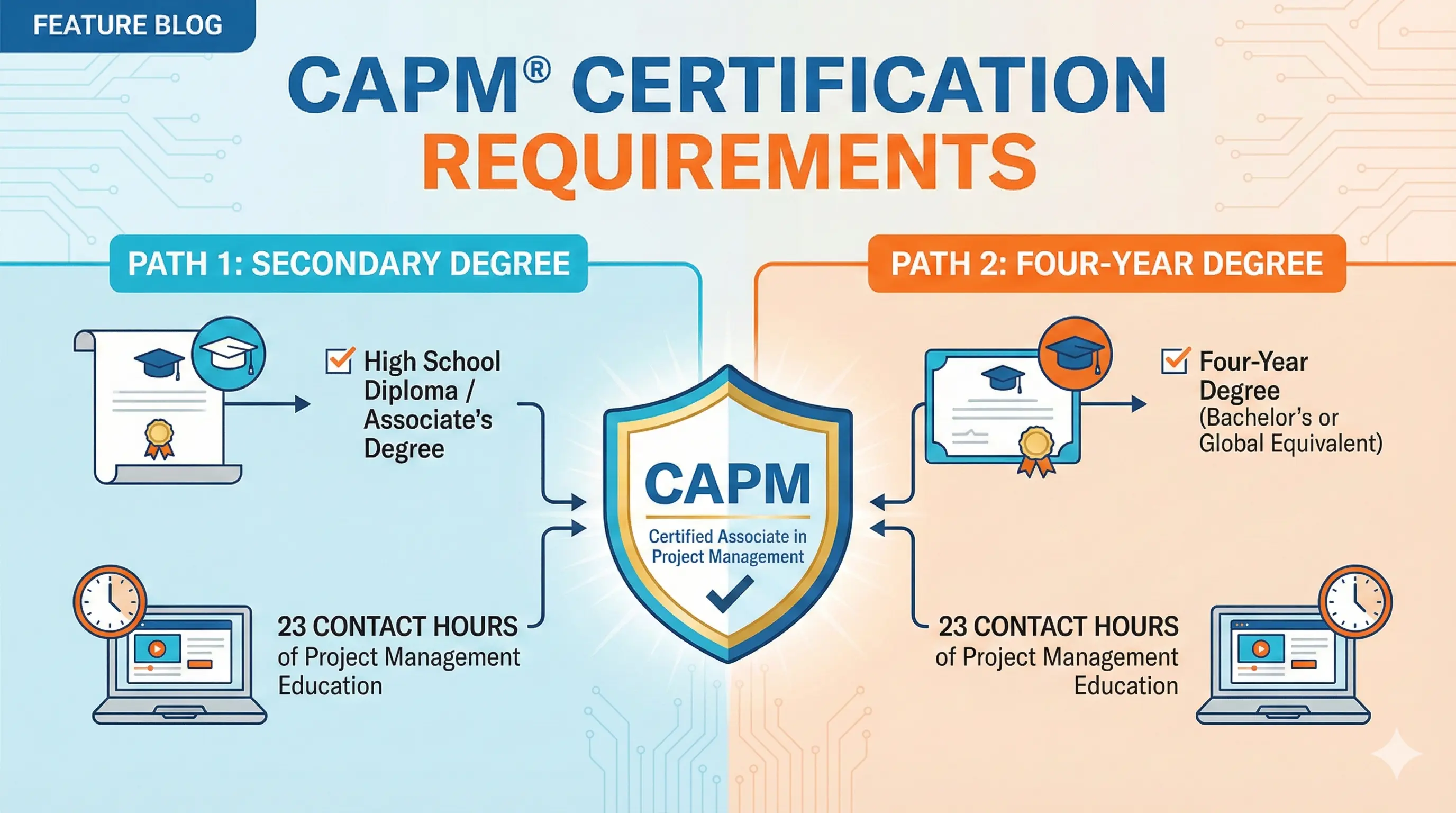
PMI keeps CAPM requirements simple. You need to meet just two criteria:
- A secondary degree (high school diploma, associate's degree, or global equivalent)
- 23 hours of project management education completed before you sit for the exam
That's it. Unlike the PMP certification, CAPM has no project management experience requirement. You don't need to have led projects, managed teams, or logged thousands of hours in a PM role. This makes CAPM the ideal starting point for students, career changers, and professionals who want to build a foundation in project management.
The certification validates that you understand fundamental project management concepts, terminology, and best practices—even if you haven't yet had the opportunity to apply them professionally.
The Education Requirement
The first requirement is a secondary degree, which PMI defines as a high school diploma, associate's degree, or the global equivalent.
For candidates in the United States, this typically means a high school diploma or GED. If you've completed any college coursework—even without finishing a degree—you meet this requirement.
For international candidates, PMI accepts equivalent secondary education from your country. This generally means completing the level of education required for university admission in your region. Examples include A-Levels in the UK, Senior Secondary Certificate in India, or Abitur in Germany.
A few important notes:
- There's no specific field of study required. Your degree can be in any subject.
- You don't need transcripts unless you're audited. PMI takes your word during the application.
- If your education documents are in a language other than English, you may need certified translations if audited.
The 23-Hour PM Education Requirement
The second requirement is where most candidates spend their preparation time. You must complete 23 contact hours of project management education before taking the exam.
What counts as PM education:
- Instructor-led courses (in-person or virtual)
- Self-paced online courses with structured curriculum
- University or college courses in project management
- Training programs from PMI Registered Education Providers (R.E.P.s)
- Workshops and seminars focused on PM topics
The key is that the education must be structured and focused on project management concepts. PMI wants to see courses that cover topics like project life cycles, scheduling, budgeting, risk management, stakeholder engagement, and similar PM fundamentals.
Free and low-cost options:
- PMI's Project Management Basics course (available free to PMI members)
- Coursera and edX courses (many can be audited for free)
- LinkedIn Learning (often free through public libraries)
- Udemy courses during sales ($15-50)
What to look for in a course:
- Clear learning objectives aligned with PM concepts
- A defined number of contact hours
- A certificate of completion you can reference in your application
Many candidates complete their 23 hours through a single comprehensive CAPM prep course, which has the added benefit of covering exam content while fulfilling the education requirement. Others piece together multiple shorter courses. Both approaches work.
What Doesn't Count Toward Your 23 Hours
Not everything that teaches you about project management qualifies for the education requirement:
- Self-study with books alone — Reading the PMBOK Guide or other PM books is valuable for exam prep, but doesn't count as contact hours
- Unstructured video content — Watching random YouTube videos about project management isn't the same as completing a structured course
- Work experience — Actually managing projects teaches you a lot, but it doesn't satisfy the education requirement
- Courses without learning objectives — The training needs to have a defined curriculum, not just general advice or tips
The distinction PMI makes is between passive consumption of information and structured educational experiences with defined learning outcomes.
Documenting Your Education for the Application
When you apply for CAPM, you'll need to provide details about your PM education. Keep records of everything as you complete your courses.
For each course, you'll need:
- Course title
- Provider or institution name
- Completion date
- Number of contact hours
- General topics covered
You don't need to upload certificates during the application process—PMI uses an honor system. However, you must be able to provide documentation if selected for an audit, so save your completion certificates and any course materials that show the content covered.
Tips for clean documentation:
- Create a simple spreadsheet tracking each course as you complete it
- Save PDF copies of completion certificates in a dedicated folder
- Note the exact hours for each course (don't round up)
- Keep email confirmations from course providers
The PMI Audit Process
A percentage of CAPM applications are randomly selected for audit. If this happens to you, don't panic—it's a normal part of PMI's quality assurance process, not an indication that something is wrong with your application.
What happens during an audit:
- PMI notifies you that your application has been selected
- You have 90 days to submit supporting documentation
- You'll need to provide proof of your secondary education (diploma or transcripts)
- You'll need to provide proof of your 23 PM education hours (certificates, transcripts, or letters from providers)
- PMI reviews your documentation and notifies you of the result
How to prepare:
- Keep all certificates and completion records from day one
- Make sure course certificates clearly show your name, the course title, hours, and completion date
- If a certificate is missing information, contact the provider for an updated version before you need it
- Store digital copies somewhere you can easily access them
The audit process typically adds a few weeks to your timeline, but it's straightforward if your documentation is in order. The vast majority of audited candidates pass without issues.
Common Mistakes to Avoid
A few pitfalls trip up CAPM applicants:
- Waiting to document until the application — Track your education hours as you go, not after the fact
- Assuming all online learning counts — Make sure your courses have structured curricula and defined hours
- Rounding up hours — Be accurate. If a course was 8 hours, don't list it as 10
- Discarding certificates — Even after you pass, keep records for a few years in case of any questions
Your Next Steps
Once you've confirmed you meet the eligibility requirements, you're ready to apply. The application process takes about 30 minutes if you have your documentation ready, and PMI typically reviews applications within 5-10 business days.
For a detailed walkthrough of the application process, see How to Apply for CAPM. If you're still weighing the investment, our breakdown of CAPM costs covers exactly what you'll spend.
Ready to start preparing? Practice with free CAPM questions on PM Drills and build confidence before exam day.