
If you're preparing for the PMP exam, understanding the format is just as important as studying the content. Here's everything you need to know about the PMP exam structure in 2026.
PMP Exam Format at a Glance
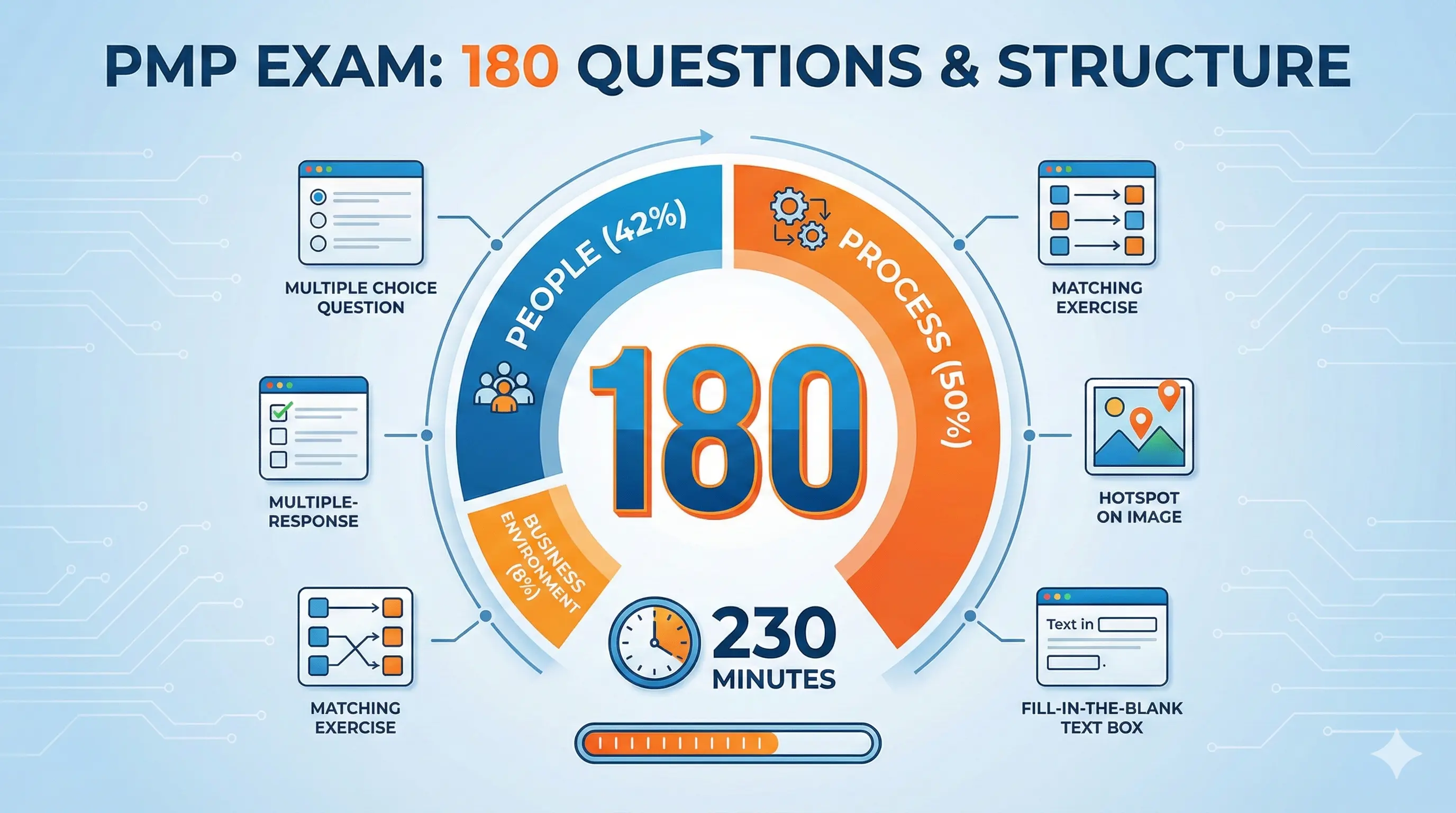
The PMP exam has 180 total questions, but only 175 are scored. The other 5 are unscored pretest questions. You have 230 minutes (3 hours and 50 minutes) to complete the exam, with two optional 10-minute breaks.
Question types include multiple choice, multiple response, matching, hotspot, and fill-in-the-blank.
Scored vs. Unscored Questions
Of the 180 questions on the PMP exam, only 175 count toward your score. The other 5 are "pretest" questions that PMI uses to evaluate potential future exam questions.
Here's the catch: you won't know which questions are unscored. They're randomly distributed throughout the exam and look identical to scored questions. This means you should treat every question as if it counts.
Why Does the PMP Have 180 Questions?
PMI designed the 180-question format to reliably assess competence across all three domains while keeping the exam to a reasonable length.
Here's the math: with People at 42%, Process at 50%, and Business Environment at 8%, PMI needs enough questions in each domain to accurately measure your knowledge. Too few questions and random chance affects your score too much. Too many and the exam becomes an endurance test.
The 180-question format has been stable since January 2021 when PMI overhauled the exam. Before that, the PMP had 200 questions with a 4-hour time limit. The current version is slightly shorter but maintains the same rigor.
The 5 unscored pretest questions serve an important purpose—they allow PMI to test new questions on real candidates before adding them to the scored pool. This keeps the exam current and ensures question quality. You're essentially helping PMI improve the exam for future candidates, though you won't know which questions are pretest.
Some candidates worry about "wasting" effort on unscored questions. Don't. Since you can't identify them, the only strategy is to treat every question seriously. Trying to guess which questions are pretest is a waste of mental energy.
The Three Domains
PMP exam questions are distributed across three domains.
The People domain covers 42% of the exam, approximately 74 questions. This includes leadership, team management, conflict resolution, and stakeholder engagement.
The Process domain covers 50% of the exam, approximately 88 questions. This includes the technical aspects of managing projects—planning, executing, monitoring, and closing.
The Business Environment domain covers 8% of the exam, approximately 13 questions. This covers how projects connect to organizational strategy and deliver business value.
Question Distribution: What to Expect in Each Section
The PMP exam is divided into three sections of 60 questions each, with optional breaks between them. However, the domain distribution isn't evenly split across sections—questions from all three domains appear throughout the exam.
Section 1 (Questions 1-60)
The first section often feels like a warm-up, but don't be fooled. PMI doesn't arrange questions by difficulty, so you might encounter challenging scenarios right away. Many candidates report the first section includes a mix of straightforward knowledge questions and complex situational problems.
After completing question 60, you'll have the option to take your first 10-minute break. The timer pauses completely—this time doesn't count against your 230 minutes.
Section 2 (Questions 61-120)
The middle section is where most candidates hit their stride—or start to fatigue. You've settled into the exam rhythm, but you're not yet in the home stretch. This is where time management becomes critical.
If you're running behind pace, resist the urge to rush. Careless mistakes from rushing cost more points than running slightly over your target time.
After question 120, take your second break. Even if you feel fine, the mental reset helps maintain focus for the final push.
Section 3 (Questions 121-180)
The final section tests your endurance as much as your knowledge. By this point, you've been concentrating for over two hours. Fatigue affects judgment, which is why the breaks matter so much.
Some candidates report that the final section feels harder, but this is likely fatigue bias rather than actual increased difficulty. PMI doesn't intentionally front-load or back-load difficulty.
Save 10-15 minutes at the end to review any questions you marked. Focus on questions where you were genuinely uncertain rather than second-guessing answers you felt confident about.
Question Types You'll Encounter
The PMP exam isn't just multiple choice anymore. You'll see several question formats.
Multiple Choice (Single Answer) is the most common type. Four options, one correct answer.
Multiple Response questions ask you to select two or more correct answers from the options provided. The question will specify how many to choose.
Matching questions require you to match items from one list to items in another using drag and drop.
Hotspot questions ask you to click on a specific area of an image or diagram to answer the question.
Fill-in-the-Blank questions require you to enter a number or short text to complete a statement, often for calculations.
Most questions are still traditional multiple choice, but be prepared for variety.
What PMP Questions Actually Look Like
Understanding the question format helps you prepare effectively. Here's what to expect from each type.
Scenario-Based Multiple Choice
Most PMP questions present a scenario and ask what you should do. These aren't simple recall questions—they test judgment.
Example format: "A project manager discovers that a key deliverable won't meet the quality standards defined in the quality management plan. The team believes they can fix the issue, but it will delay the project by two weeks. The sponsor is unaware of the problem. What should the project manager do FIRST?"
The answer options might all seem reasonable. Your job is to identify PMI's preferred approach—which typically emphasizes communication, following processes, and stakeholder engagement.
Multiple Response Questions
These questions specify how many answers to select, typically two or three. All selected answers must be correct to receive credit—there's no partial scoring.
Example format: "A project manager is transitioning a project to a new PM who will take over next month. Which TWO actions are most important for ensuring a smooth transition? (Choose 2)"
Read carefully to ensure you select exactly the number requested. Selecting too many or too few results in zero points for that question.
Matching Questions
Drag-and-drop matching questions ask you to connect related items. These often test terminology or process relationships.
Example format: Match each stakeholder engagement level (Unaware, Resistant, Neutral, Supportive, Leading) with its correct definition.
These are usually faster than scenario questions but require precise knowledge of PMI terminology.
Hotspot Questions
Hotspot questions display an image or diagram and ask you to click on a specific area. These might show a process diagram, organizational chart, or graph.
Example format: "Click on the area of the project life cycle where the cost of changes is lowest."
Practice with diagrams from the PMBOK Guide and Agile Practice Guide so you're familiar with common visuals.
Time Management: How to Pace Yourself
With 230 minutes for 180 questions, you have approximately 1 minute and 17 seconds per question. That's not a lot of time, especially for scenario-based questions that require careful reading.
For the first section (questions 1-60), aim to spend 75-80 minutes. Then take your first optional 10-minute break. For the second section (questions 61-120), aim for another 75-80 minutes. Take your second optional break. For the final section (questions 121-180), you should have 70-75 minutes remaining.
Tips for managing time: Don't spend more than 2 minutes on any single question. Mark difficult questions for review and move on. Use the breaks—they don't count against your exam time. Save 10-15 minutes at the end to review marked questions.
The Breaks
The PMP exam includes two optional 10-minute breaks: one after question 60 and one after question 120.
These breaks are NOT counted against your 230-minute exam time. Take them. Even if you feel fine, stepping away for a few minutes helps maintain focus for a nearly 4-hour test.
During breaks, you can use the restroom and have a snack (leave food outside the testing room). You cannot access your phone or study materials.
What Score Do You Need to Pass?
PMI does not disclose the exact passing score. Instead of a percentage, you'll receive a performance rating for each domain: Above Target, Target, Below Target, or Needs Improvement.
To pass, you need to demonstrate sufficient proficiency across all three domains. Most experts recommend scoring 75% or higher on practice exams to feel confident going into the real thing.
Understanding Your Score Report
When you finish the PMP exam, you'll receive a preliminary pass/fail result immediately on screen. Within a few days, PMI provides a detailed score report in your PMI account.
The Scoring System
PMI uses a "Target" based scoring system rather than a simple percentage. For each domain, you'll receive one of four ratings:
Above Target means you demonstrated strong competence—you exceeded the expected proficiency level.
Target means you demonstrated adequate competence—you met the expected proficiency level.
Below Target means you demonstrated some competence but fell short of expectations.
Needs Improvement means you demonstrated limited competence in this domain.
To pass, you need to achieve sufficient proficiency across all three domains combined. PMI doesn't disclose the exact algorithm, but candidates who score "Target" or "Above Target" in most areas typically pass.
If You Don't Pass
Failing the PMP exam isn't uncommon—many successful project managers don't pass on their first attempt. If you don't pass, your score report shows which domains need work.
You can retake the exam up to three times within your one-year eligibility period. Each retake requires paying the exam fee again ($405 for members, $555 for non-members).
Most candidates who fail do so by a small margin and pass on their second attempt after focused study on their weak domains. Use your score report to guide your preparation—there's no need to re-study domains where you scored well.
What "Passing" Actually Means
Passing the PMP means PMI has validated that you meet a global standard of project management competence. It doesn't mean you answered a specific percentage correctly—it means your overall performance demonstrated sufficient proficiency to earn the credential.
This is why chasing a specific "passing score" isn't useful. Focus on deep understanding across all domains rather than trying to game a threshold.
Frequently Asked Questions
Has the number of PMP questions changed recently?
The current 180-question format has been in place since January 2021. Before that, the exam had 200 questions. PMI periodically updates the exam content but hasn't announced plans to change the question count.
How many questions can I get wrong and still pass?
PMI doesn't disclose a specific passing threshold. Based on candidate reports, most people who pass answer approximately 70-75% of questions correctly, but this varies. Focus on competence across all domains rather than targeting a specific number.
Are all 180 questions equally weighted?
PMI doesn't publish whether questions are weighted differently. The safest assumption is that each scored question contributes equally, so treat every question as important.
Can I skip questions and come back?
Yes. You can flag questions for review and return to them later within the same section. However, once you move past a section break, you cannot return to previous sections. Use the flag feature for questions you're uncertain about.
Do the optional breaks affect my score?
No. The two 10-minute breaks are completely separate from your exam time. Taking breaks doesn't reduce your available time or affect scoring in any way. Most successful candidates take both breaks.
What if I run out of time?
Unanswered questions are scored as incorrect. If you're running low on time, it's better to make educated guesses on remaining questions than to leave them blank. There's no penalty for wrong answers beyond not receiving credit.
Is the PMP exam harder than it used to be?
The current exam places more emphasis on agile and hybrid approaches compared to previous versions. Whether this makes it "harder" depends on your background. Candidates with only traditional waterfall experience may find it more challenging than those comfortable with multiple methodologies.
How PM Drills Helps You Prepare
The best way to prepare for 180 questions is to practice with realistic questions under timed conditions.
PM Drills offers Drill Mode for practice questions with instant feedback and detailed explanations, Mock Exams to simulate real exam conditions with a countdown timer, Readiness Score to track your performance across all three domains, and Review Mistakes mode to learn from every wrong answer.
Start practicing for the PMP exam today at PM Drills.