
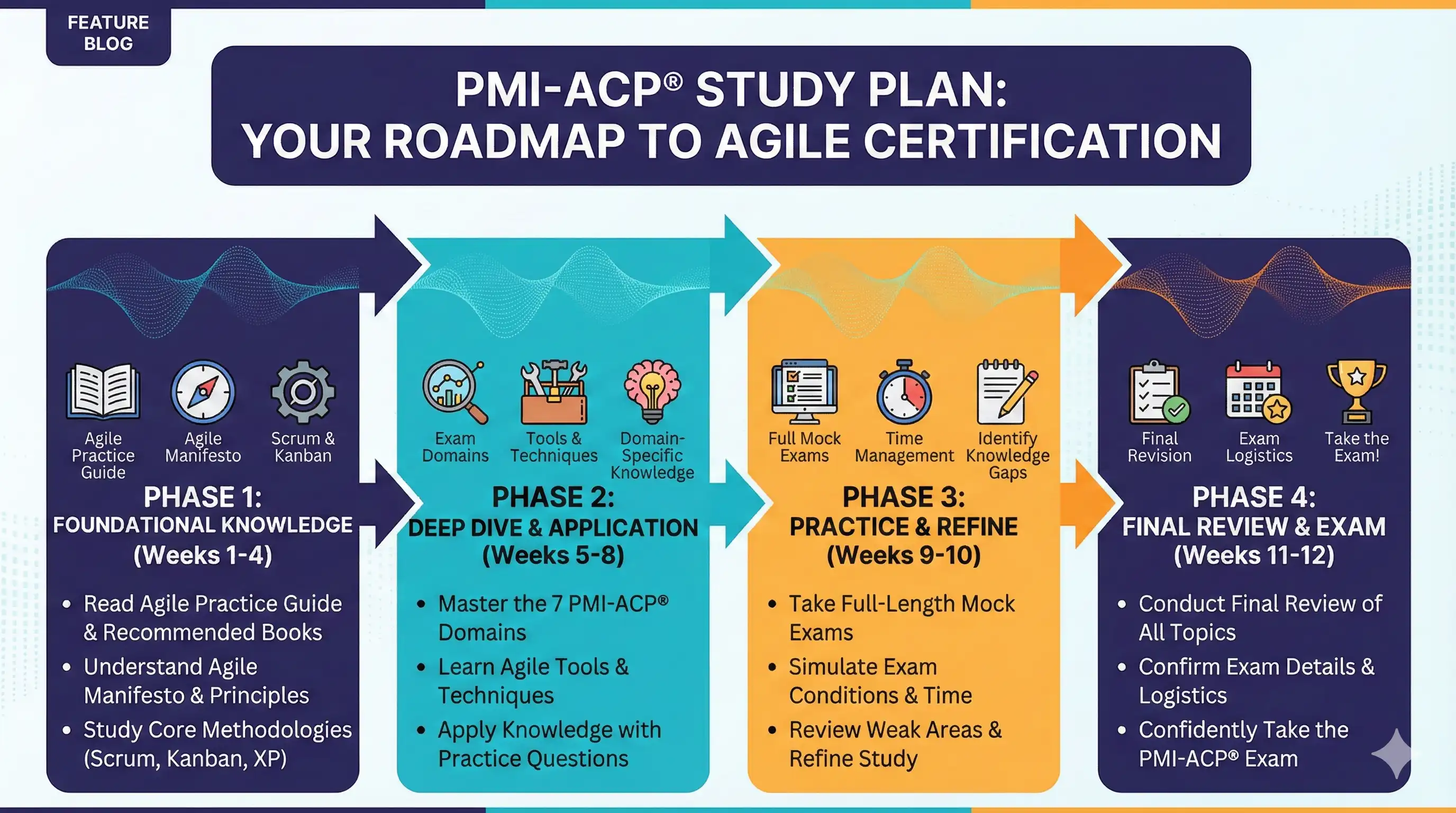
The PMI-ACP exam covers more ground than most agile certifications. While CSM focuses exclusively on Scrum and PSM tests Scrum mastery, PMI-ACP spans multiple methodologies—Scrum, Kanban, Lean, XP, and more—across seven distinct domains. A strategic study plan is essential for covering this breadth of content efficiently.
This guide provides three study schedules based on your experience level and available time, plus guidance on resources, practice strategies, and how to know when you're ready to schedule your exam. For a complete overview of the certification, see our PMI-ACP Certification Guide.
How Long Should You Study?
Most successful PMI-ACP candidates spend 80–120 hours studying over 6–10 weeks. Your actual timeline depends on several factors:
Your agile experience level:
If you've worked extensively with multiple agile methodologies, you already have a foundation. You'll spend less time learning concepts and more time refining your understanding of how PMI frames them.
If your experience is primarily in one methodology (like Scrum), you'll need extra time to learn Kanban flow principles, Lean waste elimination, XP technical practices, and other approaches tested on the exam.
Your familiarity with PMI's perspective:
If you've earned PMP or CAPM, you understand how PMI structures exams and phrases questions. This familiarity helps. If PMI-ACP is your first PMI certification, budget time to get comfortable with their testing style.
Self-assessment questions:
Before choosing a study timeline, honestly evaluate where you stand:
- Can you explain the difference between Scrum, Kanban, and XP?
- Do you understand Lean principles and the seven wastes?
- Are you comfortable with agile estimation techniques like story points and planning poker?
- Could you describe all seven PMI-ACP domains from memory?
If you answered "no" to most of these, plan for the longer timeline. If you're confident in your agile knowledge, a shorter intensive plan may work.
6-Week Intensive Study Plan
Best for: Experienced agile practitioners who work daily with multiple methodologies and can commit 2–3 hours per day.
Week 1: Foundation and Assessment
- Complete your 21-hour agile education requirement (if not already done)
- Read the Agile Practice Guide cover to cover
- Take a diagnostic practice exam to identify weak areas
- Review the Agile Manifesto—memorize the 4 values and understand the 12 principles
Week 2: Agile Methodologies Deep Dive
- Study Scrum framework in depth (roles, events, artifacts)
- Learn Kanban principles (flow, WIP limits, visualization)
- Review Lean concepts (value stream, waste elimination, Kaizen)
- Understand XP practices (pair programming, TDD, continuous integration)
- Daily practice: 20–30 questions focusing on methodology recognition
Week 3: Domains I–III
- Domain I: Agile Principles and Mindset (16%)
- Domain II: Value-Driven Delivery (20%)
- Domain III: Stakeholder Engagement (17%)
- Focus on tools and techniques within each domain
- Daily practice: 30–40 questions covering these domains
Week 4: Domains IV–VII
- Domain IV: Team Performance (16%)
- Domain V: Adaptive Planning (12%)
- Domain VI: Problem Detection and Resolution (10%)
- Domain VII: Continuous Improvement (9%)
- Daily practice: 30–40 questions covering these domains
Week 5: Integration and Practice
- Take a full-length mock exam (120 questions, timed)
- Review all incorrect answers thoroughly—understand why the right answer is right
- Revisit weak domains identified by your mock exam results
- Daily practice: 40–50 mixed questions
Week 6: Final Review and Exam
- Take a second full-length mock exam
- Light review of weak areas only—avoid cramming new material
- Review your notes on tools and techniques
- Schedule exam for mid-to-late week
- Day before exam: rest and light review only
8-Week Balanced Study Plan
Best for: Working professionals with some agile exposure who can commit 1.5–2 hours on weekdays and 3–4 hours on weekends.
Weeks 1–2: Education and Foundation
- Complete 21-hour agile education requirement
- Read Agile Practice Guide (split across both weeks)
- Study the Agile Manifesto and 12 principles
- Take diagnostic assessment to baseline your knowledge
- Weekend focus: Longer reading sessions
Weeks 3–4: Methodology Study
- Week 3: Scrum and Kanban in depth
- Week 4: Lean, XP, and other methodologies (Crystal, DSDM, FDD basics)
- See our Agile Methodologies Overview for comprehensive coverage
- Daily practice: 15–20 questions
- Weekend focus: Methodology comparison and application scenarios
Weeks 5–6: Domain Focus
- Week 5: Domains I–IV (Principles, Value-Driven Delivery, Stakeholder Engagement, Team Performance)
- Week 6: Domains V–VII (Adaptive Planning, Problem Detection, Continuous Improvement)
- For detailed domain coverage, see PMI-ACP Exam Domains
- Daily practice: 25–30 domain-specific questions
- Weekend focus: Full domain review and tools/techniques
Week 7: Mock Exams and Weak Areas
- Take first full-length mock exam on weekend
- Analyze results by domain—identify patterns in mistakes
- Targeted study on weak areas throughout the week
- Take second mock exam end of week
- Daily practice: 30–40 mixed questions
Week 8: Final Preparation
- Light review of challenging concepts
- One final mock exam early in the week (optional)
- Schedule exam for Thursday or Friday
- Final two days: minimal studying, focus on rest
- Review key tools and techniques, not new material
10-Week Extended Study Plan
Best for: Those newer to multiple agile methodologies, career changers, or anyone who prefers a less intensive pace with 1–1.5 hours daily.
Weeks 1–2: Education Requirement
- Complete 21-hour agile education course
- Take notes during training—these become study materials
- No additional studying required; let the course content settle
Weeks 3–4: Agile Foundations
- Read Agile Practice Guide
- Study Agile Manifesto deeply—understand the "why" behind each value and principle
- Introduction to all seven domains (overview level)
- Light practice: 10–15 questions daily
Weeks 5–6: Methodology Deep Dive
- Week 5: Scrum and Kanban (most heavily tested)
- Week 6: Lean, XP, and supplementary methodologies
- Daily practice: 15–20 methodology-focused questions
- Weekend: Read supplementary resources on unfamiliar methodologies
Weeks 7–8: Domain Mastery
- Systematic study of all seven domains
- Focus on tools and techniques within each domain
- Create summary notes or flashcards for review
- Daily practice: 20–25 domain-specific questions
Week 9: Integration and Mock Exams
- First full-length mock exam
- Comprehensive review of incorrect answers
- Second mock exam end of week
- Identify final weak areas for targeted review
Week 10: Final Review and Exam
- Targeted review of weak domains only
- Review tools and techniques summary
- Schedule exam mid-week
- Light review and rest before exam day
Essential Study Resources
Required: 21-Hour Agile Education
This isn't optional—you must complete it before applying. Choose a course that covers agile broadly, not just Scrum. Options range from budget-friendly Udemy courses ($15–50 during sales) to premium bootcamps ($300–800+). The course itself becomes a study resource, so choose one with good content, not just the cheapest option.
Agile Practice Guide (Free with PMI Membership)
This is your primary reference. Published jointly by PMI and Agile Alliance, it covers agile principles, lifecycle selection, and implementing agile. Read it thoroughly—many exam questions align with its content and terminology.
PMI-ACP Exam Prep Book
Mike Griffiths' "PMI-ACP Exam Prep" is the most popular choice. It covers all domains, includes practice questions, and aligns with PMI's exam content outline. Budget $40–60 for a current edition.
Practice Question Bank
Essential for exam readiness. You need exposure to hundreds of questions across all domains and methodologies. Practice reveals knowledge gaps that reading alone won't uncover.
Methodology-Specific Resources
- Scrum Guide (free): Definitive Scrum reference
- Kanban resources: David Anderson's work on Kanban method
- Lean resources: Understanding value streams and waste
- XP resources: Kent Beck's Extreme Programming Explained
How to Use Practice Questions Effectively
Practice questions are your most important study tool after completing your education requirement. Here's how to maximize their value:
Daily practice routine:
Commit to practicing every day, even if only 15–20 questions. Consistency builds pattern recognition and stamina. Increase volume as you progress through your study plan.
Review explanations thoroughly:
Don't just check if you got questions right or wrong. Read the explanation for every question—including ones you answered correctly. Understanding why wrong answers are wrong is as valuable as knowing the right answer.
Track performance by domain:
Keep a simple log of your accuracy by domain. If you're consistently scoring 80% on Team Performance but 55% on Adaptive Planning, you know where to focus your study time.
Practice across all methodologies:
Don't just answer Scrum questions because they feel familiar. Seek out questions on Kanban, Lean, and XP. The exam tests breadth, and weak methodology knowledge will cost you points.
Simulate exam conditions:
At least twice during your preparation, take a full 120-question practice exam under timed conditions. This builds stamina for the real three-hour exam and reveals pacing issues.
Signs You're Ready to Schedule
Don't schedule your exam based on calendar alone. Look for these indicators that you're genuinely prepared:
Consistent mock exam performance:
You're scoring 70% or higher on full-length practice exams consistently—not just once. One good score could be luck; three good scores indicate readiness.
Domain confidence:
You can explain each of the seven domains and identify which tools and techniques belong to each. No domain feels like a complete mystery.
Methodology fluency:
When you read a scenario question, you can quickly identify whether it's describing Scrum, Kanban, Lean, or XP—and you know how each methodology would approach the situation differently.
Tools and techniques recall:
You recognize terms like "burn-down chart," "cumulative flow diagram," "planning poker," and "Definition of Done" and can explain when each is used.
Gut check:
You feel prepared, not panicked. Some nervousness is normal, but if the thought of taking the exam fills you with dread, you likely need more preparation time.
Next Steps
Choose the study plan that matches your experience and schedule, then commit to it. Adjust as needed—if you're progressing faster than expected, move up your timeline. If you're struggling with methodologies, give yourself extra time.
For detailed coverage of what's tested in each domain, see PMI-ACP Exam Domains: Complete Breakdown. To understand the agile methodologies you'll need to master, read our Agile Methodologies Overview.
Ready to start practicing? Access PMI-ACP practice questions covering all seven domains and multiple methodologies, or download the PM Drills app to build daily practice into your routine.