
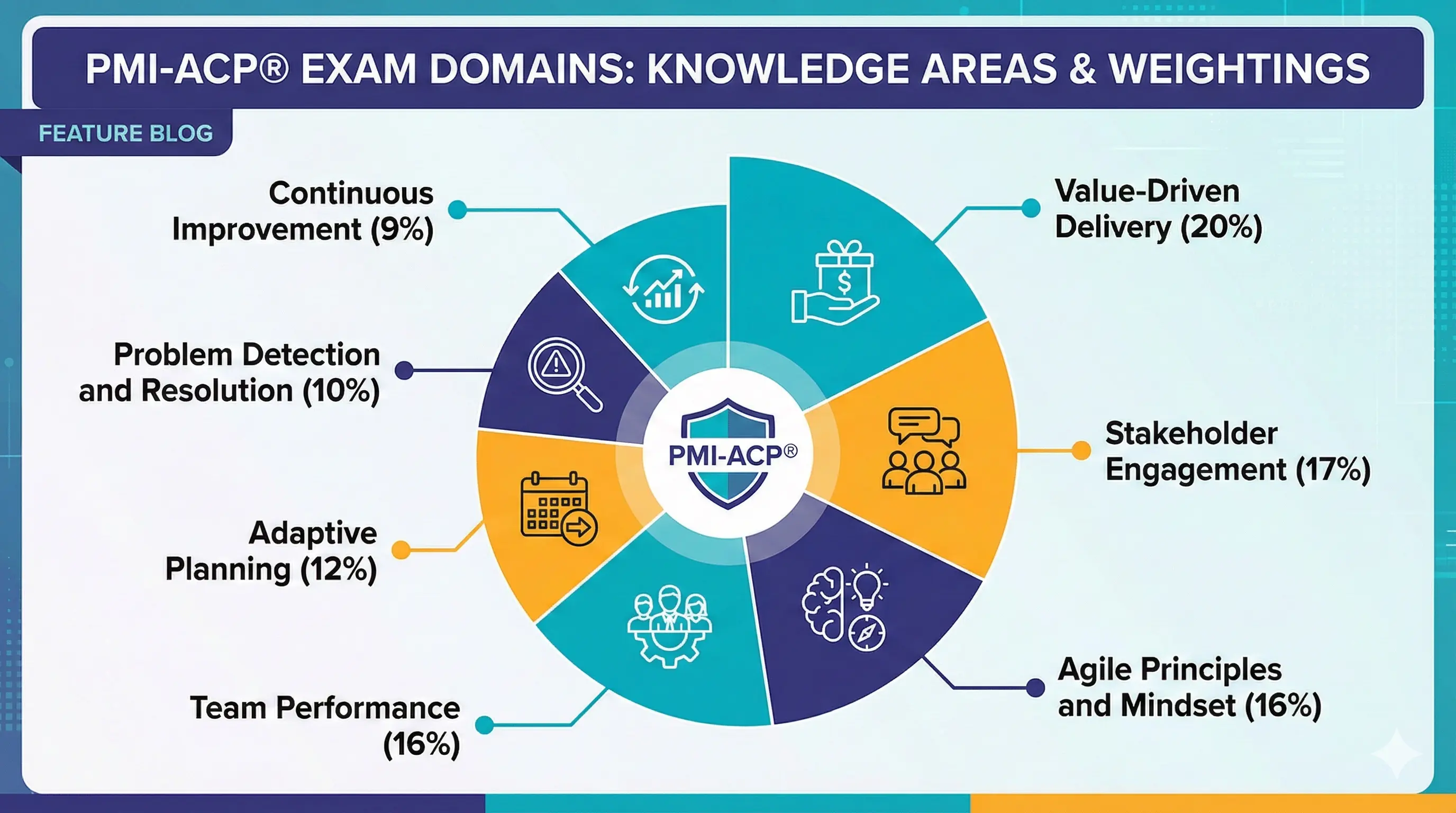
The PMI-ACP exam organizes its content into seven domains, each representing a critical area of agile practice. Unlike PMP's three broad domains, PMI-ACP's seven domains provide a more granular view of what you'll be tested on—and the percentage weights tell you exactly where to focus your study time.
This guide breaks down each domain in detail, covering what's tested, key concepts to master, and study tips for each area. For a complete overview of the certification, see our PMI-ACP Certification Guide.
How the PMI-ACP Exam Content is Organized
PMI developed the PMI-ACP examination content outline based on a role delineation study—essentially surveying agile practitioners worldwide to determine what knowledge and skills matter most in real-world agile work.
The result is seven domains that apply across methodologies. Whether you're working in Scrum, Kanban, Lean, or XP, these domains represent the core competencies of effective agile practice.
Domain Weights at a Glance
- Domain I: Agile Principles and Mindset — 16%
- Domain II: Value-Driven Delivery — 20%
- Domain III: Stakeholder Engagement — 17%
- Domain IV: Team Performance — 16%
- Domain V: Adaptive Planning — 12%
- Domain VI: Problem Detection and Resolution — 10%
- Domain VII: Continuous Improvement — 9%
These percentages matter for study prioritization. Value-Driven Delivery at 20% deserves more attention than Continuous Improvement at 9%—though you can't ignore any domain entirely.
Each domain includes specific tasks, knowledge areas, and skills. The exam tests your ability to apply this knowledge to scenarios, not just recall definitions. Expect questions that describe a situation and ask what you would do or recommend.
Domain I: Agile Principles and Mindset (16%)
This domain tests your understanding of agile's foundational concepts—the "why" behind agile practices, not just the "what."
What it covers:
The Agile Manifesto sits at the heart of this domain. You need to know the four values and twelve principles thoroughly—not just memorize them, but understand how to apply them in scenarios.
Key concepts to master:
- The four values of the Agile Manifesto and what each means in practice
- All twelve principles and how they guide decision-making
- Agile mindset versus traditional project management thinking
- Servant leadership and how it differs from command-and-control
- Self-organization and empowered teams
- Empiricism: transparency, inspection, adaptation
How questions appear:
Expect scenario questions like: "A stakeholder insists on detailed upfront documentation before work begins. How should the agile practitioner respond?" The correct answer applies Manifesto values (working software over comprehensive documentation) while still respecting stakeholder needs.
Study tips:
Don't just memorize the Manifesto—internalize it. For each principle, think of a real-world example of how it applies. When answering practice questions, ask yourself "which principle or value does this relate to?"
Domain II: Value-Driven Delivery (20%)
This is the highest-weighted domain, and for good reason—delivering value is the ultimate purpose of agile approaches.
What it covers:
How agile teams define, prioritize, and deliver value incrementally. This domain spans the entire delivery lifecycle from understanding what customers need to getting working product into their hands.
Key concepts to master:
- Defining value from the customer's perspective
- Prioritization techniques: MoSCoW, value vs. effort, weighted shortest job first
- Minimum Viable Product (MVP) and incremental delivery
- User stories, acceptance criteria, and Definition of Done
- Value stream mapping and identifying waste (Lean concepts)
- Frequent delivery and feedback loops
- Risk-adjusted backlog prioritization
How questions appear:
Scenarios often present competing priorities or stakeholder requests. You'll need to identify the approach that maximizes value delivery. Questions may ask about prioritization techniques, how to handle changing requirements, or when to release.
Study tips:
Understand multiple prioritization frameworks—the exam may present a scenario and ask which technique applies. Practice identifying value versus effort trade-offs. Know Lean concepts like value stream and waste, as they appear frequently in this domain.
Domain III: Stakeholder Engagement (17%)
Agile success depends on continuous collaboration with stakeholders. This domain tests your ability to facilitate that engagement effectively.
What it covers:
Building relationships with stakeholders, managing expectations, gathering feedback, and ensuring the right people are involved throughout the project.
Key concepts to master:
- Identifying and engaging stakeholders appropriately
- The Product Owner role and stakeholder representation
- Collaboration over contract negotiation
- Gathering and incorporating feedback
- Managing expectations in an agile environment
- Communication strategies for different stakeholder types
- Shared understanding and information radiators
- Participatory decision-making
How questions appear:
Expect scenarios involving stakeholder conflict, unclear requirements, or communication breakdowns. Questions test whether you'd take a collaborative approach versus a defensive or avoidance approach.
Study tips:
Focus on the collaborative nature of agile stakeholder engagement. The right answer usually involves more communication, not less. Understand the Product Owner's role as the voice of stakeholders and how to support that role.
Domain IV: Team Performance (16%)
High-performing teams are central to agile success. This domain covers how to build, support, and sustain effective agile teams.
What it covers:
Team dynamics, collaboration, self-organization, conflict resolution, and the conditions that enable teams to perform at their best.
Key concepts to master:
- Characteristics of high-performing agile teams
- Self-organization: what it means and how to foster it
- Tuckman's stages of team development (forming, storming, norming, performing)
- Servant leadership behaviors
- Collaboration and co-location (or effective distributed practices)
- Conflict resolution approaches
- Team agreements and working norms
- Motivation and team morale
How questions appear:
Scenarios describe team challenges—conflict between members, low morale, over-reliance on a leader, or difficulty self-organizing. You'll choose the response that supports team growth rather than undermining it.
Study tips:
Know Tuckman's model and what behaviors to expect (and encourage) at each stage. Understand that the agile leader's role is to remove impediments and support the team, not direct their work. When in doubt, choose answers that empower the team.
Domain V: Adaptive Planning (12%)
Agile planning embraces change rather than fighting it. This domain tests your understanding of planning approaches that adapt as learning occurs.
What it covers:
How agile teams plan at multiple levels—from release planning to iteration planning to daily planning—and how those plans evolve based on feedback and changing conditions.
Key concepts to master:
- Progressive elaboration and rolling wave planning
- Release planning and roadmaps
- Iteration/sprint planning
- Estimation techniques: story points, planning poker, relative sizing
- Velocity and using historical data
- Capacity planning
- Adjusting plans based on feedback
- Embracing change versus change control
How questions appear:
Scenarios may present estimation challenges, planning conflicts, or situations where initial plans need adjustment. Questions test whether you understand that agile plans are meant to evolve.
Study tips:
Know multiple estimation techniques and when each is appropriate. Understand the concept of velocity and how it's used (and misused). Remember that agile planning happens continuously, not just at project start.
Domain VI: Problem Detection and Resolution (10%)
Agile teams surface and address problems quickly. This domain covers how to identify issues and resolve them effectively.
What it covers:
Recognizing impediments, risks, and problems early, then taking action to resolve them before they derail the team.
Key concepts to master:
- Identifying and removing impediments
- Risk identification and mitigation in agile
- Root cause analysis techniques
- Problem-solving approaches
- Escalation when appropriate
- Transparency about problems (making issues visible)
- Team-based problem resolution
How questions appear:
Scenarios describe problems the team is facing—technical blockers, process issues, or external dependencies. You'll choose responses that address root causes rather than symptoms.
Study tips:
Understand that transparency is key—hiding problems is never the right answer. Know basic root cause analysis approaches. Remember that the Scrum Master or agile leader role includes removing impediments for the team.
Domain VII: Continuous Improvement (9%)
Agile teams constantly seek to improve their practices. This domain tests your understanding of how that improvement happens.
What it covers:
Retrospectives, process improvement, learning from experience, and building a culture of continuous improvement.
Key concepts to master:
- Retrospective facilitation and formats
- Kaizen and continuous improvement principles
- Inspect and adapt cycles
- Process tailoring and experimentation
- Learning from failures
- Metrics that drive improvement (without becoming counterproductive)
- Building improvement into team routines
How questions appear:
Scenarios often involve teams that have stopped improving, retrospectives that aren't effective, or resistance to change. Questions test whether you understand how to foster genuine improvement.
Study tips:
Know multiple retrospective formats and when each might be useful. Understand that improvement requires psychological safety—team members must feel safe to raise issues. Remember that small, incremental improvements compound over time.
Tools and Techniques Across Domains
Beyond the seven domains, the PMI-ACP exam tests your knowledge of specific tools and techniques. These span multiple domains and methodologies.
Commonly tested tools and techniques:
- Burn-down and burn-up charts
- Cumulative flow diagrams
- Kanban boards and WIP limits
- User stories and story mapping
- Planning poker and estimation techniques
- Retrospective formats
- Daily standups/scrums
- Information radiators
- Velocity tracking
- Definition of Done and acceptance criteria
How tool questions appear:
You may be asked which tool is appropriate for a given situation, how to interpret a chart or diagram, or what a particular metric indicates. Some questions show a visual (like a burn-down chart) and ask you to draw conclusions.
Study tips:
Don't just know tool names—understand what each tool reveals and when it's useful. For charts and diagrams, practice interpreting them. For example, know what a flat burn-down line indicates or what happens to a cumulative flow diagram when WIP limits are exceeded.
For comprehensive coverage of methodologies and their specific tools, see our Agile Methodologies Overview.
Next Steps
Understanding the domains gives you a framework for organizing your study. As you prepare, track your performance by domain to identify where you need more work.
For guidance on structuring your preparation time, see PMI-ACP Study Plan: Complete Schedules. To understand the exam logistics, review PMI-ACP Exam Format.
Ready to test your domain knowledge? Practice PMI-ACP questions organized by domain to identify your strengths and gaps, or download the PM Drills app to study on the go.