
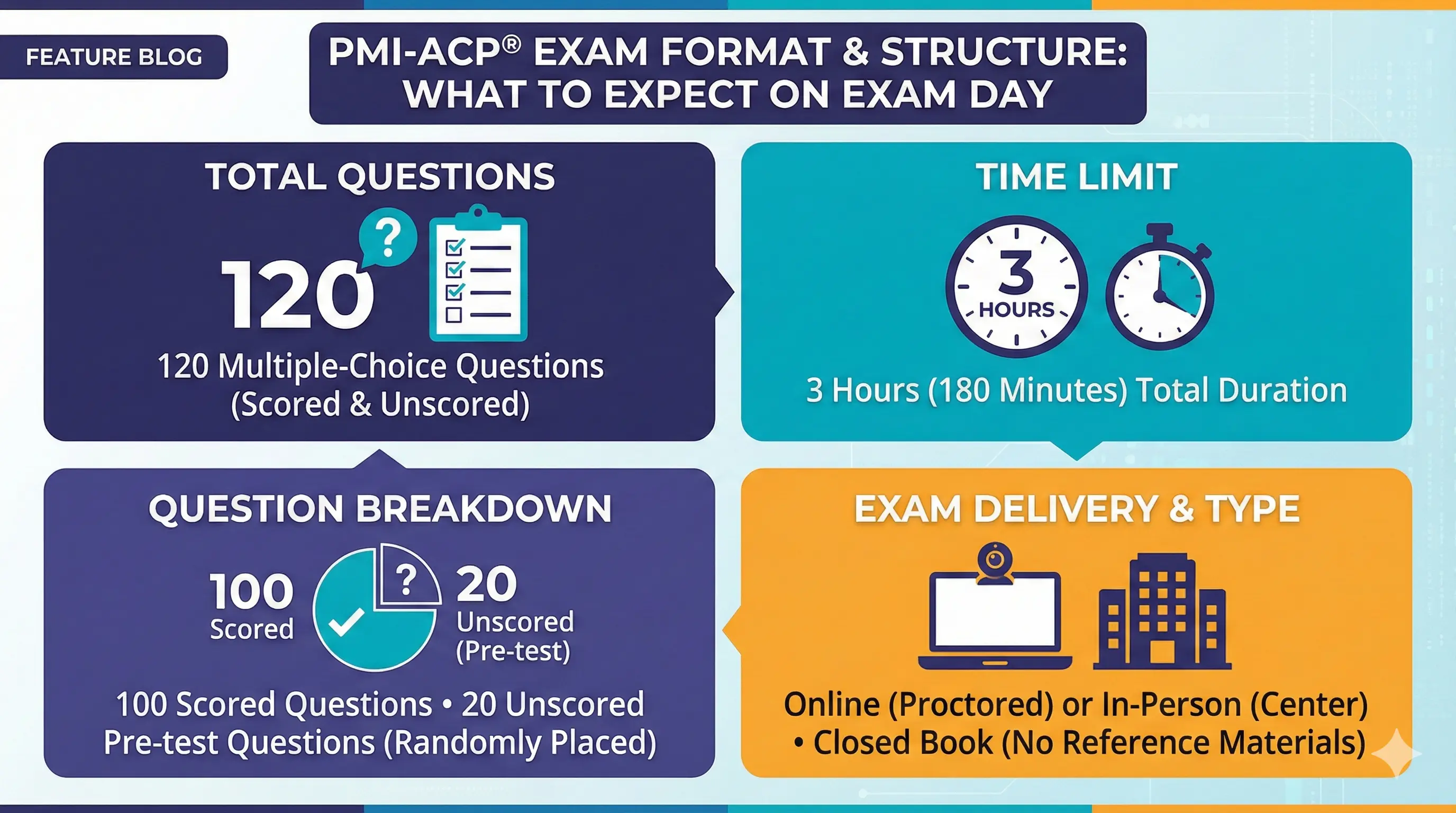
The PMI-ACP exam tests your knowledge of agile principles across multiple methodologies—not just Scrum. Understanding the exam format before you start studying helps you prepare strategically and manage your time effectively on test day.
This guide covers everything you need to know about the exam structure, question types, scoring, and testing options. For a complete overview of the certification, see our PMI-ACP Certification Guide.
Exam Structure at a Glance
Exam Basics
- Total questions: 120
- Time limit: 3 hours (180 minutes)
- Format: Computer-based testing
- Delivery: Test center or online proctored
- Breaks: No scheduled breaks (unscheduled bathroom breaks allowed)
- Result: Pass/fail (no published passing score)
Unlike PMP's 180-question marathon with scheduled breaks, PMI-ACP is a straight three-hour session. All 120 questions count toward your score—PMI doesn't disclose which questions might be pretest items, so treat every question as if it matters.
The exam draws from seven domains and tests your understanding of multiple agile methodologies including Scrum, Kanban, Lean, XP, and others. You won't just answer theoretical questions—expect scenarios that ask you to apply the right approach to specific situations.
Question Types You'll Encounter
The PMI-ACP exam uses several question formats, though multiple choice remains the most common.
Multiple Choice (Single Answer)
These make up the majority of the exam. You'll see a question or scenario followed by four answer options, and you select the single best answer.
Example structure: "A team is struggling with too much work in progress. As an agile practitioner, what should you recommend first?"
Multiple Response
These questions require you to select two or more correct answers from the options provided. The question will specify how many to choose (for example, "Select TWO").
Read carefully—partial credit isn't given. You need all correct answers and no incorrect ones.
Matching
Drag-and-drop style questions where you match items from one list to another. These often test your knowledge of which tools or techniques belong to which methodology or domain.
Example: Match agile practices to their originating methodology.
Hotspot
These questions display an image or diagram and ask you to click on the correct area. They're less common but can appear when testing visual concepts like Kanban boards or process flows.
Scenario-Based Questions
Regardless of format, many PMI-ACP questions are scenario-based. You'll read a situation describing a team, project, or problem, then determine the best response. These test application of knowledge, not just recall.
The scenarios may reference specific methodologies. A question might describe a Scrum team facing an impediment, a Kanban team with flow problems, or a situation where you need to choose between approaches.
What the Exam Covers
PMI-ACP questions are drawn from seven domains, each weighted differently:
Domain Breakdown
- Agile Principles and Mindset: 16%
- Value-Driven Delivery: 20%
- Stakeholder Engagement: 17%
- Team Performance: 16%
- Adaptive Planning: 12%
- Problem Detection and Resolution: 10%
- Continuous Improvement: 9%
Value-Driven Delivery carries the most weight at 20%, so expect significant coverage of prioritization, incremental delivery, and defining value. Agile Principles and Mindset (16%) tests your understanding of the Agile Manifesto and foundational concepts.
Beyond domains, the exam tests tools and techniques that span multiple methodologies:
- Scrum artifacts, events, and roles
- Kanban boards, WIP limits, and flow metrics
- Lean principles and waste elimination
- XP practices like pair programming and TDD
- Estimation techniques (story points, planning poker)
- Retrospectives and continuous improvement methods
For a detailed breakdown of each domain, see our guide on PMI-ACP Exam Domains.
How Scoring Works
PMI uses a pass/fail model without publishing an exact passing score. Your result comes from psychometric scoring, which accounts for question difficulty.
What you'll receive:
- Immediate preliminary result (pass/fail) at the test center or online
- Official score report within a few days
- Performance breakdown by domain showing your proficiency level in each area
What the score report tells you:
You won't see a percentage or number of correct answers. Instead, you'll see proficiency ratings for each domain—typically shown as "Above Target," "Target," "Below Target," or "Needs Improvement."
No penalty for guessing:
Answer every question. Blank answers count against you, but incorrect guesses don't cost extra. If you're unsure, eliminate obviously wrong options and make your best choice.
Target score for practice:
While there's no official passing threshold, most successful candidates recommend scoring 70% or higher consistently on practice exams before scheduling the real thing. Some aim for 75% to build a comfortable margin.
Test Center vs Online Proctoring
You can take the PMI-ACP exam at a Pearson VUE test center or through OnVUE online proctoring from home or office.
Test Center
- Controlled, distraction-free environment
- No technology setup required on your end
- Staff available if issues arise
- Must travel to location and arrive early
- Subject to center availability and hours
Online Proctoring
- Take the exam from home or office
- More scheduling flexibility (including evenings and weekends)
- No travel required
- Requires quiet, private space with no interruptions
- You're responsible for technology (computer, webcam, internet)
- Strict environment requirements (clear desk, no materials visible)
Technical requirements for online:
- Reliable internet connection
- Working webcam and microphone
- Supported operating system and browser
- Private room where you won't be interrupted
- Clear workspace with nothing on walls within camera view
Which should you choose?
Choose the test center if you're concerned about technology issues, don't have a reliably quiet space, or prefer the structure of a formal testing environment.
Choose online proctoring if you have a suitable home setup, want scheduling flexibility, or prefer the comfort of familiar surroundings.
Both options deliver the same exam. Your choice comes down to personal preference and logistics.
Time Management Strategy
With 120 questions in 180 minutes, you have exactly 90 seconds per question on average. That's more time per question than PSM (45 seconds) but requires sustained focus without scheduled breaks.
Pacing checkpoints:
- After 1 hour: Should have completed approximately 40 questions
- After 2 hours: Should have completed approximately 80 questions
- Final hour: Complete remaining 40 questions plus review time
Recommended approach:
Work through questions at a steady pace. If a question is taking too long, flag it and move on. You can return to flagged questions after completing the full exam.
Don't spend more than 2-3 minutes on any single question during your first pass. Some questions are intentionally difficult—spending 5 minutes on one question means rushing through others.
Managing energy:
Three hours without a scheduled break requires stamina. Some tips:
- Use the restroom before starting (you can take unscheduled breaks, but the clock doesn't stop)
- Stay hydrated but not excessively
- If you feel mental fatigue mid-exam, close your eyes for 30 seconds, take deep breaths, then continue
- Trust your preparation—second-guessing wastes time and energy
Final review:
If you finish with time remaining, use it to review flagged questions. Don't change answers unless you have a clear reason—first instincts are often correct.
Next Steps
Understanding the exam format is the first step. Now it's time to dive deeper into what's actually tested and build your study plan.
For detailed coverage of each domain, see PMI-ACP Exam Domains: Complete Breakdown. When exam day approaches, our PMI-ACP Exam Day Guide covers exactly what to expect and how to prepare.
Ready to start practicing? Try PMI-ACP practice questions that mirror the real exam format, or download the PM Drills app to build exam stamina with timed practice sessions.