
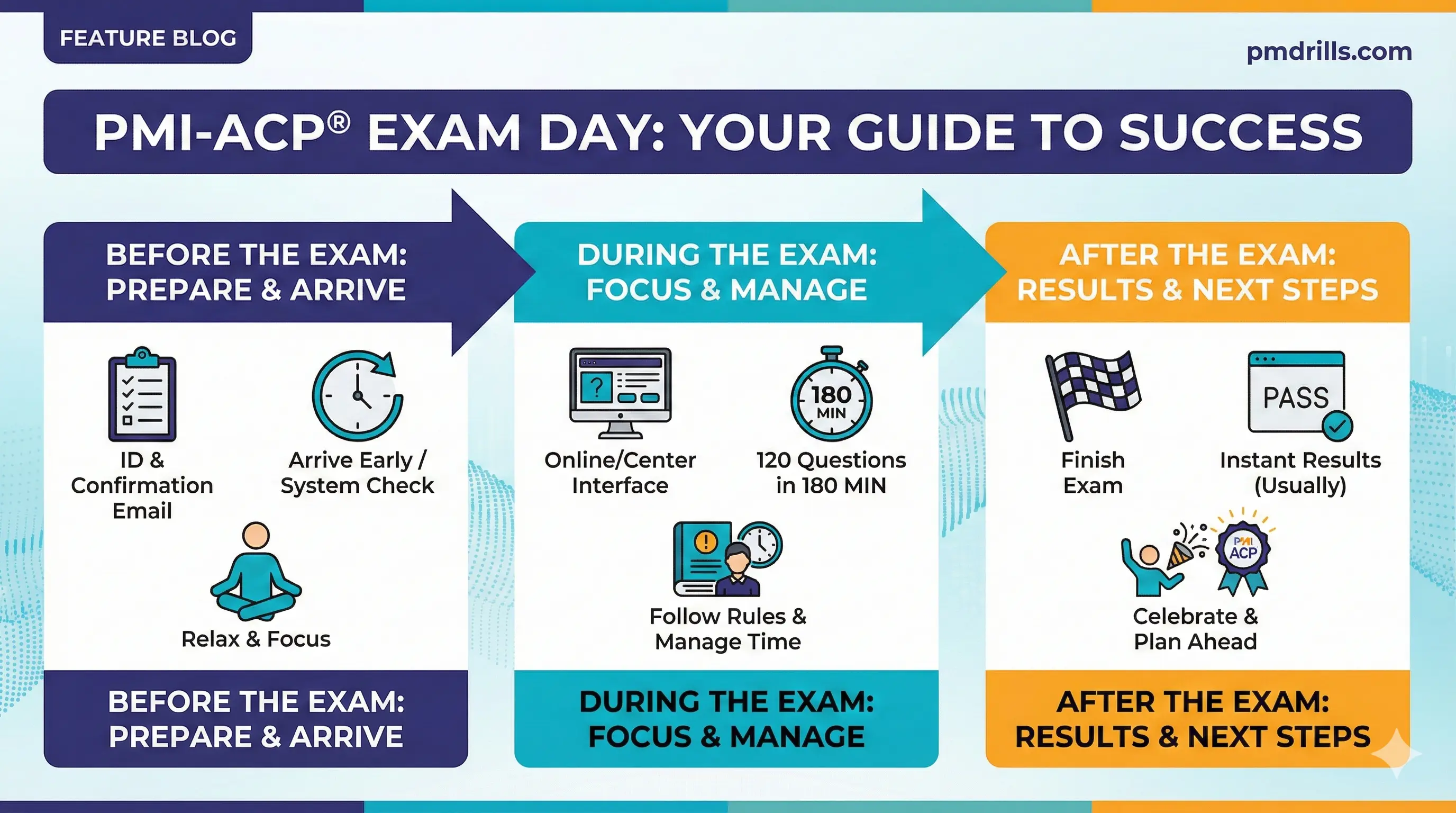
You've completed the requirements, submitted your application, and put in the study hours. Now it's time to execute on exam day. Knowing exactly what to expect—whether you're testing at a center or online—helps you stay calm and focused for the full three hours.
This guide covers everything from final preparation in the days before your exam to what happens after you click "Submit." For a complete overview of the certification, see our PMI-ACP Certification Guide.
The Days Before Your Exam
The week leading up to your exam matters as much as the months of preparation. How you spend these final days can impact your performance.
One week out:
- Confirm your exam appointment (date, time, location or online setup)
- Take one final full-length mock exam to confirm readiness
- Identify any remaining weak areas for targeted review
- Begin shifting from intensive study to lighter review
Two to three days out:
- Review your notes on tools and techniques
- Skim domain summaries without deep diving
- Ensure you're scoring consistently on practice questions
- Avoid learning new material—reinforce what you know
The day before:
- Light review only—flip through flashcards or summaries
- Prepare everything you'll need (ID, confirmation, workspace setup)
- Get a full night's sleep—cognitive performance suffers without rest
- Avoid alcohol and heavy meals that might affect sleep quality
What not to do:
Don't cram the night before. Your brain needs rest to consolidate what you've learned. Staying up late studying creates fatigue that hurts performance more than any last-minute knowledge helps.
Test Center Experience
If you scheduled at a Pearson VUE test center, here's what to expect.
Before you leave:
Gather required items:
- Valid government-issued ID (name must match your PMI registration exactly)
- Appointment confirmation (printed or on phone)
- Nothing else—personal items aren't allowed in the testing room
Arrival:
Arrive 30 minutes before your scheduled time. Late arrivals may be turned away and forfeit their exam fee.
Check-in process:
- Present your ID at the front desk
- Sign in and review testing rules
- Store personal belongings in a locker (phones, watches, wallets, bags)
- Some centers take a photo and/or palm vein scan
What you can bring into the testing room:
Nothing. The center provides:
- Scratch paper or erasable notepad
- Pencils or markers
- Your workstation with the exam loaded
Testing room environment:
- Individual workstations with dividers
- Noise-canceling headphones usually available
- Climate controlled (bring a light layer—temperatures vary)
- Video monitoring throughout
Bathroom breaks:
No scheduled breaks exist for PMI-ACP. You can take unscheduled bathroom breaks, but the clock keeps running. Raise your hand or signal the proctor, sign out, and return quickly. Minimize breaks to preserve your time.
Online Proctoring Experience
If you're testing from home or office via OnVUE, preparation is critical.
Technical setup (do this days before, not exam day):
- Run the Pearson VUE system check to verify your computer meets requirements
- Test your webcam, microphone, and internet connection
- Close unnecessary programs and disable notifications
- Ensure your computer is plugged in (don't rely on battery)
Workspace requirements:
- Private room with a closed door
- Clear desk—nothing except your computer
- No papers, books, or notes visible anywhere
- No additional monitors
- Nothing on walls within camera view (posters, whiteboards, sticky notes)
- No one else can enter the room during the exam
Check-in process:
- Log in 30 minutes before your appointment
- Take photos of your ID using your webcam or phone
- Take photos of your workspace (all four walls, desk surface, under desk)
- Wait for a proctor to review and connect
During the exam:
- You must remain visible on camera at all times
- No talking aloud (even reading questions to yourself)
- No leaving the camera view
- The proctor may interrupt if they observe rule violations
- You can communicate with the proctor via chat
Bathroom breaks:
Technically allowed but highly discouraged for online testing. You must notify the proctor, and your exam may be paused for review when you return. Plan to avoid breaks if possible.
Technical issues:
If you lose internet connection or experience technical problems:
- Try to reconnect immediately
- Contact Pearson VUE support
- Document what happened (screenshot if possible)
- PMI may offer a retake if the issue was on their end
During the Exam: Strategy and Pacing
With 120 questions in 180 minutes, you have 90 seconds per question on average. Here's how to use that time effectively.
First few questions:
Don't let the first questions throw you off. They may feel harder than expected—this is normal. Take a breath, read carefully, and work through them methodically. Your performance on early questions doesn't determine your final result.
Pacing strategy:
Set mental checkpoints to stay on track:
- 30 minutes in: Should be around question 20
- 60 minutes in: Should be around question 40
- 90 minutes in: Should be around question 60
- 120 minutes in: Should be around question 80
- 150 minutes in: Should be around question 100
- Final 30 minutes: Complete remaining questions and review
If you're falling behind these checkpoints, pick up your pace. Don't spend more than 2-3 minutes on any single question during your first pass.
Flagging strategy:
Use the flag feature for questions you want to revisit:
- Flag questions where you're torn between two answers
- Flag questions where you feel uncertain
- Don't flag every difficult question—only those where review might help
- Plan to have 10-15 minutes at the end for reviewing flagged questions
Handling difficult questions:
When you hit a tough question:
- Eliminate obviously wrong answers first
- Look for clues in the scenario about which methodology applies
- Choose your best answer and flag it if needed
- Move on—don't let one question consume excessive time
Methodology-specific questions:
The exam may describe scenarios specific to Scrum, Kanban, XP, or Lean. Read carefully to identify which framework applies—the correct answer depends on context. A Scrum-based scenario calls for Scrum solutions; a flow problem points to Kanban thinking.
Managing energy:
Three hours without a break requires mental stamina:
- If you feel foggy, close your eyes and take three deep breaths
- Stretch your shoulders and neck without leaving your seat
- Stay hydrated but don't overdo it (remember, breaks cost time)
- Trust your preparation—anxiety wastes energy
Answering Strategies
Beyond pacing, how you approach individual questions affects your score.
Read the full question:
Don't skim. PMI questions often include important details at the end. A question might describe a scenario, then ask "What should the agile practitioner do FIRST?" Missing that "FIRST" changes the correct answer.
Identify what's being asked:
Before looking at answers, understand the question type:
- What would you do?
- What is the BEST approach?
- What should happen FIRST?
- Which tool or technique applies?
Eliminate wrong answers:
Most questions have one or two clearly wrong options. Eliminating these improves your odds even when you're unsure between remaining choices.
Choose the most agile answer:
When torn between options, consider which answer best reflects agile values:
- Collaboration over control
- Responding to change over following a rigid plan
- Empowering teams over directing them
- Delivering value over completing tasks
Trust your preparation:
If you've studied thoroughly, your first instinct is often correct. Don't second-guess every answer—make your choice and move forward.
Answer every question:
There's no penalty for guessing. Never leave a question blank. If you're completely stuck, eliminate what you can and make your best guess.
After You Finish
When you've answered all 120 questions and completed any review, it's time to submit.
Completing the exam:
- Review any flagged questions if time permits
- Click through to submit your exam
- Confirm you want to end the exam
- Complete the brief post-exam survey
Getting your results:
Your preliminary result (pass or fail) appears on screen immediately after you complete the survey. This feels like an eternity but takes only a few seconds.
At a test center: You'll also receive a printed score report before you leave.
Online: Your preliminary result appears on screen. The official report follows via email within a few days.
Understanding your score report:
You won't see a specific score or percentage. Instead, you'll see your pass/fail status and performance by domain, typically shown as proficiency levels:
- Above Target
- Target
- Below Target
- Needs Improvement
This feedback helps you understand your strengths and identify areas for continued development.
If You Pass
Congratulations—you're now a PMI Agile Certified Practitioner.
Immediate next steps:
- Download your digital certificate from PMI
- Update LinkedIn and your resume
- Celebrate your achievement
Maintaining your certification:
PMI-ACP requires 30 Professional Development Units (PDUs) every three years to maintain. Start tracking PDU opportunities immediately so renewal doesn't sneak up on you.
If You Don't Pass
A non-passing result is disappointing but not the end of your journey. Many successful PMI-ACP holders didn't pass on their first attempt.
Analyze your results:
Your score report shows domain performance. Focus your renewed study on domains where you scored "Below Target" or "Needs Improvement."
Retake eligibility:
You can retake the exam up to three times within your one-year eligibility window at the same fee ($435 member, $495 non-member). If you don't pass after three attempts, you must wait one year before reapplying.
Adjust your approach:
- Increase practice question volume
- Focus on weak domains identified in your score report
- Consider different study resources
- Allow adequate time before your retake (typically 2-4 weeks minimum)
Most candidates who fail narrowly pass on their second attempt with focused additional preparation.
Next Steps
With exam day behind you, you've either earned your credential or have clear direction for your next attempt.
For those still preparing, review PMI-ACP Exam Format to ensure you understand the question types you'll encounter. If you need to strengthen your study approach, revisit our PMI-ACP Study Plan.
Ready to build exam confidence? Practice PMI-ACP questions under timed conditions to simulate the real experience, or download the PM Drills app to sharpen your skills anywhere.