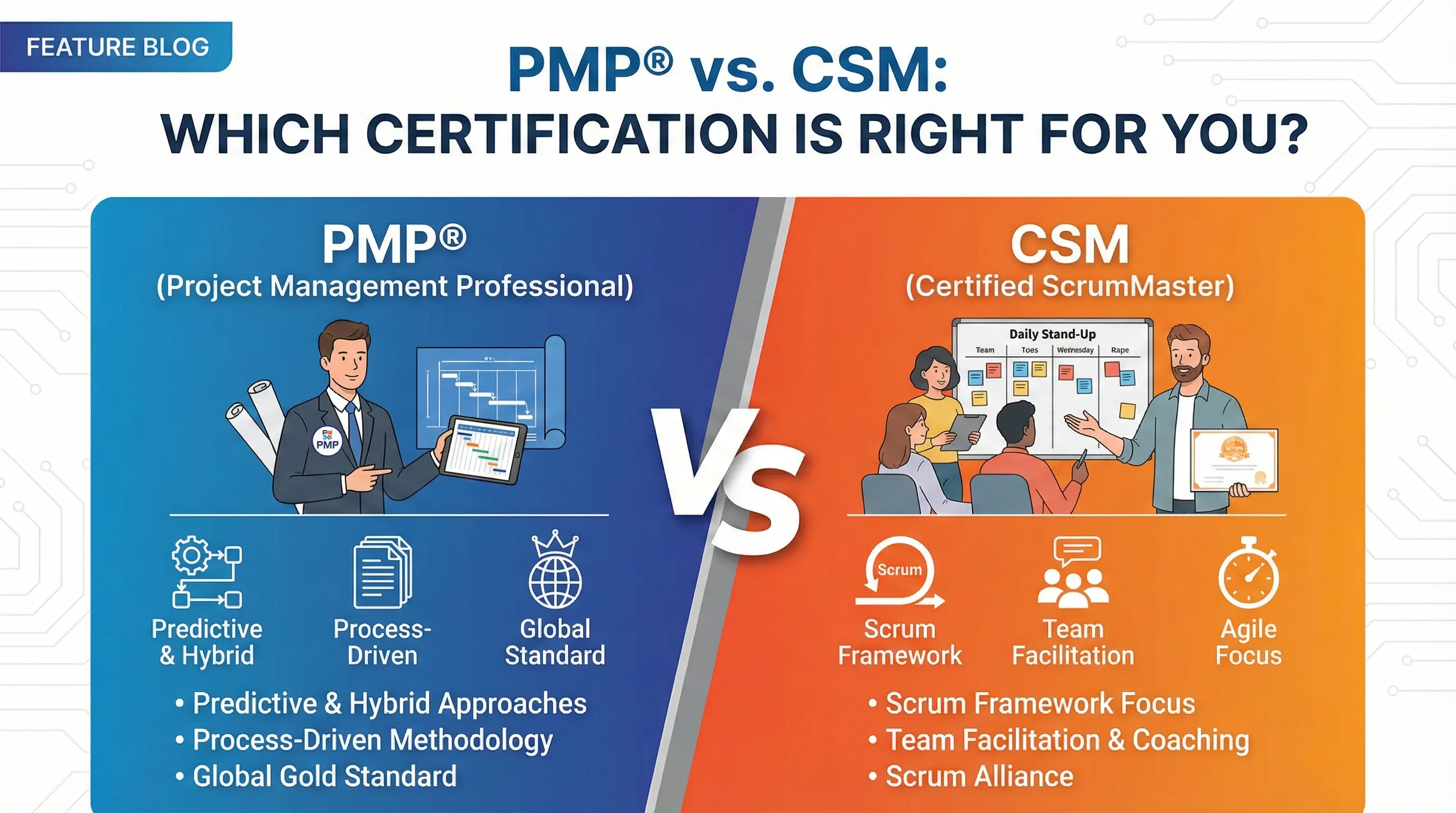
The PMP and CSM represent two different approaches to project work—and two different career paths. One certifies you to lead and direct projects across methodologies. The other certifies you to facilitate Scrum teams. They're not interchangeable, and choosing between them shapes your professional trajectory.
This guide compares both certifications to help you understand which aligns with your goals, work environment, and career aspirations. For a complete overview of the PMP, see our PMP Certification Guide. For an overview of of the CSM, see our CSM Certification Guide.
Quick Comparison
PMP (Project Management Professional)
- Issuing Body: PMI (Project Management Institute)
- Focus: Leading projects (predictive + agile + hybrid)
- Role Orientation: Manager directing work
- Experience Required: 36-60 months leading projects
- Education Required: 35 contact hours + degree
- Exam Questions: 180
- Exam Duration: 230 minutes
- Exam Difficulty: Challenging
- Total Cost: $700-1,500+
- Renewal Cycle: 3 years (60 PDUs)
- Best For: Project managers, PM leadership
CSM (Certified Scrum Master)
- Issuing Body: Scrum Alliance
- Focus: Facilitating Scrum teams
- Role Orientation: Servant leader enabling teams
- Experience Required: None
- Education Required: 16-hour course (mandatory)
- Exam Questions: 50
- Exam Duration: 60 minutes
- Exam Difficulty: Straightforward
- Total Cost: $1,000-1,500
- Renewal Cycle: 2 years (20 SEUs + fee)
- Best For: Scrum Masters, agile team facilitators
What is the PMP?
The Project Management Professional (PMP) is the most widely recognized project management certification in the world. It validates your ability to lead projects from initiation through closure using whatever methodology fits the situation.
What it covers:
The PMP tests three performance domains:
- People (42%): Team leadership, conflict management, stakeholder engagement
- Process (50%): Planning, executing, monitoring, and controlling projects
- Business Environment (8%): Connecting projects to organizational strategy
The current exam balances predictive (waterfall) and agile/hybrid content roughly equally. You're expected to know when and how to apply different approaches.
Who it's for:
The PMP targets experienced professionals who have been leading and directing projects—not just participating on project teams. Requirements include:
- Bachelor's degree + 36 months leading projects + 35 hours PM education, or
- High school/associate's + 60 months leading projects + 35 hours PM education
These are significant barriers. Most candidates need several years of career experience before qualifying.
What it proves:
A PMP signals you can take responsibility for project outcomes, lead diverse teams, navigate organizational complexity, and deliver results. It's recognized across industries worldwide—from construction to healthcare to technology.
What is the CSM?
The Certified Scrum Master (CSM) validates understanding of the Scrum framework and the Scrum Master role specifically. It's issued by the Scrum Alliance, not PMI.
What it covers:
The CSM focuses on:
- Scrum framework fundamentals (roles, events, artifacts)
- The Scrum Master role and responsibilities
- Servant leadership principles
- Team facilitation and coaching
- Removing impediments
- Protecting the team from distractions
The certification is narrow by design—it's about Scrum specifically, not project management broadly or even agile generally.
Who it's for:
The CSM has no experience requirements. Anyone can pursue it. The mandatory path is:
- Attend a 16-hour course from a Certified Scrum Trainer (CST)
- Pass a 50-question exam (60 minutes, ~74% to pass)
This accessibility makes CSM popular for career changers, those new to agile, and anyone wanting a quick credential.
What it proves:
A CSM demonstrates you understand how Scrum works and what a Scrum Master does. It's an entry point—a foundation for further learning and practice. It doesn't prove deep expertise or extensive experience; it proves you've completed training and can pass a basic exam.
Key Differences
These certifications differ fundamentally in philosophy, not just requirements.
Role orientation: Manager vs. Facilitator
This is the core distinction.
A Project Manager (what PMP validates) leads and directs projects. You're accountable for outcomes. You make decisions about scope, schedule, budget, and resources. You assign work, track progress, and manage stakeholders. The project's success or failure reflects on you.
A Scrum Master (what CSM validates) facilitates and enables teams. You're not the boss—the team self-organizes. Your job is removing impediments, coaching the team on Scrum practices, and protecting them from distractions. You don't assign work or direct activities; you create conditions for the team to succeed.
These are genuinely different roles. In traditional project management, the PM drives. In Scrum, the team drives and the Scrum Master supports.
Requirements: Rigorous vs. Accessible
The PMP demands proof of substantial experience before you can even apply. PMI verifies that you've actually led projects. A percentage of applications are audited.
The CSM requires only that you attend a course and pass a straightforward exam. No experience verification. No application review. No audit process.
This difference reflects the certifications' purposes. The PMP certifies experienced practitioners. The CSM introduces newcomers to a framework.
Exam difficulty:
The PMP exam is notoriously challenging:
- 180 questions over nearly 4 hours
- Scenario-based questions requiring judgment
- 150-200+ hours of study typically needed
- Pass rate estimated at 60-70%
The CSM exam is much simpler:
- 50 questions in 60 minutes
- Primarily knowledge recall
- Covered mostly in the required course
- Pass rate over 95%
If you're looking for a quick win, CSM is easier. If you want a credential that signals serious commitment and capability, PMP carries more weight.
Methodology scope:
The PMP covers the full spectrum: predictive project management, agile approaches, hybrid methods, and when to use each. You learn to adapt your approach based on project context.
The CSM covers Scrum only. Not Kanban. Not Lean. Not XP. Not traditional PM. Just the Scrum framework. This is deep but narrow.
Industry recognition:
PMP is universally recognized across industries worldwide. Job postings in construction, healthcare, government, finance, and technology all reference PMP. It transcends specific methodologies.
CSM is well-recognized in tech and software but less relevant elsewhere. Industries that don't use Scrum have little use for Scrum Masters. If you're in manufacturing, healthcare administration, or government contracting, CSM alone won't advance your career much.
Cost structure:
The certifications have different cost models:
PMP Costs
- Required training: $30-2,500 (your choice)
- Exam fee: $405-555
- Total initial cost: $700-1,500+
- Renewal cost: 60 PDUs (often free)
CSM Costs
- Required training: $1,000-1,500 (mandatory course)
- Exam fee: Included in course
- Total initial cost: $1,000-1,500
- Renewal cost: ~$100 + 20 SEUs every 2 years
The PMP lets you control costs—you can use budget study materials or premium bootcamps. The CSM requires an expensive mandatory course regardless.
Renewal requirements:
PMP requires 60 PDUs (Professional Development Units) every three years. PDUs can be earned through various activities—training, volunteering, writing, working—many at no cost.
CSM requires 20 SEUs (Scrum Education Units) plus a renewal fee (~$100) every two years. The shorter cycle and recurring fee mean higher ongoing costs.
Career Paths
These certifications support different trajectories.
PMP career path:
The PMP aligns with traditional project management progression:
Project Coordinator → Project Manager → Senior Project Manager → Program Manager → Portfolio Manager → Director of PMO → VP of Project Delivery
PMP holders typically move toward greater scope and authority—managing larger projects, then programs (multiple related projects), then portfolios (strategic alignment of all projects). The path leads to executive leadership roles.
Industries favoring PMP:
- Construction and engineering
- Healthcare and life sciences
- Financial services
- Government and defense
- Manufacturing
- Consulting firms
- Enterprise IT
CSM career path:
The CSM aligns with agile-specific progression:
Team Member → Scrum Master → Senior Scrum Master → Agile Coach → Release Train Engineer (SAFe) → Enterprise Agile Coach → Agile Transformation Lead
CSM holders typically move toward coaching and organizational change. Rather than managing bigger projects, you help more teams adopt and improve agile practices. The path leads to transformation and coaching roles.
Industries favoring CSM:
- Software development
- Technology startups
- Digital product companies
- Tech divisions within larger enterprises
- Agile consultancies
Salary comparison:
Both certifications improve earning potential, but in different markets.
PMP holders report 20-25% salary premiums across industries. Because PMP applies broadly, this premium shows up in diverse sectors and geographies.
CSM holders see salary benefits primarily in tech. A Scrum Master in software development earns competitive wages, but the CSM itself adds less incremental value than experience and results. Many Scrum Master job postings say "CSM preferred" but don't require it.
Job market reality:
Search job postings and you'll notice:
- "PMP required" appears across industries at various levels
- "CSM required" appears mainly in tech, often at entry/mid levels
- Senior roles more often specify PMP
- Scrum Master roles may accept CSM, PSM, or equivalent experience
The PMP opens more doors across more industries. The CSM opens specific doors in agile tech environments.
Which Should You Choose?
Your situation determines the right choice.
Choose PMP if:
- You want to lead and direct projects, not just facilitate teams
- You work in traditional industries (construction, healthcare, finance, government)
- You want maximum career versatility across industries
- You're targeting senior PM roles, program management, or executive positions
- Your organization uses multiple methodologies, not just Scrum
- You want the most respected, globally recognized PM credential
- You have the experience to qualify and time to prepare
Choose CSM if:
- You want to be a Scrum Master specifically, not a project manager
- You work in software development or tech
- You're new to agile and want foundational training
- You don't have enough experience for PMP yet
- You need a credential quickly (course + exam in a few days)
- Your organization runs Scrum teams and values the specific title
- You're transitioning into tech from another field
Choose both if:
Many professionals hold both certifications, combining broad PM credibility with agile-specific credentials.
Common path 1: Start with CSM early in your career when you don't qualify for PMP. Add PMP later as you accumulate leadership experience. This builds agile foundations first, then adds comprehensive PM authority.
Common path 2: Earn PMP first to establish project management credibility. Add CSM later if you move into an environment where Scrum Master experience is valued. This establishes broad expertise first, then adds specific agile credentials.
Having both signals you understand traditional and agile approaches—valuable in organizations navigating between methodologies or using hybrid models.
If you're torn:
Consider what you want to be doing in five years.
If you see yourself directing major initiatives, managing budgets and timelines, and being accountable for project outcomes—pursue the PMP. The PM role is about leadership and accountability.
If you see yourself coaching teams, facilitating collaboration, and helping organizations adopt better ways of working—the CSM path (and its advanced certifications) may fit better. The Scrum Master role is about enablement and service.
These are genuinely different jobs with different satisfactions. Neither is better objectively; they're better for different people.
The Bigger Picture
Certifications are tools, not destinations. The PMP or CSM can open doors, but what you do after walking through matters more.
The best project managers succeed because they deliver results, build relationships, and continuously improve—not because of letters after their names. The best Scrum Masters succeed because they genuinely help teams work better, not because they attended a two-day course.
Whichever certification you choose, commit to learning the underlying skills deeply. The credential gets you in the door; capability keeps you there.
For comparison with another agile certification, see our guide on PMP vs PMI-ACP.
If you've decided the PMP is your path, start preparing with PM Drills and build the knowledge and confidence to pass.
Interested in Scrum Master certification? Explore CSM prep on PM Drills.