The Project Management Professional (PMP) is the most recognized project management certification globally. It validates your ability to lead and direct projects across any methodology—predictive (waterfall), agile, or hybrid approaches. For a complete overview of PMI's agile certification, see our PMI-ACP Certification Guide, or see our PMP Certification Guide.
What it covers:
The PMP tests three domains:
- People (42%): Leading teams, managing conflict, stakeholder engagement
- Process (50%): Planning, executing, and controlling project work
- Business Environment (8%): Connecting projects to organizational strategy
The current exam is roughly half predictive content and half agile/hybrid content, reflecting how modern projects actually operate.
Who it's for:
The PMP targets experienced project managers who lead and direct projects. You need either:
- Bachelor's degree + 36 months leading projects + 35 hours PM education, or
- High school/associate's + 60 months leading projects + 35 hours PM education
This isn't an entry-level certification. PMI wants evidence you've been in the driver's seat on real projects.
What it proves:
A PMP demonstrates you can manage projects from initiation through closure, adapt your approach based on context, lead teams effectively, and deliver value to organizations. It's methodology-agnostic—you're not pigeonholed into one way of working.
What is the PMI-ACP?
The PMI Agile Certified Practitioner (PMI-ACP) validates expertise specifically in agile principles and practices. While the PMP covers agile as part of a broader toolkit, the PMI-ACP goes deep on agile exclusively.
What it covers:
The PMI-ACP tests knowledge across multiple agile frameworks and approaches:
- Scrum
- Kanban
- Lean
- Extreme Programming (XP)
- Test-Driven Development (TDD)
- Agile principles and mindset
Rather than focusing on one framework (like a Scrum-specific certification), the PMI-ACP validates broad agile literacy across methodologies.
Who it's for:
The PMI-ACP has lower experience thresholds than the PMP:
- 12 months of general project experience within the last 5 years
- 8 months of agile project experience within the last 3 years
- 21 contact hours of agile education
This makes it accessible to professionals earlier in their careers or those transitioning into agile roles.
What it proves:
A PMI-ACP demonstrates you understand agile principles deeply, can work effectively within agile teams, and have practical experience applying agile practices. It signals to employers that you're not just familiar with agile terminology—you've lived it.
Key Differences
Understanding the distinctions helps you choose wisely.
Methodology scope:
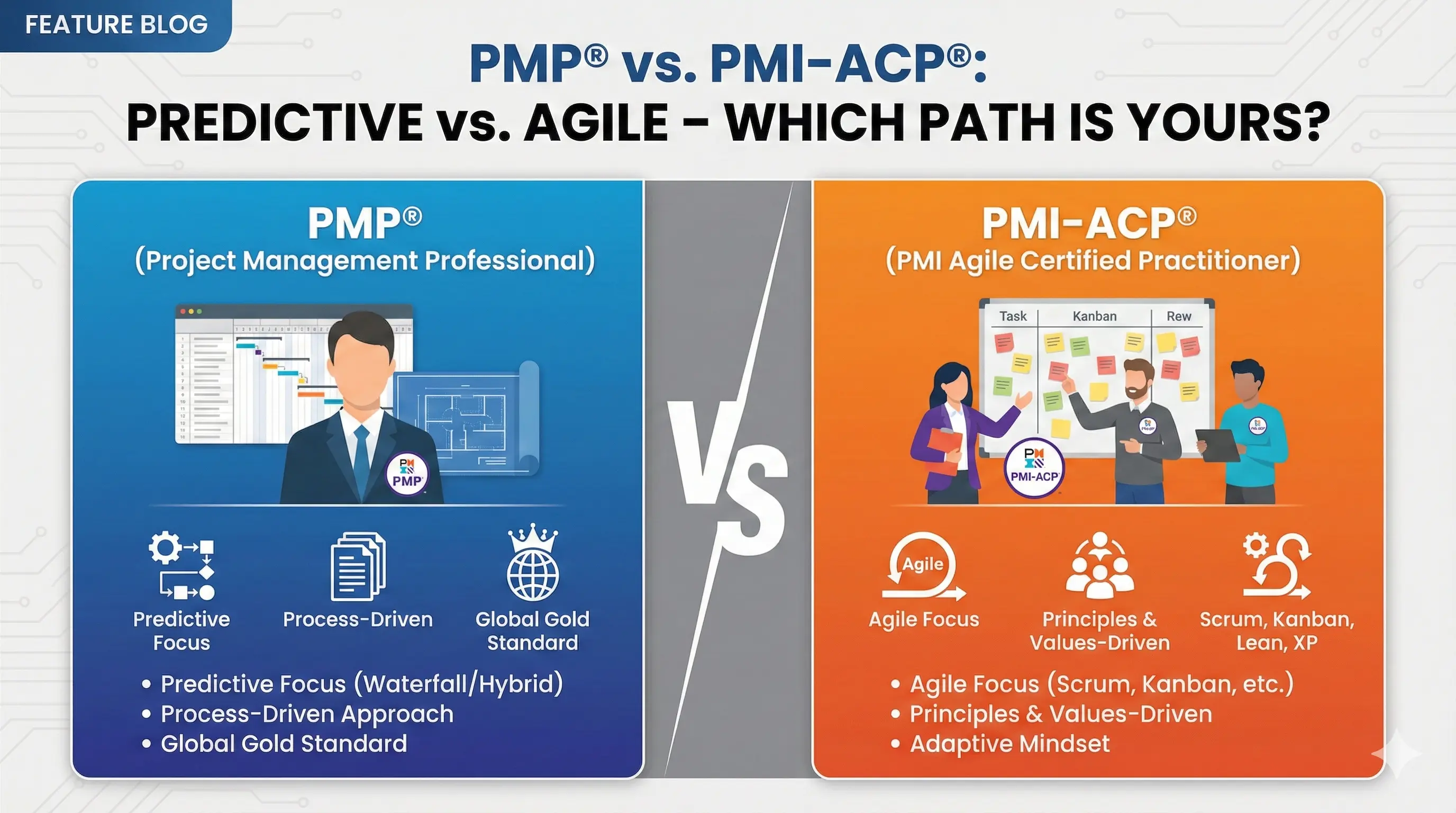
The PMP is broad. It covers predictive project management, agile approaches, and hybrid methods. You learn when to apply each approach based on project context. This versatility is valuable in organizations that don't operate purely in one mode.
The PMI-ACP is deep but narrow. It focuses exclusively on agile, covering multiple frameworks in detail. You won't learn traditional project management techniques, but you'll have comprehensive agile expertise.
Experience requirements:
The PMP demands significant leadership experience—36 to 60 months of actually leading and directing projects. This is a high bar that takes years to meet.
The PMI-ACP requires less total experience (12 months general + 8 months agile). You could potentially qualify within 1-2 years of starting your career if you're working in agile environments.
Exam format and difficulty:
The PMP exam is longer (180 questions, 230 minutes) and widely considered more challenging. It tests application across multiple methodologies and requires understanding "PMI-isms"—how PMI thinks about project management.
The PMI-ACP exam is shorter (120 questions, 180 minutes) and more focused. If you already work in agile environments, much of the content will feel familiar.
Study time:
Most PMP candidates study 150-200+ hours over 2-4 months. The breadth of content and scenario-based questions require substantial preparation.
PMI-ACP candidates typically need 80-120 hours of preparation. The narrower scope and alignment with daily agile practice (for those already in agile roles) reduces the learning curve.
Cost comparison:
Interestingly, the PMI-ACP exam fee is slightly higher for members ($435 vs $405) but lower for non-members ($495 vs $555). Education requirements are also lower for PMI-ACP (21 hours vs 35 hours), potentially reducing overall costs.
PMP Costs
- Exam fee (member): $405
- Exam fee (non-member): $555
- Education hours required: 35
- Typical study time: 150-200 hours
PMI-ACP Costs
- Exam fee (member): $435
- Exam fee (non-member): $495
- Education hours required: 21
- Typical study time: 80-120 hours
Industry recognition:
The PMP is more universally recognized. Hiring managers across industries—construction, healthcare, finance, IT, manufacturing—know what PMP means. It's often listed as required or preferred in job postings regardless of sector.
The PMI-ACP is well-recognized in tech and software development but less so in traditional industries. If you're in an industry that hasn't fully embraced agile, the PMI-ACP carries less weight.
Renewal requirements:
Both certifications require renewal every three years:
- PMP: 60 PDUs (Professional Development Units)
- PMI-ACP: 30 PDUs
The PMP's higher renewal requirement reflects its broader scope. Both are manageable through normal professional development activities.
Career Paths
The certifications align with different career trajectories.
PMP career path:
The PMP supports a traditional project management career ladder:
- Project Manager → Senior Project Manager → Program Manager → Portfolio Manager → Director of PMO → VP of Operations
PMP holders often move into leadership roles that oversee multiple projects or programs. The certification's breadth prepares you for increasing responsibility and diverse project types.
Industries where PMP is particularly valued:
- Construction and engineering
- Healthcare and pharmaceuticals
- Financial services and banking
- Government and defense
- Consulting
- IT and technology (enterprise)
PMI-ACP career path:
The PMI-ACP supports agile-focused career progression:
- Team Member → Scrum Master → Senior Scrum Master → Agile Coach → Release Train Engineer → Agile Transformation Lead
PMI-ACP holders often specialize in enabling agile teams and driving organizational agility. The focus is on facilitation and coaching rather than traditional project direction.
Industries where PMI-ACP is particularly valued:
- Software development
- Technology startups
- Digital product companies
- Tech divisions of larger enterprises
- Agile consultancies
Salary comparison:
Both certifications provide salary premiums, though direct comparison is difficult because they often apply to different roles.
PMP holders report earning 20-25% more than non-certified peers in similar roles. The PMP's broad recognition means this premium applies across industries.
PMI-ACP holders also report salary increases, though data is less comprehensive. The premium is most significant in tech environments where agile expertise commands a clear market value.
Job posting analysis:
Search job boards and you'll notice patterns:
- "PMP required" or "PMP preferred" appears across industries and role levels
- "PMI-ACP" or "agile certification" appears primarily in tech roles
- Senior leadership roles more often specify PMP
- Scrum Master and Agile Coach roles may prefer PMI-ACP or CSM
Which Should You Choose?
The right choice depends on your situation, goals, and work environment.
Choose PMP if:
- You want maximum career versatility and portability
- You work in traditional industries (construction, healthcare, finance, government)
- You lead projects using multiple methodologies, not just agile
- You're targeting senior PM roles, program management, or PMO leadership
- Your organization uses hybrid approaches
- You want the most widely recognized PM credential
- You have the experience to qualify (36-60 months leading projects)
Choose PMI-ACP if:
- You work exclusively in agile environments
- You're in software development, tech, or digital products
- You want to become a Scrum Master, Agile Coach, or similar role
- You don't yet have enough experience for the PMP
- You want an agile credential from PMI specifically (vs. Scrum Alliance)
- You already have the PMP and want to deepen agile expertise
- Your organization values agile specialization over broad PM knowledge
The case for getting both:
Many professionals eventually earn both certifications. A common path:
- Start with PMI-ACP if you're early in your career and working in agile. The lower experience requirements make it accessible sooner.
- Add PMP later as you accumulate leadership experience. The PMP complements your agile expertise with broader project management credibility.
Alternatively:
- Start with PMP if you have the experience and want maximum versatility.
- Add PMI-ACP later if you want to signal deep agile expertise beyond what the PMP covers.
Having both signals comprehensive capability—you understand the full spectrum of project delivery approaches.
If you're unsure:
When in doubt, the PMP is the safer choice for most project management careers. Its broader scope and universal recognition provide flexibility as your career evolves. You can always add the PMI-ACP later.
The PMI-ACP makes more sense if you're certain your career will stay in agile-centric environments and you want to signal that specialization.
Making Your Decision
Consider these questions:
- What methodology does your current/target organization use? Match your certification to the environment where you'll apply it.
- Do you have enough experience for the PMP? If not, the PMI-ACP offers a path to PMI certification sooner.
- What role do you want in 5 years? Project Director? Get the PMP. Agile Coach? The PMI-ACP aligns better.
- What does your industry value? Ask colleagues, check job postings, and understand what credentials carry weight in your sector.
- Are you building breadth or depth? PMP provides breadth across methodologies. PMI-ACP provides depth in agile specifically.
For another comparison, see our guide on PMP vs CSM, which compares the PMP to the Certified Scrum Master credential.
Ready to pursue the PMP? Start practicing with PM Drills and build confidence across all three exam domains.
Interested in agile certification? Explore PMI-ACP prep on PM Drills.