CSM Exam Format: What to Expect on the Certified Scrum Master Test
The CSM exam is one of the most straightforward certification exams you'll encounter. With a 98% pass rate and open-book format, it's designed to confirm you learned the material from your course—not to trick you or weed out candidates.
That said, knowing exactly what to expect reduces test anxiety and helps you prepare effectively. This guide covers the complete exam format, question types, and what the testing experience looks like. For a complete overview of the certification, see our CSM Certification Guide.
Exam Structure at a Glance
Here's what you're facing:
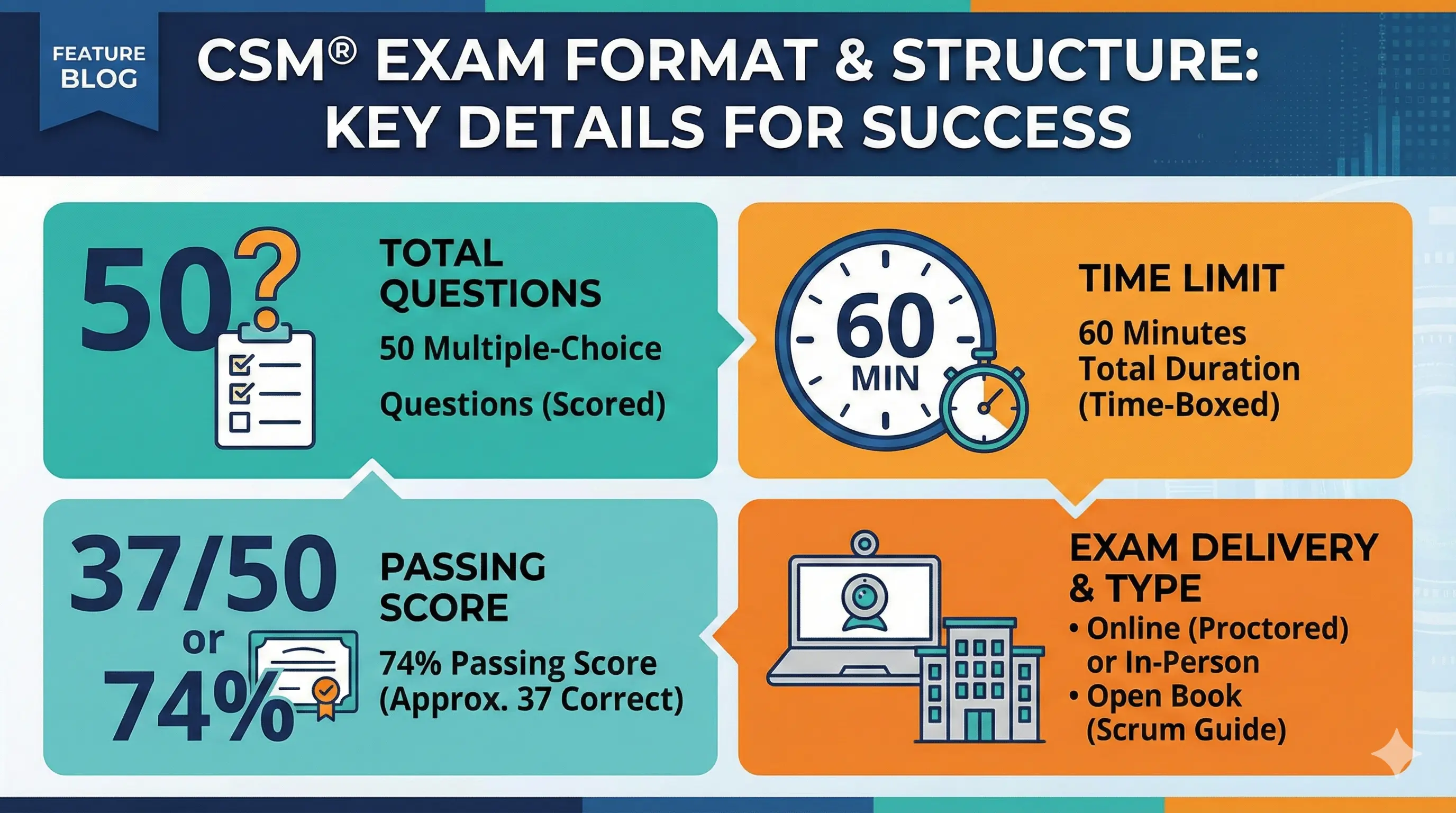
CSM Exam Overview
- Questions: 50 multiple-choice
- Time Limit: 60 minutes
- Passing Score: 37/50 (74%)
- Format: Online, unproctored
- Attempts Included: 2 with course fee
- Time to Complete: Within 90 days of course
With 60 minutes for 50 questions, you have just over a minute per question. Most people finish with time to spare.
Question Types and Content
All 50 questions are multiple-choice with a single correct answer. There are no multi-select questions, drag-and-drop exercises, or written responses.
What the Questions Cover
The exam tests your understanding of:
- The Scrum Framework — roles, events, artifacts, and how they work together
- Scrum Master Responsibilities — facilitation, coaching, removing impediments, protecting the team
- Scrum Events — Sprint Planning, Daily Scrum, Sprint Review, Sprint Retrospective, and the Sprint itself
- Scrum Artifacts — Product Backlog, Sprint Backlog, Increment, and the Definition of Done
- Servant Leadership — how Scrum Masters lead without authority
- Scrum Values — commitment, courage, focus, openness, respect
Everything on the exam comes from either your course material or the Scrum Guide. There are no questions about advanced scaling frameworks, organizational change management, or topics outside core Scrum.
Question Style
Questions are straightforward and scenario-based. You might see something like:
"During the Daily Scrum, a team member starts discussing a technical solution in detail. As the Scrum Master, what should you do?"
The correct answer aligns with Scrum principles—in this case, redirecting the conversation since the Daily Scrum is for inspection and adaptation of progress toward the Sprint Goal, not detailed problem-solving.
There are no trick questions designed to confuse you. If you understand why Scrum works the way it does, the right answers become obvious.
The Exam Experience
Understanding the logistics helps you feel prepared on exam day.
Accessing the Exam
After completing your CSM course, you'll receive an email from Scrum Alliance within 24-48 hours. This email contains a link to access the exam through your Scrum Alliance account.
You have 90 days from your course completion date to pass the exam. Don't wait too long—the material is freshest right after training.
Taking the Exam
The exam is entirely online. You'll log into the Scrum Alliance portal and launch the test from your computer. Key details:
- No proctoring — There's no webcam monitoring or screen recording. It's an honor-system exam.
- Open book — You can technically reference materials, but with limited time, looking things up is impractical for most questions.
- Any location — Take it at home, in a coffee shop, or anywhere with reliable internet.
- Any time — The exam is available 24/7 once you have access.
During the Test
You can navigate freely between questions, flag items to review later, and change answers before submitting. The interface is simple and intuitive.
When you submit, you'll see your results immediately. No waiting days or weeks—you'll know within seconds whether you passed.
Pass Rate and Difficulty
The CSM exam has an approximately 98% pass rate. This isn't because the certification lacks value—it's because the mandatory course genuinely prepares you.
Why It's Designed to Be Passable
Scrum Alliance believes the real learning happens in the course through interactive exercises, discussions, and hands-on practice. The exam is a validation checkpoint, not a high-stakes filter.
This philosophy differs from PMI certifications (where exams are intentionally challenging) and even Scrum.org's PSM certification (which has a harder exam but no mandatory course).
Who Fails and Why
The small percentage who don't pass typically:
- Didn't pay attention during the course
- Waited too long after training and forgot the material
- Rushed through questions without reading carefully
- Had fundamental misunderstandings about Scrum that the course didn't correct
If you engaged with your training and take the exam within a week or two, you'll almost certainly pass.
Comparison to Other Certification Exams
CSM Exam
- Pass Rate: ~98%
- Questions: 50
- Time: 60 minutes
PSM I Exam
- Pass Rate: ~85%
- Questions: 80
- Time: 60 minutes
CAPM Exam
- Pass Rate: ~70-75%
- Questions: 150
- Time: 3 hours
PMP Exam
- Pass Rate: ~60%
- Questions: 180
- Time: 230 minutes
CSM is objectively the easiest of these exams—by design.
What If You Don't Pass?
First, don't panic. It's rare, but it happens. Here's what you need to know:
Second Attempt
Your course fee includes two exam attempts. If you don't pass the first time, review the Scrum Guide, revisit your course notes, and try again. There's no waiting period—you can retake it immediately.
Additional Attempts
If you somehow fail both included attempts (very uncommon), you can purchase additional attempts for $25 each through Scrum Alliance. There's no limit on retakes.
Analyzing What Went Wrong
The exam doesn't show which specific questions you missed, but it does indicate which topic areas need work. Use this feedback to focus your review before retaking.
Exam Preparation Tips
Even with a 98% pass rate, a little preparation ensures you're in the majority who pass on the first try.
Pay Attention During Your Course
This is the most important factor. The two-day training covers everything you need to know. Participate in exercises, ask questions, and stay engaged—especially during afternoon sessions when attention tends to drift.
Review the Scrum Guide
The Scrum Guide is the authoritative source for exam content. It's short (about 13 pages) and free. Reading it once before your course and once after reinforces the key concepts.
Take the Exam Soon After Training
Don't wait weeks. The material fades quickly. Most successful candidates take the exam within a few days of completing their course while everything is fresh.
Don't Overthink
The questions are straightforward. If you find yourself constructing elaborate justifications for an answer, you're probably overcomplicating it. Trust your training and go with the response that aligns with Scrum principles.
Practice Questions Help
While the exam is easy, practicing with sample questions helps you get comfortable with the format and identify any gaps in understanding. It also builds confidence.
Ready to Prepare?
The CSM exam is designed for you to pass. Complete your course, review the Scrum Guide, and take the test while the material is fresh. You'll be a Certified Scrum Master before you know it.
For details on course requirements, see CSM Requirements. To understand the Scrum Master role the exam tests you on, check out Scrum Master Role Explained.
Want to reinforce your learning with practice questions? Start practicing on PM Drills to build confidence before exam day.