The Certified Scrum Master (CSM) has the simplest requirements of any major project management certification. Unlike PMP or CAPM, there's no experience to document, no lengthy application to submit, and no educational prerequisites to verify.
That said, CSM does have one unique requirement that sets it apart: you must complete a mandatory two-day course before you can even attempt the exam. This guide covers every requirement in detail so you know exactly what to expect. For a complete overview of the certification, see our CSM Certification Guide.
CSM Requirements at a Glance
Here's the complete list of what you need to earn your CSM:
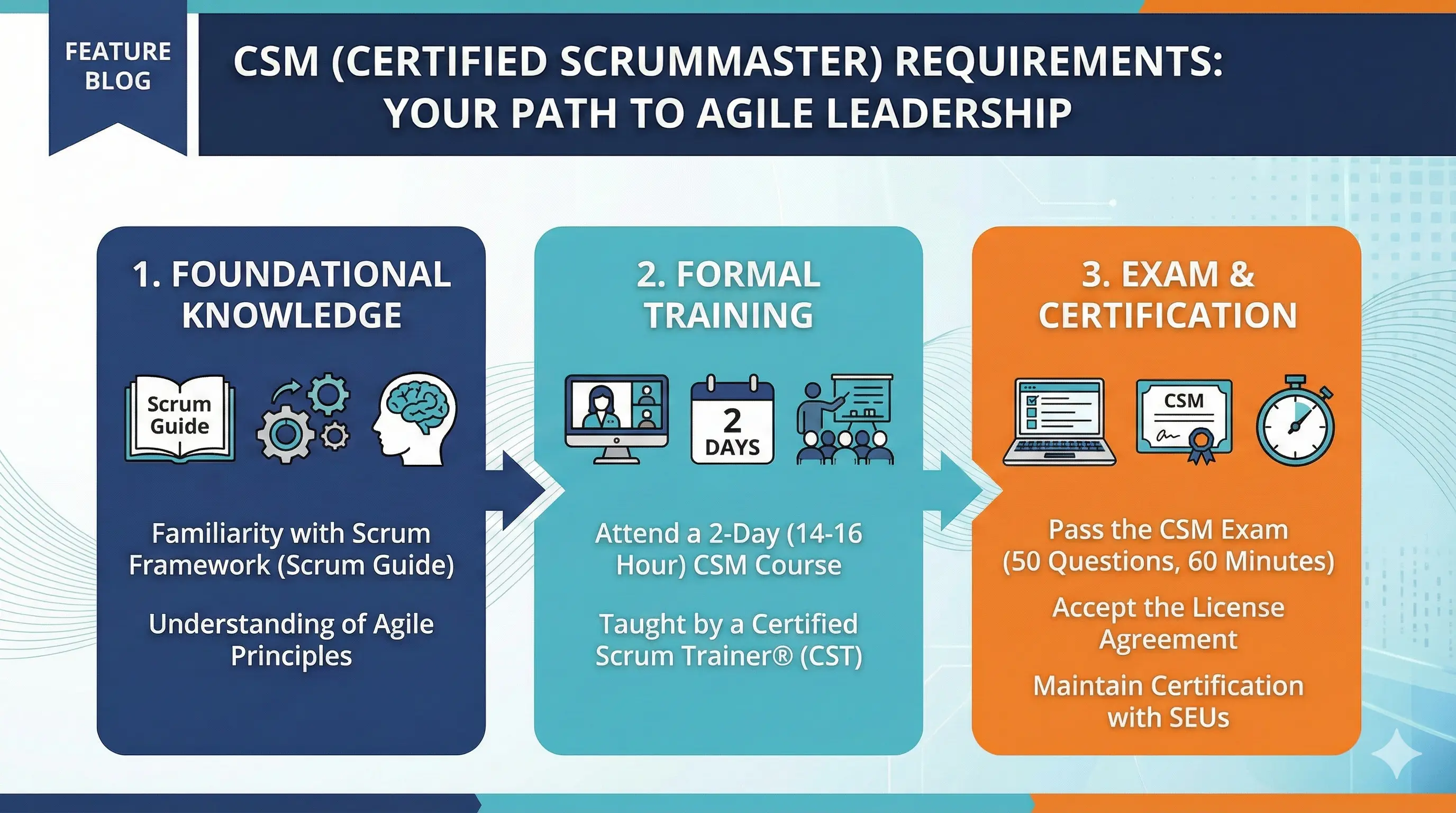
- Complete a 2-day (14-16 hour) CSM course taught by a Certified Scrum Trainer
- Pass the CSM exam (50 questions, 37 correct to pass)
- Be at least 18 years old
- Accept the Scrum Alliance license agreement
- Create a Scrum Alliance profile
That's it. No project management experience. No specific degree. No application process. The barrier to entry is essentially the course fee and two days of your time.
The Mandatory Course Requirement
This is where CSM differs fundamentally from certifications like PMP, CAPM, or even PSM. You cannot self-study for the CSM exam. Scrum Alliance requires every candidate to complete an approved course before gaining access to the exam.
What the Course Involves
CSM courses run 14-16 hours, typically delivered over two consecutive days. The format is highly interactive—expect group exercises, Scrum simulations, discussions, and hands-on activities rather than passive lectures.
Every CSM course covers the same core curriculum:
- The Scrum framework (roles, events, artifacts)
- Scrum Master responsibilities and servant leadership
- How to facilitate Scrum events effectively
- Removing impediments and protecting the team
- Coaching teams toward self-organization
- Real-world application of Scrum principles
Certified Scrum Trainer (CST) Requirement
Your course must be taught by a Certified Scrum Trainer—someone who has been vetted and approved by Scrum Alliance. This ensures consistent quality across all CSM training worldwide. You can find approved trainers through the Scrum Alliance website.
Course Format Options
You have flexibility in how you complete the training:
In-person courses offer face-to-face interaction, easier networking with classmates, and fewer distractions. They typically cost more and require travel.
Live online courses provide the same interactive experience via video conference. They're often less expensive and more convenient, though they require discipline to stay engaged through a screen.
Schedule formats vary by trainer—some run Tuesday-Wednesday, others Saturday-Sunday, and some split the training across two weekends. Choose what works for your schedule.
For detailed guidance on selecting a course, see our guide to CSM Training Courses.
The Exam Requirement
After completing your course, you'll receive an email from Scrum Alliance with a link to take the CSM exam. The exam validates that you absorbed the material from training.
Exam Details
- 50 multiple-choice questions
- 60 minutes to complete
- Passing score: 37/50 (74%)
- Online, taken on your own computer
- Two attempts included with your course fee
- Must complete within 90 days of finishing the course
Why the Exam Is Manageable
The CSM exam has an approximately 98% pass rate. It's designed to confirm you learned the Scrum fundamentals—not to trick you or test obscure edge cases. If you paid attention during your course and understand the Scrum Guide, you'll pass.
This stands in stark contrast to the PMP exam (around 60% pass rate) or even PSM I (around 85% pass rate). Scrum Alliance intentionally keeps the CSM exam accessible because they believe the real learning happens in the course and through practice.
For complete exam details, see our CSM Exam Format guide.
Additional Requirements
Beyond the course and exam, a few administrative requirements round out the process.
Age Requirement
You must be at least 18 years old to earn the CSM certification. This is standard across most professional certifications.
License Agreement
You'll need to accept the Scrum Alliance license agreement, which covers ethical conduct, proper use of the CSM credential, and agreement to Scrum Alliance policies.
Scrum Alliance Profile
Creating a profile in the Scrum Alliance system is required. This is where you'll access your exam, track your certification status, log SEUs for renewal, and manage your credentials going forward.
What You Don't Need for CSM
Understanding what's not required helps put CSM in perspective—especially if you're comparing it to other certifications.
No Project Management Experience
Unlike PMP (which requires 36-60 months of leading projects) or even some entry-level certifications, CSM has zero experience requirements. You could be a recent graduate, a career changer, or someone completely new to project management.
No Specific Educational Background
There's no degree requirement. Whether you have a PhD or a high school diploma, you're equally eligible for CSM.
No Application Process
PMP candidates spend hours documenting projects, calculating experience hours, and hoping they don't get audited. CSM has none of that. You sign up for a course, attend, and take the exam.
No Prior Scrum Knowledge
While familiarity with Scrum helps you get more from the course, it's not required. CSM courses are designed for beginners. Many people take CSM as their first introduction to Scrum.
No Self-Study Option
This cuts both ways. You can't skip the course by studying on your own (unlike PSM, which allows exam-only certification). The mandatory training is both a requirement and a benefit—everyone who earns CSM has had hands-on instruction from an experienced trainer.
Preparing Before Your Course
While no preparation is required, a little advance work helps you get more value from your two-day training.
Read the Scrum Guide
The Scrum Guide is the definitive source document for Scrum. It's only about 13 pages and completely free. Reading it before your course means you'll spend less time learning terminology and more time on practical application.
Understand Basic Agile Concepts
If terms like "iteration," "backlog," and "sprint" are completely foreign, spend 30 minutes reading introductory agile content. Your course will cover everything, but baseline familiarity helps.
Come Ready to Participate
CSM courses are interactive by design. The more you engage with exercises, ask questions, and participate in discussions, the more you'll retain—and the easier the exam will be.
CSM Requirements vs. Other Certifications
To put CSM requirements in context:
CSM
- Experience Required: None
- Education Required: None
- Course Required: Yes (2 days)
- Exam Difficulty: Easy (~98% pass)
PSM I
- Experience Required: None
- Education Required: None
- Course Required: No
- Exam Difficulty: Moderate (~85% pass)
CAPM
- Experience Required: None
- Education Required: None
- Course Required: 23 hours training
- Exam Difficulty: Moderate
PMP
- Experience Required: 36-60 months
- Education Required: Secondary/Bachelor's
- Course Required: 35 hours training
- Exam Difficulty: Hard (~60% pass)
CSM's mandatory course requirement is unique, but it also means every CSM holder has had structured training—not just exam cramming.
Next Steps
If you meet the simple requirements above (and almost everyone does), your next step is choosing a CSM course. Consider factors like trainer reviews, format preference, schedule, and cost.
Once you've completed your training and passed the exam, you'll be a Certified Scrum Master—typically within a week of starting the process.
For help selecting the right course, see our CSM Training Courses guide. To understand total costs, check out CSM Cost.
Ready to start preparing? Practice with CSM questions on PM Drills to reinforce your learning before and after your course.