The Scrum Master is one of the most misunderstood roles in modern business. It's not a project manager with a different title. It's not a team lead who assigns tasks. And despite the name, it's not someone who "masters" the team.
So what does a Scrum Master actually do? This guide breaks down the role's responsibilities, how it differs from traditional management, and what makes someone effective in the position. For a complete overview of the certification, see our CSM Certification Guide.
What Is a Scrum Master?
The Scrum Guide defines the Scrum Master as accountable for "establishing Scrum as defined in the Scrum Guide" and for "the Scrum Team's effectiveness."
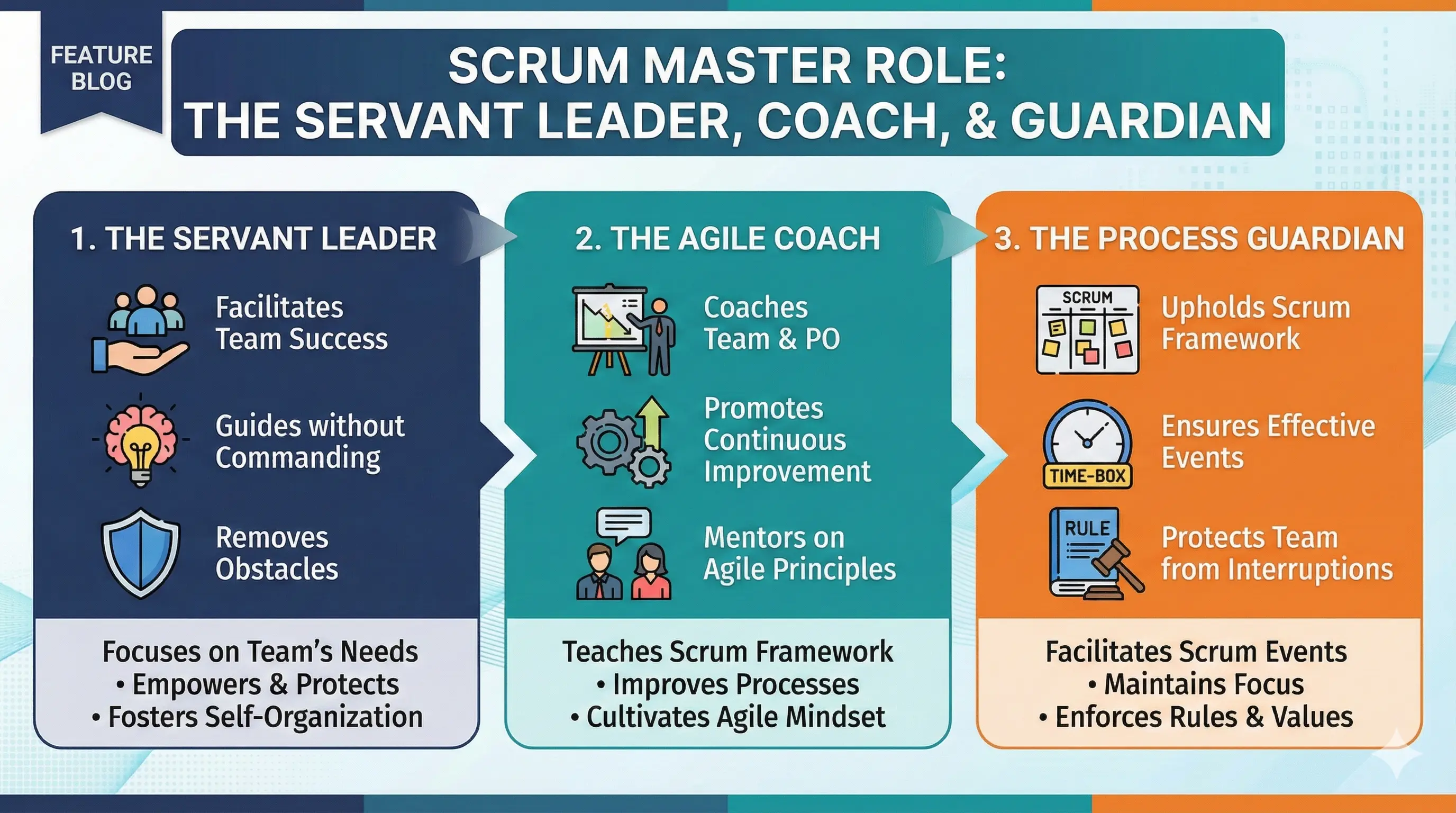
In practical terms, the Scrum Master is a servant leader who helps the team work well together, removes obstacles that slow them down, and ensures everyone understands and follows Scrum practices.
Part of the Scrum Team
The Scrum Master is one of three roles on a Scrum Team:
Scrum Master
- Facilitates the process
- Removes impediments
- Coaches the team on Scrum
Product Owner
- Owns the Product Backlog
- Defines what to build
- Represents stakeholders
Developers
- Build the product
- Self-organize to complete work
- Deliver increments each Sprint
These three roles work together as equals. The Scrum Master doesn't manage the other roles—they serve them.
Servant Leadership
This concept is central to understanding the Scrum Master role. Traditional managers direct work from above. Servant leaders support their teams from alongside or below.
A Scrum Master leads by:
- Helping rather than directing
- Listening rather than dictating
- Enabling rather than controlling
- Coaching rather than commanding
This doesn't mean Scrum Masters are passive. They actively protect the team, challenge dysfunction, and drive improvement—but through influence and facilitation rather than authority.
Core Responsibilities
The Scrum Master wears many hats throughout a typical Sprint. Here's what the role involves day-to-day.
Facilitating Scrum Events
Scrum has five events, and the Scrum Master ensures each one happens and stays productive.
Sprint Planning — Helps the team select work for the Sprint and define the Sprint Goal. Ensures the meeting stays focused and time-boxed.
Daily Scrum — Facilitates (but doesn't run) the team's daily 15-minute sync. Keeps it focused on progress toward the Sprint Goal, not status reporting.
Sprint Review — Coordinates the demonstration of completed work to stakeholders. Facilitates feedback collection and discussion.
Sprint Retrospective — Leads the team in reflecting on what went well, what didn't, and what to improve. Creates a safe space for honest discussion.
The Sprint Itself — Protects the Sprint's integrity by preventing scope changes and interruptions that derail the team's focus.
Removing Impediments
When something blocks the team's progress, the Scrum Master works to remove it. Impediments might include:
- Technical obstacles requiring coordination with other teams
- Missing information or delayed decisions
- Resource constraints
- Organizational policies that slow work down
- Interpersonal conflicts affecting collaboration
- External dependencies not being met
Some impediments the Scrum Master resolves directly. Others require escalation or influence across the organization. Either way, it's the Scrum Master's job to ensure obstacles don't linger.
Coaching the Team
Scrum Masters help teams understand and implement Scrum effectively. This includes:
- Teaching Scrum practices to new team members
- Helping the team improve their processes over time
- Challenging behaviors that undermine Scrum principles
- Guiding the team toward self-organization
- Sharing techniques for estimation, backlog refinement, and collaboration
Good coaching means asking questions that help the team find their own answers rather than simply providing solutions.
Protecting the Team
Scrum Masters shield the team from distractions and disruptions:
- Stakeholders who want to add work mid-Sprint
- Managers who pull team members onto other projects
- Meetings that don't require the team's participation
- Organizational noise that fragments focus
This protection allows Developers to concentrate on delivering their Sprint commitment without constant context-switching.
Helping the Product Owner
While the Scrum Master doesn't manage the Product Owner, they support them by:
- Facilitating effective backlog refinement sessions
- Helping communicate the product vision to the team
- Coaching on techniques for writing clear backlog items
- Ensuring the team understands what the Product Owner needs
Fostering Continuous Improvement
Beyond individual Sprints, Scrum Masters drive ongoing team improvement:
- Tracking patterns across Retrospectives
- Introducing new practices and techniques
- Measuring and improving team metrics
- Building team capabilities over time
Scrum Master vs. Project Manager
This comparison trips up many people—especially those transitioning from traditional project management.
Project Manager
- Directs the team's work
- Assigns tasks to individuals
- Manages timeline and budget
- Reports status to stakeholders
- Has authority over team members
- Accountable for project delivery
Scrum Master
- Facilitates the team's process
- Lets the team self-organize task assignment
- Helps remove obstacles to progress
- Enables transparency through Scrum artifacts
- Has no direct authority over team members
- Accountable for team effectiveness, not delivery
The fundamental difference: Project Managers control what gets done and how. Scrum Masters create conditions for teams to figure that out themselves.
Can You Be Both?
Some organizations combine these roles, especially during transitions to Scrum. This creates tension—the directive nature of project management conflicts with the servant leadership of Scrum.
When possible, keep the roles separate. A Scrum Master who also manages the project will default to control when pressure mounts, undermining the team's self-organization.
For a deeper comparison, see our guide on PMP vs CSM.
Working with the Team
The Scrum Master's relationships differ across the Scrum Team.
With Developers
The Scrum Master helps Developers become a high-performing, self-organizing team. This means:
- Coaching on Scrum practices without micromanaging
- Facilitating collaboration and communication
- Removing obstacles that block their work
- Building psychological safety for experimentation
- Trusting them to determine how to complete work
With the Product Owner
The relationship is collaborative, not hierarchical:
- Helping the Product Owner maximize the value of the Product Backlog
- Facilitating communication between the Product Owner and Developers
- Coaching on effective backlog management techniques
- Ensuring everyone understands product goals
With Stakeholders
Scrum Masters help stakeholders understand how to work with a Scrum Team:
- Educating on Scrum processes and expectations
- Facilitating their participation in Sprint Reviews
- Managing expectations about scope and timeline flexibility
- Protecting the team from inappropriate interference
With Other Scrum Masters
In organizations with multiple Scrum Teams, Scrum Masters collaborate:
- Sharing practices and lessons learned
- Coordinating on cross-team dependencies
- Driving organizational improvements together
- Supporting each other's growth
Common Misconceptions
Understanding what a Scrum Master isn't helps clarify what they are.
"The Scrum Master assigns tasks."Wrong. Developers self-organize and choose their own work. The Scrum Master facilitates this but doesn't direct it.
"The Scrum Master is the team's boss."Wrong. Scrum Masters have no direct authority over team members. They lead through influence and service.
"The Scrum Master runs the Daily Scrum."Partially wrong. The Scrum Master ensures the Daily Scrum happens and stays on track, but it's the Developers' meeting. The Scrum Master facilitates rather than leads the discussion.
"Mature teams don't need a Scrum Master."Debatable but generally wrong. Even high-performing teams benefit from facilitation, impediment removal, and continuous improvement coaching. The role may evolve, but it doesn't disappear.
"Scrum Master is an entry-level position."Wrong. Effective Scrum Masters need facilitation skills, organizational influence, coaching ability, and conflict resolution expertise. It's a specialized role, not a stepping stone.
"The Scrum Master tracks status and reports to management."Wrong. Scrum creates transparency through its artifacts (Product Backlog, Sprint Backlog, Increment). The Scrum Master ensures these artifacts exist and are visible—but status reporting isn't their job.
Skills of an Effective Scrum Master
What makes someone good at this role?
Facilitation
- Running effective meetings
- Keeping discussions on track
- Drawing out quieter voices
- Managing group dynamics
Coaching
- Teaching without lecturing
- Asking powerful questions
- Helping others find their own solutions
- Providing feedback constructively
Communication
- Listening actively
- Translating between technical and business language
- Presenting clearly to various audiences
- Writing concise documentation
Conflict Resolution
- Addressing tension before it escalates
- Facilitating difficult conversations
- Finding common ground
- Remaining neutral when appropriate
Organizational Awareness
- Understanding company politics and dynamics
- Knowing who to influence for impediment removal
- Navigating bureaucracy effectively
- Building relationships across departments
Patience and Empathy
- Giving teams time to grow
- Understanding different perspectives
- Supporting people through change
- Remaining calm under pressure
Continuous Learning
- Staying current on Scrum and agile practices
- Seeking feedback on their own performance
- Experimenting with new techniques
- Learning from other Scrum Masters
Is Scrum Master Right for You?
The role suits people who:
- Enjoy helping others succeed more than personal achievement
- Prefer influence over authority
- Have patience for gradual improvement
- Like facilitation and coaching
- Can tolerate ambiguity and resistance to change
It may not suit people who:
- Need direct control over outcomes
- Prefer working independently
- Want clear hierarchical authority
- Get frustrated by slow organizational change
Next Steps
Understanding the role is the first step. If Scrum Master sounds like a fit, the CSM certification provides foundational training in both Scrum and the specific responsibilities of this role.
For details on career progression, see Scrum Master Career Path. To understand what certification involves, review CSM Requirements.
Ready to prepare for your CSM certification? Practice with Scrum Master questions on PM Drills to test your understanding of the role.