
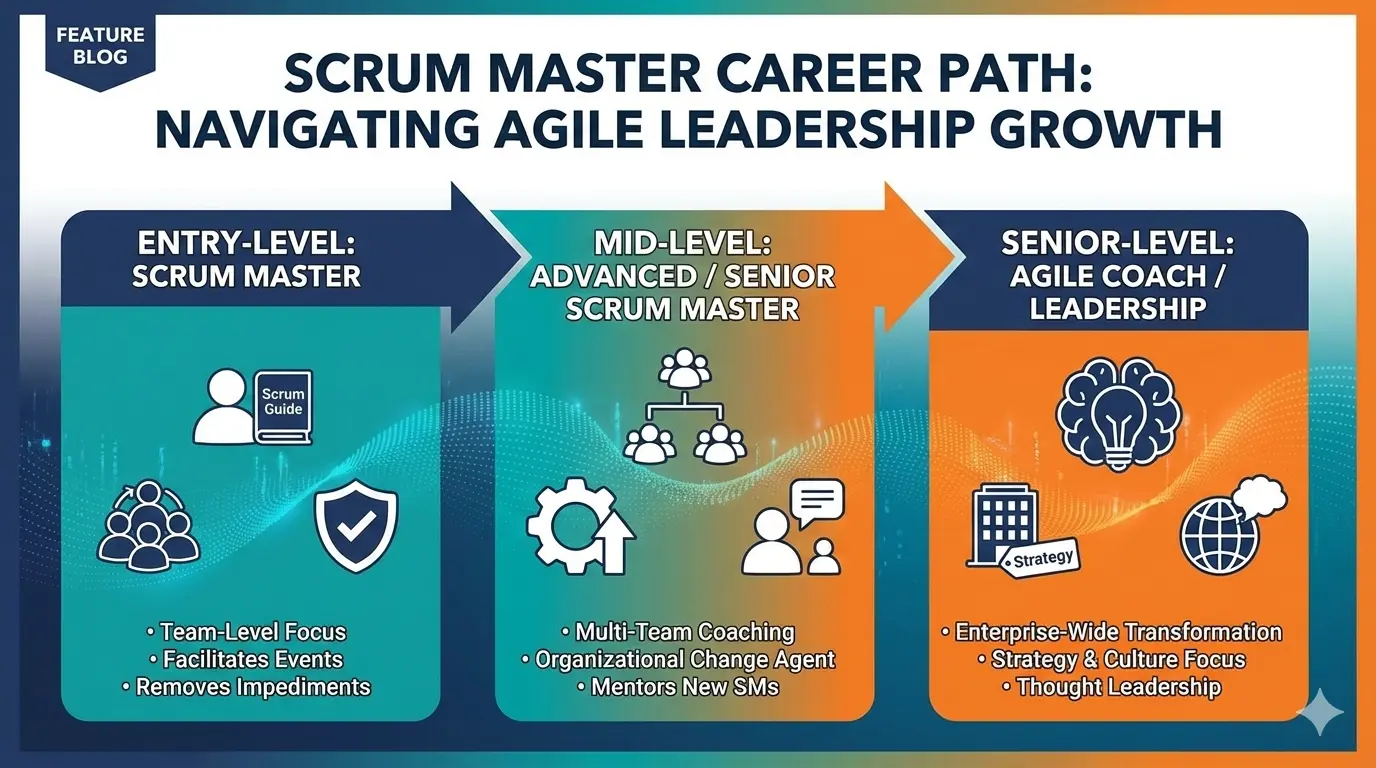
The Scrum Master role has evolved from a niche position in software development to a recognized career path across industries. Organizations adopting agile practices need skilled facilitators, and demand continues to grow as more companies embrace Scrum.
This guide covers how to enter the field, what to expect at each career stage, salary ranges, and how to advance from entry-level Scrum Master to senior leadership roles. For a complete overview of the foundational certification, see our CSM Certification Guide.
Getting Started as a Scrum Master
Breaking into the Scrum Master role happens through several common pathways.
Common Entry Points
Developers TransitioningSoftware developers who've worked on Scrum teams often move into the Scrum Master role. They understand the technical context and have experienced Scrum from the inside. The transition requires developing facilitation and coaching skills.
Project Managers Adopting AgileTraditional project managers shifting to agile environments frequently become Scrum Masters. They bring organizational skills and stakeholder management experience but must unlearn directive management habits in favor of servant leadership.
Team Leads Making the ShiftTeam leads and supervisors sometimes transition when their organizations adopt Scrum. The challenge is moving from authority-based leadership to influence-based facilitation.
Career ChangersPeople from unrelated fields enter through certification and entry-level positions. Without technical or PM background, breaking in takes longer but is achievable with persistence and networking.
First Scrum Master Role Challenges
Your first role comes with predictable challenges:
Building CredibilityTeams may question why they need a Scrum Master or resist your facilitation. Earning trust takes time and consistent demonstration of value.
Learning the OrganizationUnderstanding company politics, who makes decisions, and how to remove impediments requires organizational knowledge you don't have yet.
Balancing Facilitation and CoachingNew Scrum Masters often do too much (controlling) or too little (passive). Finding the right balance takes practice.
Handling ResistanceNot everyone embraces Scrum. You'll encounter skeptics, people who prefer old ways, and managers who undermine agile principles.
The Value of Certification
While certification alone won't land you a job, it removes a common filter. Many job postings require or prefer CSM, PSM, or equivalent credentials. Certification signals:
- Baseline Scrum knowledge
- Professional commitment to the role
- Completed structured training (for CSM)
For entry-level candidates without Scrum Master experience, certification is often essential to get interviews.
For details on getting certified, see CSM Requirements.
Scrum Master Salary Overview
Compensation varies significantly based on experience, location, industry, and company size. These ranges provide general guidance for the US market—adjust expectations based on your geography.
Entry-Level Scrum Master (0-2 years)
- Salary Range: $70,000-90,000
- Typical Titles: Scrum Master, Associate Scrum Master, Junior Scrum Master
- Context: Often single-team responsibility, learning the role
Mid-Level Scrum Master (2-5 years)
- Salary Range: $90,000-120,000
- Typical Titles: Scrum Master, Senior Scrum Master
- Context: May handle multiple teams, mentoring junior SMs
Senior Scrum Master (5+ years)
- Salary Range: $110,000-140,000+
- Typical Titles: Senior Scrum Master, Lead Scrum Master
- Context: Complex environments, organizational influence, coaching others
Agile Coach / RTE (7+ years)
- Salary Range: $130,000-180,000+
- Typical Titles: Agile Coach, Release Train Engineer, Enterprise Agile Coach
- Context: Coaching multiple teams or entire organizations
Factors Affecting Salary
LocationMajor tech hubs (San Francisco, New York, Seattle) pay 20-40% more than smaller markets. Remote work has narrowed but not eliminated geographic differences.
IndustryFinancial services, healthcare IT, and large tech companies typically pay more than startups, nonprofits, or government agencies.
Company SizeEnterprise organizations generally offer higher base salaries. Startups may compensate with equity but lower cash.
CertificationsAdvanced certifications (A-CSM, CSP-SM, SAFe) can command salary premiums, though experience matters more than credentials.
Career Progression Path
The Scrum Master role offers clear advancement opportunities for those who develop their skills.
Level 1: Scrum Master (Single Team)
This is where everyone starts. You're responsible for one Scrum team—facilitating events, removing impediments, and coaching team members on Scrum practices.
Focus Areas
- Mastering Scrum fundamentals
- Developing facilitation skills
- Learning to remove impediments effectively
- Building trust with your team
TimelineMost spend 1-3 years at this level before advancing.
Level 2: Senior Scrum Master (Multiple Teams)
Senior Scrum Masters handle increased complexity—multiple teams, challenging organizational dynamics, or high-stakes projects.
Focus Areas
- Coaching across teams
- Handling inter-team dependencies
- Mentoring junior Scrum Masters
- Influencing beyond your immediate teams
TimelineTypically reached after 3-5 years of experience.
Level 3: Agile Coach
Agile Coaches work at a higher level than individual teams. You're coaching Scrum Masters, helping teams improve, and driving agile adoption across departments or business units.
Focus Areas
- Organizational change management
- Coaching other coaches
- Metrics and continuous improvement at scale
- Stakeholder and leadership engagement
TimelineUsually requires 5-8 years of progressive experience.
Level 4: Release Train Engineer (SAFe) / Enterprise Roles
For organizations using scaled frameworks like SAFe, the Release Train Engineer coordinates multiple teams toward common objectives. Enterprise Agile Coaches drive transformation across entire organizations.
Focus Areas
- Large-scale coordination
- Executive stakeholder management
- Transformation strategy
- Organizational design
TimelineTypically 8+ years of experience with demonstrated leadership.
Level 5: Head of Agile / Transformation Lead
The most senior practitioners lead agile practices for entire organizations—setting strategy, building coaching teams, and reporting to executive leadership.
Focus Areas
- Enterprise strategy
- Building and leading agile teams
- Executive influence
- Cultural transformation
TimelineUsually 10+ years with exceptional track record.
Certification Progression
Certifications mark your development and open doors at each career stage.
Scrum Alliance Path
CSM → A-CSM → CSP-SM → CTC/CEC
CSM (Certified Scrum Master)Entry-level certification. Validates Scrum fundamentals.
A-CSM (Advanced Certified Scrum Master)Requires CSM plus 12 months of experience. Deepens facilitation and coaching skills.
CSP-SM (Certified Scrum Professional - Scrum Master)Professional-level certification demonstrating mastery.
CTC/CEC (Certified Team Coach / Certified Enterprise Coach)Expert credentials for those coaching at scale. Rigorous application and evaluation process.
Complementary Certifications
Beyond Scrum Alliance, consider:
SAFe CertificationsIf your organization uses Scaled Agile Framework, SAFe Scrum Master (SSM) or SAFe Release Train Engineer (RTE) certifications add value.
ICAgile CertificationsICAgile offers coaching-focused certifications (ICP-ACC, ICP-ENT) valued in the coaching community.
PMI-ACPDemonstrates broad agile knowledge beyond Scrum. Useful if you work with multiple methodologies.
When to Pursue Advanced Certifications
Don't rush to collect credentials. Advanced certifications matter most when:
- You have experience to match the credential level
- The certification teaches skills you'll actually use
- Your target roles specifically value that certification
- You've maximized value from your current credentials
For more on CSM specifically, see CSM Renewal & SEUs.
Industries Hiring Scrum Masters
While Scrum originated in software development, the role has expanded across sectors.
High-Demand Industries
TechnologyThe natural home for Scrum Masters. Software companies, tech startups, and IT departments consistently hire.
Financial ServicesBanks, insurance companies, and fintech firms have heavily adopted agile. These roles often pay premium salaries.
Healthcare ITHealthcare organizations modernizing their technology need Scrum Masters who can navigate regulatory complexity.
ConsultingManagement and technology consulting firms hire Scrum Masters for client engagements and internal teams.
E-commerce and RetailCompanies with significant digital presence need agile teams for continuous platform development.
Emerging Opportunities
Government and Public SectorGovernment agencies are slowly adopting agile, creating new opportunities with good job security.
ManufacturingBeyond software, some manufacturers apply Scrum principles to product development and operations.
Marketing and CreativeMarketing teams increasingly use Scrum for campaign management and content development.
Remote Work Opportunities
The Scrum Master role adapts well to remote work. Many organizations now hire remote or hybrid Scrum Masters, expanding your job market beyond local opportunities.
Building Your Scrum Master Career
Beyond certifications and job titles, deliberate career development accelerates your growth.
Continuous Learning
The agile field evolves constantly. Stay current through:
- Reading books on facilitation, coaching, and agile practices
- Following thought leaders and practitioners
- Attending conferences and local meetups
- Experimenting with new techniques in your teams
Community Involvement
Building your network pays dividends:
- Join local agile meetups and user groups
- Participate in online communities and forums
- Attend Scrum Alliance gatherings or regional conferences
- Connect with other Scrum Masters facing similar challenges
Building a Portfolio of Success
Document your impact:
- Teams you've helped improve (with metrics if possible)
- Impediments you've removed and their business impact
- Organizational changes you've influenced
- Coaching moments that made a difference
These stories become powerful in interviews and performance reviews.
Mentorship
Both giving and receiving mentorship accelerates growth:
- Find experienced practitioners who can guide your development
- Mentor newer Scrum Masters to solidify your own understanding
- Build relationships that provide support and accountability
Specialization Options
As you advance, consider focusing on:
- Technical teams (requiring deeper technical understanding)
- Scaled environments (SAFe, LeSS, Nexus expertise)
- Organizational coaching (change management focus)
- Specific industries (healthcare, finance, government)
Specialization can differentiate you in competitive job markets.
Next Steps
The Scrum Master career path rewards those who continuously develop their skills and build genuine expertise in helping teams succeed.
Start with solid fundamentals. Understand the Scrum Master Role deeply before worrying about career advancement. Master your current level before reaching for the next.
Ready to begin your journey? Practice Scrum Master concepts on PM Drills to build the knowledge foundation your career will rest on.