
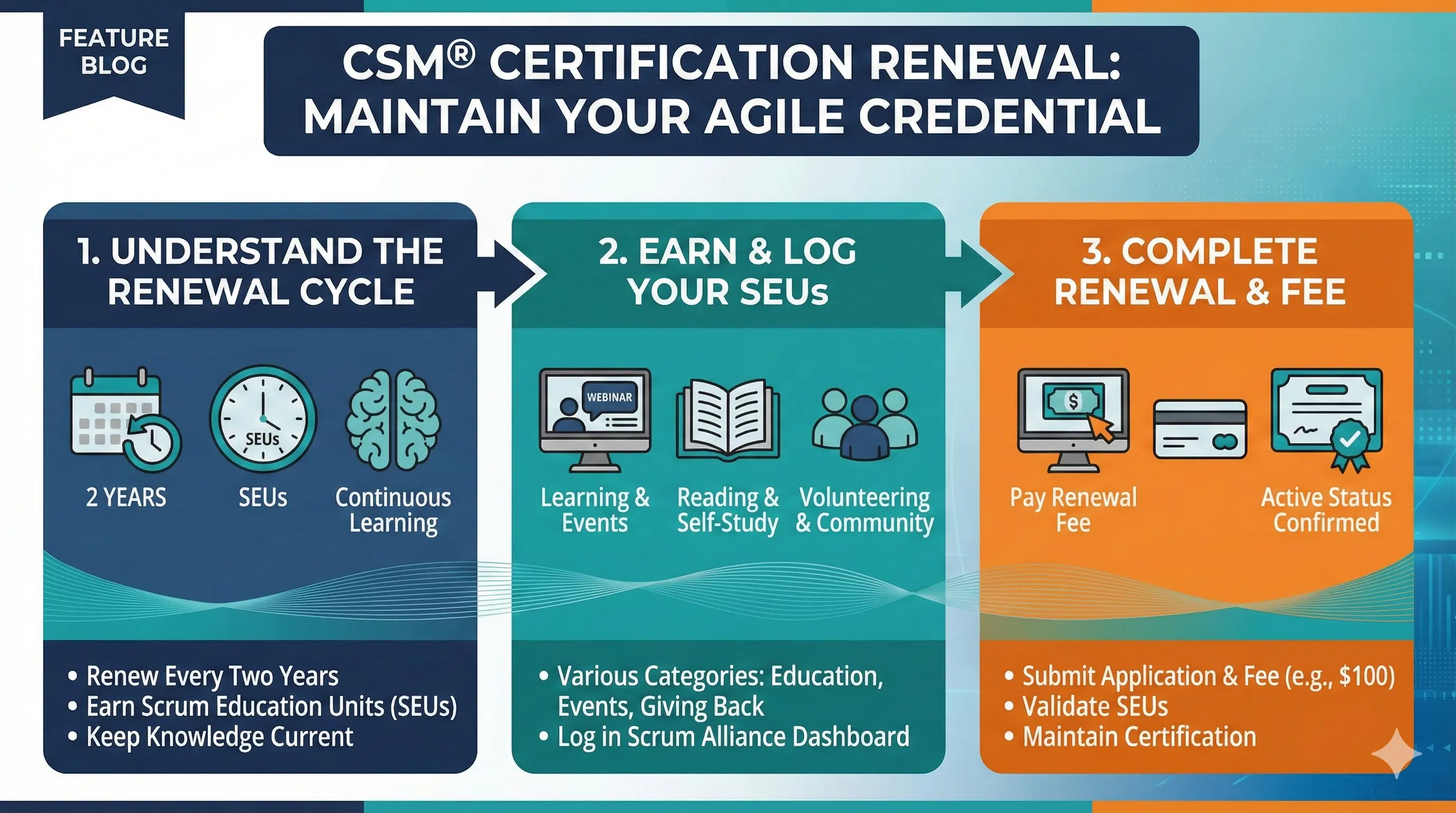
Your CSM certification doesn't last forever. Every two years, you need to renew by earning continuing education credits and paying a modest fee. The good news: CSM renewal is straightforward, affordable, and many of the required credits can be earned for free.
This guide explains exactly how renewal works, what Scrum Education Units (SEUs) are, and the most efficient ways to maintain your certification. For a complete overview of the certification, see our CSM Certification Guide.
CSM Renewal Overview
Here's what you need to know at a glance:
Certification Period
- Valid for 2 years from your certification date
Renewal Requirements
- Earn 20 Scrum Education Units (SEUs)
- Pay $100 renewal fee
Deadline
- Must complete before your certification expires
Grace Period
- Limited grace period available, but certification lapses if not renewed
What Happens If You Don't Renew
- Certification becomes inactive
- Cannot use CSM designation
- Must retake the course and exam to recertify
Renewal isn't optional if you want to maintain your credential. Plan ahead so you're not scrambling at the last minute.
Understanding Scrum Education Units (SEUs)
SEUs are Scrum Alliance's continuing education currency. They ensure certified practitioners stay current and continue developing their skills.
How SEUs Work
One SEU roughly equals one hour of learning or professional development activity. You need 20 SEUs per two-year cycle, which averages to less than one hour of learning per month.
SEU Categories
Scrum Alliance organizes SEUs into categories to encourage diverse learning:
Category A: Scrum Alliance Courses
- Advanced Scrum Alliance courses (A-CSM, CSP-SM, etc.)
- Scrum Gatherings and official events
- No limit on hours claimed
Category B: Outside Education
- Non-Scrum Alliance courses and training
- Conferences and workshops
- Webinars and online learning
- Books and articles
- No limit on hours claimed
Category C: Volunteer and Other Activities
- Coaching and mentoring others
- Presenting at events
- Writing articles or blog posts
- Contributing to Scrum community
- No limit on hours claimed
You can earn all 20 SEUs from a single category or mix across categories—there's flexibility in how you accumulate credits.
SEUs vs. PDUs
If you're familiar with PMI's Professional Development Units (PDUs), SEUs work similarly but with simpler rules:
SEUs (Scrum Alliance)
- 20 required per 2-year cycle
- Flexible categories
- Many free earning options
- Self-reported with minimal documentation
PDUs (PMI)
- 60 required per 3-year cycle (PMP)
- Strict category requirements
- Mix of free and paid options
- More documentation required
SEUs are generally easier to earn and track than PDUs.
Ways to Earn SEUs
You have many options for accumulating the 20 SEUs you need. Here's what qualifies.
Courses and Training
Any learning activity related to Scrum, agile, or professional development counts:
- Scrum Alliance courses (A-CSM, CSP-SM, etc.)
- Agile training programs
- Leadership and coaching courses
- Technical skills training relevant to your role
- Online courses from platforms like LinkedIn Learning, Coursera, or Udemy
One hour of instruction equals one SEU. A two-day advanced course could earn you all 20 SEUs at once.
Events and Conferences
Attending professional events earns SEUs:
- Scrum Alliance Global Gatherings
- Regional Scrum conferences
- Agile meetups and user groups
- Industry conferences with agile content
- Webinars and virtual events
Track the hours you spend in sessions—each hour counts as one SEU.
Self-Directed Learning
Independent learning qualifies too:
- Reading books on Scrum, agile, or leadership
- Watching educational videos
- Listening to relevant podcasts
- Studying articles and research papers
For books, Scrum Alliance suggests claiming one SEU per chapter read (reasonably). For videos and podcasts, claim the actual time spent.
Coaching and Mentoring
Helping others learn earns SEUs:
- Coaching team members on Scrum practices
- Mentoring aspiring Scrum Masters
- Facilitating learning sessions at your organization
- Leading Scrum training for colleagues
Document the hours spent in these activities.
Community Contributions
Giving back to the Scrum community counts:
- Presenting at meetups or conferences
- Writing articles or blog posts about Scrum
- Creating educational content
- Volunteering with Scrum Alliance
- Participating in Scrum user groups
These activities demonstrate expertise while earning renewal credits.
Free Ways to Earn SEUs
You don't need to spend money to maintain your certification. Plenty of free options exist.
Scrum Alliance Resources
Scrum Alliance provides free learning for members:
- Webinars on various Scrum topics
- Community forums and discussions
- Learning resources in the member portal
- Recorded sessions from past events
Check the Scrum Alliance website regularly for upcoming free webinars.
Reading and Self-Study
Books from your library (physical or digital) cost nothing:
- Re-read the Scrum Guide and reflect on applications
- Borrow Scrum and agile books from your library
- Read free articles on agile websites
- Follow thought leaders and read their content
Document what you read and the time spent.
Podcasts and Videos
Free audio and video content is abundant:
- Scrum-focused podcasts
- YouTube videos on agile topics
- TED talks on leadership and teamwork
- Free webinar recordings
Commute time becomes SEU-earning time.
Community Participation
Engaging with the Scrum community costs nothing:
- Attend free local meetups
- Participate in online forums
- Join LinkedIn groups and discussions
- Mentor colleagues informally
These activities build your network while earning credits.
Workplace Learning
Activities you're already doing may qualify:
- Facilitating retrospectives and improving your techniques
- Coaching team members on Scrum practices
- Leading lunch-and-learn sessions
- Experimenting with new facilitation approaches
Document the learning and reflection, not just the doing.
The Renewal Process
When it's time to renew, here's what to do:
Step 1: Log Your SEUs
Throughout your certification period, track your learning activities in the Scrum Alliance portal. You can log SEUs anytime—don't wait until renewal.
For each activity, record:
- Date of the activity
- Description of what you learned
- Category (A, B, or C)
- Number of SEUs claimed
Step 2: Verify Your Total
Before your expiration date, confirm you have at least 20 SEUs logged. The Scrum Alliance portal shows your current total and certification expiration date.
Step 3: Pay the Renewal Fee
Once you have sufficient SEUs, pay the $100 renewal fee through the Scrum Alliance portal. Payment can be made by credit card.
Step 4: Receive Confirmation
After payment, your certification is renewed for another two years. You'll receive confirmation and your new expiration date.
Timeline Recommendations
Don't wait until the last minute:
- Start logging SEUs immediately after certification
- Check your total quarterly
- Aim to have 20 SEUs logged one month before expiration
- Set a calendar reminder 60 days before your deadline
What If Your Certification Lapses?
If you miss the renewal deadline:
Short LapseScrum Alliance may allow late renewal with a grace period. Contact them promptly if you miss your deadline.
Extended LapseIf your certification has been inactive too long, you'll need to start over—retake a CSM course and pass the exam again.
The $100 and 20 SEUs are far easier than repeating the entire certification process. Don't let it lapse.
Path to Advanced Certifications
Renewal keeps your CSM active, but you can also advance your credentials:
A-CSM (Advanced Certified Scrum Master)
- Next level after CSM
- Requires CSM plus 12 months of Scrum Master experience
- Additional course required
- Deeper skills in facilitation, coaching, and servant leadership
CSP-SM (Certified Scrum Professional - Scrum Master)
- Professional-level certification
- Requires A-CSM plus additional experience
- Demonstrates mastery of Scrum Master role
- Pathway to trainer certifications
CTC and CEC (Certified Team Coach / Certified Enterprise Coach)
- Expert-level certifications
- For those coaching at scale
- Rigorous requirements and evaluation
Each advanced certification has its own renewal requirements, but earning them also satisfies CSM renewal—you don't need to maintain both separately.
For details on career progression, see Scrum Master Career Path.
SEU Tracking Tips
Make renewal easy with good habits:
Log as You GoEnter SEUs in the portal right after completing an activity. Waiting means forgetting details.
Keep Simple RecordsA spreadsheet or note with dates, activities, and hours helps if you need to reference later.
Diversify Your LearningMix courses, reading, events, and community activities. It keeps learning interesting and covers different aspects of the role.
Set Calendar RemindersQuarterly reminders to check your SEU total prevent last-minute stress.
Combine with WorkMany work activities count toward SEUs. Facilitation practice, coaching conversations, and retrospective improvements all qualify when you document the learning.
Next Steps
Renewal is simple when you plan ahead. Start accumulating SEUs immediately after earning your CSM, and the 20-credit requirement spreads easily across two years.
For details on what CSM costs initially, see CSM Cost. To understand the role you're staying certified for, review Scrum Master Role Explained.
Ready to strengthen your Scrum knowledge? Practice on PM Drills to reinforce concepts while earning self-study SEUs.