The PMI-ACP certification has the most complex eligibility requirements of any agile certification. Unlike CSM or PSM, which have minimal or no prerequisites, PMI-ACP requires you to document two distinct types of project experience plus complete formal agile education before you can even apply.
This guide breaks down all three requirements in detail, explains what counts as qualifying experience, and covers what happens if PMI audits your application. For a complete overview of the certification, see our PMI-ACP Certification Guide.
The Three PMI-ACP Requirements
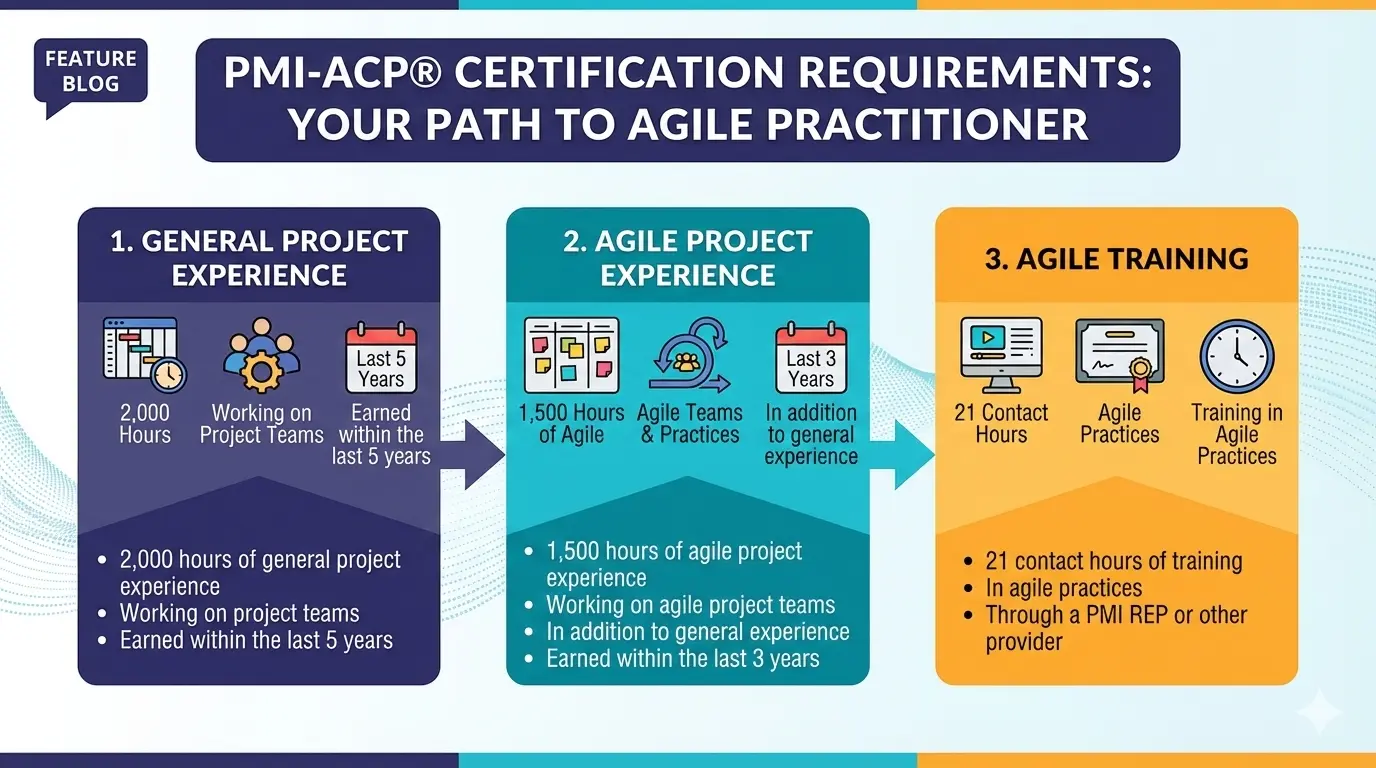
PMI-ACP eligibility rests on three separate requirements that you must satisfy simultaneously:
General Project Experience
- 2,000 hours working on project teams
- Must be within the last 5 years
- Does not need to be agile-specific
Agile Project Experience
- 1,500 hours working on agile project teams
- Must be within the last 3 years
- This is in addition to general experience
Agile Education
- 21 contact hours of training in agile practices
- Can be completed through courses, workshops, or training programs
This three-part structure differs significantly from other certifications. PMP requires project leadership experience but doesn't separate general from agile. CSM requires only a two-day course with no experience documentation. PSM has no requirements at all beyond passing the exam.
The good news: if you already hold PMP or PgMP certification, your general project experience requirement is automatically satisfied—you only need to document your agile experience and education.
General Project Experience: 2,000 Hours
The first requirement is 2,000 hours of general project experience, which works out to approximately 12 months of full-time project work. This experience must fall within the last five years at the time you submit your application.
What counts as general project experience:
- Working as a team member on any type of project
- Contributing to project deliverables in any capacity
- Participating in project planning, execution, or closure activities
- Any industry or project type qualifies
What doesn't count:
- Operational or business-as-usual work outside of projects
- Experience older than five years
- Time spent in training or education
Key point for PMP holders: If you already have your PMP or PgMP certification, PMI considers this requirement automatically satisfied. You won't need to document any general project experience—just your agile-specific hours and education.
When documenting this experience on your application, you'll need to provide project titles, your role, the organization, dates, and hours worked. Be prepared to describe your contributions if audited. Keep your descriptions factual and specific rather than inflated.
Agile Project Experience: 1,500 Hours
The second requirement—and the one that trips up most candidates—is 1,500 hours of agile project experience. This is approximately 8 months of full-time work on agile teams and must be within the last three years.
Critical distinction: These 1,500 agile hours are in addition to your 2,000 general hours, not a subset of them. PMI wants to see that you have broad project experience plus dedicated agile experience on top of that.
What counts as agile project experience:
- Working on Scrum teams in any role
- Participating in Kanban-based workflows
- Contributing to XP, Lean, or other agile methodology projects
- Hybrid projects with significant agile components
- Any role on the agile team (developer, tester, analyst, Scrum Master, Product Owner)
How to identify qualifying agile experience:
If your team used iterative delivery with regular feedback cycles, that likely qualifies. Look for these indicators in your work history:
- Sprint or iteration-based delivery
- Daily standups or regular sync meetings
- Backlogs and user stories
- Retrospectives and continuous improvement practices
- Kanban boards and WIP limits
- Incremental releases to users or stakeholders
Common questions about agile experience:
Does my Scrum Master work count? Yes—any role on an agile team qualifies, including Scrum Master, Product Owner, team member, or agile coach.
What if my team wasn't purely agile? Hybrid approaches count if there were meaningful agile practices in use. You don't need to have worked in a textbook Scrum environment.
Can I count multiple methodologies? Absolutely. PMI-ACP covers multiple agile approaches, so experience with Scrum, Kanban, XP, Lean, or others all qualifies.
Agile Education: 21 Contact Hours
The third requirement is 21 contact hours of education in agile practices. This must be formal training—self-study through books or videos doesn't count toward this requirement (though it's valuable for exam prep).
What qualifies as contact hours:
- Instructor-led courses (in-person or virtual)
- Workshops and bootcamps
- PMI-approved training programs
- University courses with agile content
- Scrum Alliance CSM courses (if you took one)
Education options by budget:
Free to low cost ($0–50)
- Limited options exist at this price point
- Some employers offer internal agile training that qualifies
- Udemy courses during sales can qualify if they're instructor-led
Mid-range ($100–300)
- LinkedIn Learning agile courses
- Online instructor-led programs
- PMI's own agile courses for members
Premium ($300–800+)
- Formal bootcamps and intensive programs
- PMI Authorized Training Partner courses
- Corporate training programs
If you already completed agile training for another purpose:
Your CSM course counts toward these 21 hours if it covered agile practices broadly. PMP education hours may partially overlap if your course included agile content. Keep certificates from any agile training you've completed—you may have more qualifying hours than you realize.
When documenting education, you'll need course titles, providers, completion dates, and the number of hours. PMI may request certificates if you're audited.
The PMI Audit Process
Approximately 5-10% of PMI-ACP applications are randomly selected for audit. If this happens to you, don't panic—it's a verification process, not an accusation.
What happens during an audit:
- PMI notifies you that your application requires verification
- You have 90 days to submit documentation
- You'll need to provide experience verification from supervisors or colleagues
- You'll need copies of education certificates
- PMI reviews your documentation and makes an eligibility decision
How to prepare proactively:
Even before you apply, gather documentation that supports your claims:
- Contact information for supervisors who can verify your project experience
- Certificates from any agile training you've completed
- Records of projects you worked on with dates and hours
Timeline impact:
An audit adds approximately 5-7 business days to your application processing once you submit documentation. The 90-day window gives you plenty of time to gather what you need.
Don't Meet the Requirements Yet?
If you're short on experience or education, you have several paths forward.
If you lack general project experience:
Focus on getting involved in project-based work at your current organization. Volunteer for project teams, take on project coordinator roles, or seek positions that involve defined project work rather than purely operational tasks.
If you lack agile project experience:
This is the more common gap. Options include:
- Transition to an agile team within your current organization
- Seek roles at companies using Scrum, Kanban, or other agile approaches
- Volunteer for agile projects or contribute to open-source projects using agile methods
- Consider contract or consulting work on agile teams
If you want an agile certification now:
CSM requires only a two-day course—no experience needed. PSM requires only passing the exam. Either can provide an agile credential while you build toward PMI-ACP eligibility.
Building toward PMI-ACP typically takes 1-2 years if you're starting without agile experience. Use that time to also study agile methodologies so you're exam-ready when you qualify.
Next Steps
Once you've confirmed you meet all three requirements, you're ready to start the application process. Gather your experience documentation and education certificates before beginning—having everything ready makes the application smoother.
For a step-by-step walkthrough of the application, see our guide on How to Apply for PMI-ACP. To understand the full investment involved, check out PMI-ACP Cost: Complete Breakdown.
Ready to start preparing? Practice with PMI-ACP questions covering all seven domains and multiple agile methodologies, or download the PM Drills app to study anywhere.