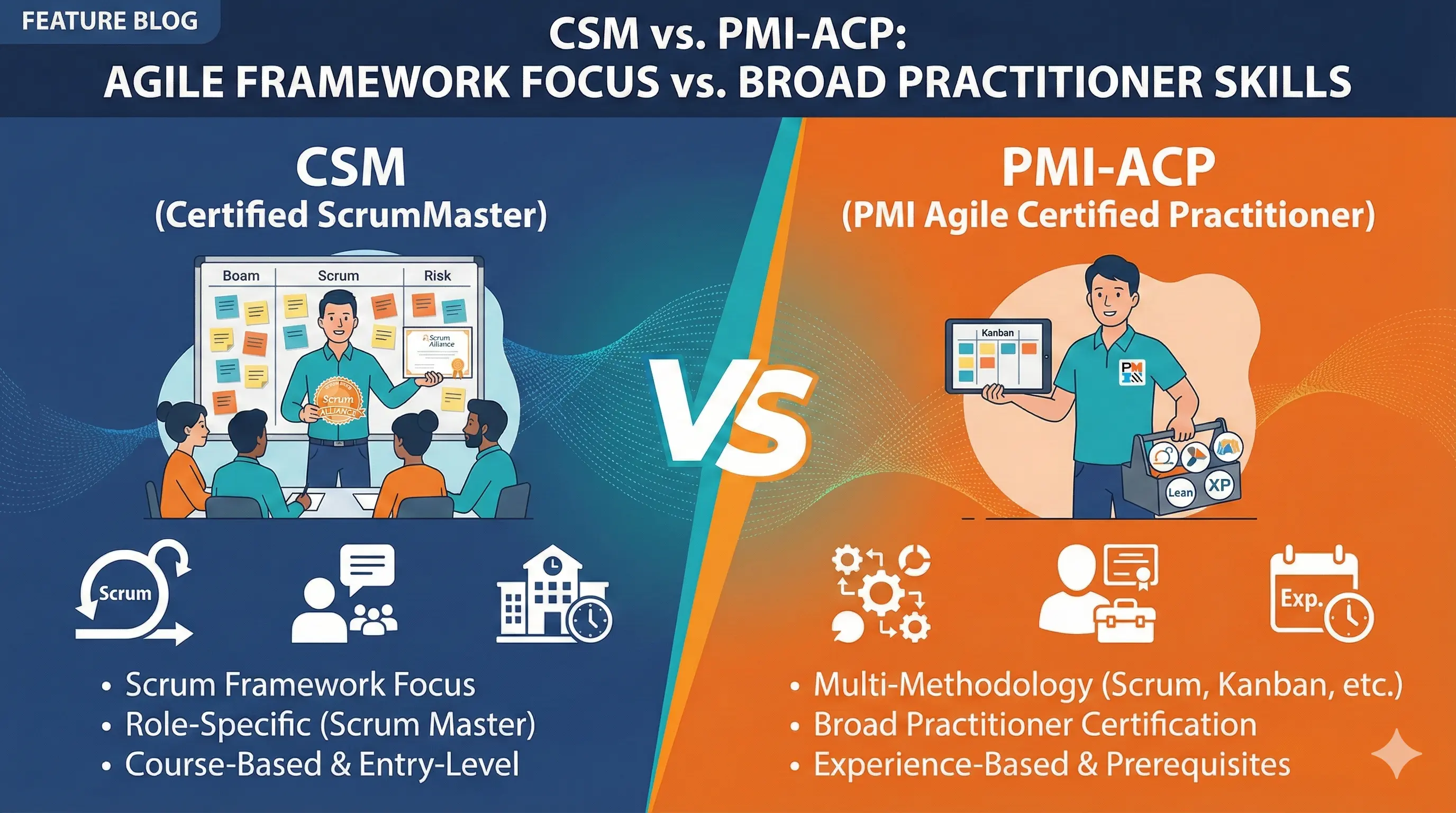
CSM and PMI-ACP both fall under the agile umbrella, but they serve different purposes. CSM focuses specifically on the Scrum framework and the Scrum Master role. PMI-ACP covers multiple agile methodologies and validates broad agile knowledge without being role-specific.
Choosing between them depends on your career direction, current experience, and how you'll apply agile in your work. This guide compares both certifications so you can make an informed decision. For a complete overview of CSM, see our CSM Certification Guide.
Quick Comparison
CSM (Scrum Alliance)
- Focus: Scrum framework specifically
- Role Orientation: Scrum Master
- Prerequisites: None
- Training Required: Yes (2-day mandatory course)
- Exam Questions: 50 multiple-choice
- Exam Time: 60 minutes
- Passing Score: 74%
- Pass Rate: ~98%
- Cost: $995-1,500 (course includes exam)
- Renewal: Every 2 years, 20 SEUs + $100
PMI-ACP (Project Management Institute)
- Focus: Multiple agile methodologies
- Role Orientation: Agile practitioner (any role)
- Prerequisites: Experience required (see below)
- Training Required: 21 hours of agile education
- Exam Questions: 180 multiple-choice
- Exam Time: 230 minutes
- Passing Score: Pass/fail (no published threshold)
- Pass Rate: ~80%
- Cost: $435-555 (exam) + training costs
- Renewal: Every 3 years, 30 PDUs + $150
What Is CSM?
Certified Scrum Master is Scrum Alliance's foundational certification for the Scrum Master role. It validates your understanding of the Scrum framework and prepares you to serve as a Scrum Master on a Scrum team.
CSM Approach
CSM takes a focused, course-based approach:
- Mandatory two-day training with a Certified Scrum Trainer
- Covers Scrum framework, events, artifacts, and roles
- Emphasizes the Scrum Master's servant leadership responsibilities
- Exam confirms you absorbed the course material
- No experience or education prerequisites
The certification is role-specific—it prepares you specifically for Scrum Master responsibilities rather than general agile practice.
What CSM Covers
CSM training and exam content includes:
- Scrum framework fundamentals
- Scrum roles (Scrum Master, Product Owner, Developers)
- Scrum events (Sprint, Planning, Daily Scrum, Review, Retrospective)
- Scrum artifacts (Product Backlog, Sprint Backlog, Increment)
- Servant leadership and facilitation
- Removing impediments and protecting the team
Everything centers on Scrum. You won't learn Kanban, XP, Lean, or other methodologies in a CSM course.
For more details, see CSM Requirements and CSM Exam Format.
What Is PMI-ACP?
PMI Agile Certified Practitioner is PMI's agile certification—the same organization behind PMP and CAPM. Unlike CSM's Scrum-only focus, PMI-ACP validates knowledge across multiple agile approaches.
PMI-ACP Approach
PMI-ACP takes a broader, experience-based approach:
- Requires documented agile project experience
- Requires 21 hours of agile education (self-study or courses)
- Covers multiple methodologies, not just Scrum
- More rigorous exam testing conceptual understanding
- Application process similar to PMP
The certification is methodology-agnostic—it validates that you understand agile principles and can apply various frameworks appropriately.
What PMI-ACP Covers
The PMI-ACP exam tests knowledge across:
- Agile principles and mindset
- Value-driven delivery
- Stakeholder engagement
- Team performance
- Adaptive planning
- Problem detection and resolution
- Continuous improvement
Within these domains, you'll encounter content on:
- Scrum
- Kanban
- Lean
- Extreme Programming (XP)
- Crystal
- Feature-Driven Development (FDD)
- Dynamic Systems Development Method (DSDM)
PMI-ACP expects you to understand when and how to apply different approaches—not just one framework.
Key Differences
These certifications differ significantly in scope, requirements, and career application.
Scope and Focus
CSMCSM goes deep on one framework. You'll thoroughly understand Scrum—its events, artifacts, roles, and underlying principles. The trade-off is narrow scope; CSM doesn't prepare you for non-Scrum agile environments.
PMI-ACPPMI-ACP goes broad across methodologies. You'll understand multiple frameworks and when each applies. The trade-off is less depth in any single approach; you're a generalist rather than a Scrum specialist.
Prerequisites and Experience
CSM Prerequisites
- None required
- No project experience needed
- No education requirements
- Truly entry-level
PMI-ACP Prerequisites
- 2,000 hours of general project experience (within last 5 years)
- 1,500 hours of agile project experience (within last 3 years)
- 21 hours of agile education
- Secondary degree or higher
PMI-ACP's experience requirements make it inaccessible to newcomers. You need roughly 8-12 months of agile project work before you qualify. CSM has no such barrier—you can earn it with zero professional experience.
Exam Difficulty
CSM Exam
- 50 questions in 60 minutes
- 74% passing score
- ~98% pass rate
- Based directly on course material
- Straightforward, not designed to trick you
PMI-ACP Exam
- 180 questions in 230 minutes
- Pass/fail scoring (threshold not published)
- ~80% pass rate
- Covers broad agile knowledge
- Scenario-based, requires deeper analysis
PMI-ACP is substantially harder. The combination of more questions, broader content, and rigorous scenarios makes it a more challenging certification to earn.
Cost Comparison
CSM Costs
- Course + exam: $995-1,500
- Renewal (every 2 years): $100 + 20 SEUs
- 10-year total: ~$1,500-2,000
PMI-ACP Costs
- Exam fee: $435 (PMI member) or $555 (non-member)
- Training (21 hours): $200-1,000+
- PMI membership (optional): $139/year
- Renewal (every 3 years): $150 + 30 PDUs
- 10-year total: ~$1,500-2,500
Initial costs are similar, though PMI-ACP can be cheaper if you find affordable training. Long-term costs depend on how you earn continuing education credits.
Time to Certification
CSM Timeline
- Can complete in one week
- Register for course → attend 2 days → pass exam
- No application or waiting period
PMI-ACP Timeline
- Typically 2-6 months
- Must already have qualifying experience
- Complete 21 hours of training
- Submit application and wait for approval
- Schedule and pass exam
If you need a certification quickly and lack agile experience, CSM is your only option. PMI-ACP requires both experience and a longer process.
Renewal Requirements
CSM Renewal
- Every 2 years
- 20 SEUs required
- $100 fee
- Many free SEU options available
PMI-ACP Renewal
- Every 3 years
- 30 PDUs required
- $150 fee
- PDUs have category requirements
Both require ongoing education, but PMI-ACP's three-year cycle and PMI's PDU system may integrate better if you also hold PMP or CAPM.
Career Implications
Your career direction should heavily influence this choice.
When CSM Makes Sense
You want to be a Scrum Master. CSM is the most recognized credential specifically for this role. Job postings for Scrum Master positions frequently require or prefer CSM.
You work on Scrum teams. If your organization uses Scrum and you want to facilitate that process, CSM provides directly applicable training.
You're new to agile. With no prerequisites, CSM offers an entry point into agile roles without existing experience.
You want quick certification. Complete a course over a weekend and you can be certified within days.
When PMI-ACP Makes Sense
You work with multiple agile approaches. If your organization uses Kanban for operations, Scrum for development, and Lean principles throughout, PMI-ACP validates your breadth.
You're an agile project manager. PMI-ACP suits people managing agile projects without being dedicated Scrum Masters—roles that require methodology flexibility.
You have PMI certifications. If you hold PMP or CAPM, PMI-ACP complements your credentials within the same ecosystem. PDUs can count toward multiple certifications.
Your employer values PMI credentials. Some organizations standardize on PMI certifications. If that's your environment, PMI-ACP aligns better politically.
You have the required experience. PMI-ACP's prerequisites mean you can only pursue it once you've accumulated agile project hours. If you qualify, it signals meaningful experience.
Can You Get Both?
Yes, and it sometimes makes sense. The certifications complement rather than duplicate each other:
- CSM shows deep Scrum expertise and Scrum Master capability
- PMI-ACP shows broad agile knowledge across methodologies
Holding both signals versatility—you can serve as a dedicated Scrum Master while understanding how Scrum fits within a larger agile landscape.
However, unless your career specifically benefits from both perspectives, the time and cost may be better spent advancing to higher-level certifications (A-CSM, PMP) rather than collecting entry-level credentials.
Common Questions
Is CSM easier than PMI-ACP?Yes, significantly. CSM has a 98% pass rate versus PMI-ACP's ~80%. CSM's exam is shorter, has fewer questions, and tests course material directly.
Can I get PMI-ACP without agile experience?No. PMI-ACP requires 1,500 hours of agile project experience. You cannot substitute training or education for this requirement.
Which is more recognized?It depends on context. CSM is more recognized for Scrum Master roles specifically. PMI-ACP is well-recognized in organizations that value PMI credentials or use multiple agile approaches.
Should I get CSM first, then PMI-ACP?CSM can help you gain the agile experience needed for PMI-ACP. Earning CSM, working as a Scrum Master, then pursuing PMI-ACP is a reasonable progression.
Does PMI-ACP teach Scrum Master skills?PMI-ACP covers Scrum concepts but doesn't focus on the Scrum Master role specifically. CSM provides deeper training in facilitation, servant leadership, and Scrum Master responsibilities.
Making Your Decision
Ask yourself these questions:
Do I want to be a Scrum Master specifically?If yes, start with CSM. It's designed for that role.
Do I have 1,500+ hours of agile experience?If no, PMI-ACP isn't an option yet. CSM has no such barrier.
Does my organization use only Scrum or multiple methodologies?Scrum-only environments favor CSM. Multi-methodology environments may value PMI-ACP's breadth.
Do I already hold PMI certifications?If yes, PMI-ACP fits naturally into your credential portfolio.
How quickly do I need certification?CSM can be done in a week. PMI-ACP takes months including the application process.
Next Steps
If CSM fits your goals, start by understanding CSM Requirements and exploring CSM Training Courses.
For another certification comparison, see CSM vs PSM to understand your options within Scrum-specific credentials.
Ready to start preparing? Practice with agile questions on PM Drills to build your foundation regardless of which certification you pursue.