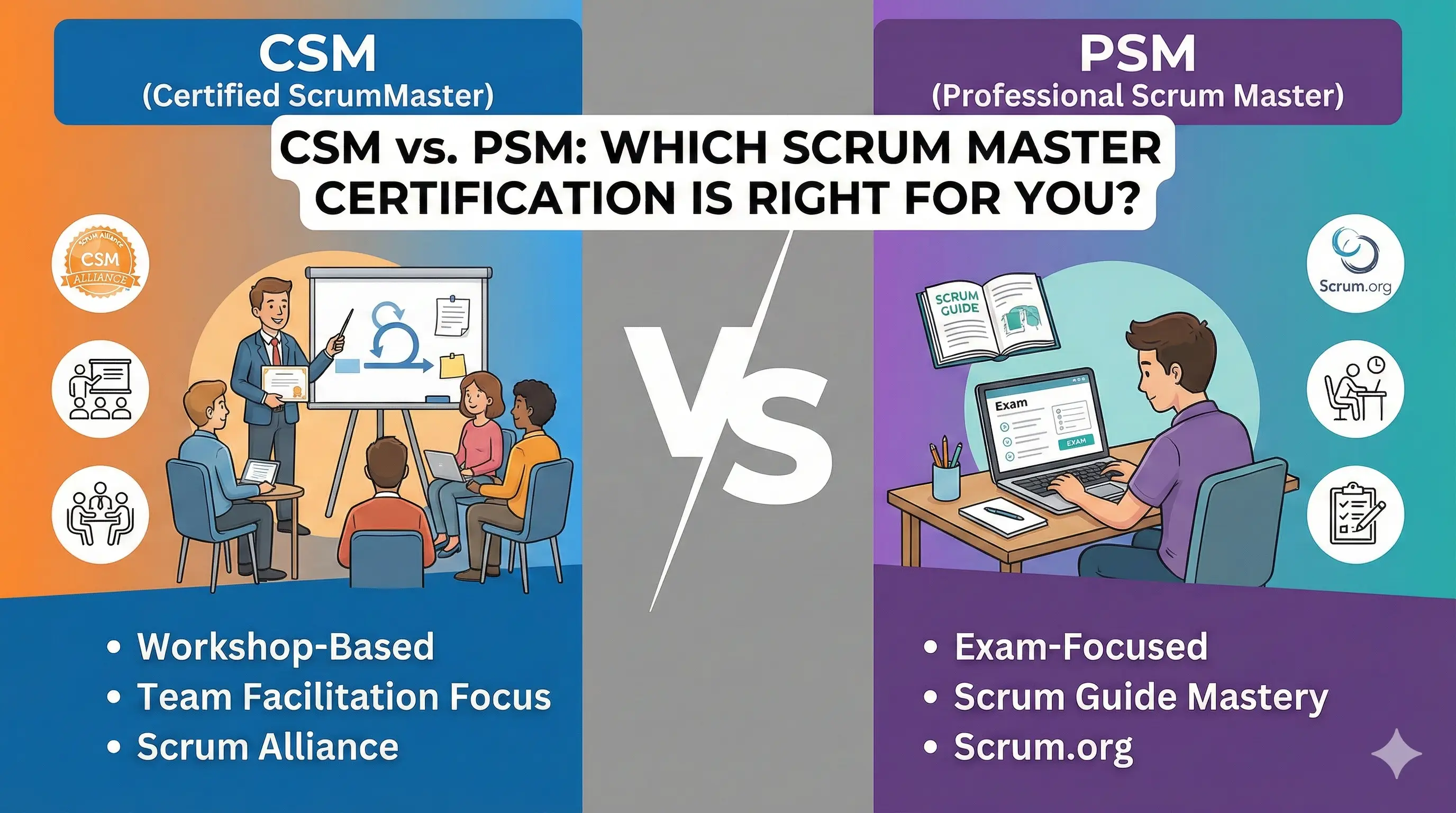
Two certifications dominate the Scrum Master landscape: Certified Scrum Master (CSM) from Scrum Alliance and Professional Scrum Master (PSM) from Scrum.org. Both validate Scrum knowledge, both are widely recognized, and both can launch or advance your career.
But they take fundamentally different approaches to certification. CSM requires a course before you can attempt the exam. PSM lets you take the exam anytime with no prerequisites. This guide breaks down every difference to help you choose the right path. For a complete overview of CSM, see our CSM Certification Guide.
Quick Comparison
CSM (Scrum Alliance)
- Issuing Body: Scrum Alliance
- Course Required: Yes (2 days mandatory)
- Exam Questions: 50 multiple-choice
- Time Limit: 60 minutes
- Passing Score: 74% (37/50)
- Pass Rate: ~98%
- Cost: $995-1,500 (course includes exam)
- Renewal: Every 2 years, 20 SEUs + $100
- Certification Levels: CSM → A-CSM → CSP-SM
PSM I (Scrum.org)
- Issuing Body: Scrum.org
- Course Required: No (optional)
- Exam Questions: 80 multiple-choice
- Time Limit: 60 minutes
- Passing Score: 85% (68/80)
- Pass Rate: ~85%
- Cost: $200 (exam only) or $1,000-1,500 (with optional course)
- Renewal: Never expires
- Certification Levels: PSM I → PSM II → PSM III
What Is CSM?
Certified Scrum Master is the original Scrum Master certification, created by Scrum Alliance in 2002. It's the most widely held Scrum certification globally.
How CSM Works
CSM requires completing a two-day course taught by a Certified Scrum Trainer before you can access the exam. This mandatory training ensures every CSM holder has received hands-on instruction in Scrum principles and practices.
The course covers the Scrum framework, Scrum Master responsibilities, facilitation techniques, and practical application through exercises and simulations. After completing training, you receive access to the online exam.
The CSM Exam
The CSM exam has 50 multiple-choice questions with a 60-minute time limit. You need 37 correct answers (74%) to pass. Two attempts are included with your course fee.
With a pass rate around 98%, the exam is designed to confirm you learned the material—not to eliminate candidates. If you paid attention during your course, you'll pass.
CSM Renewal
CSM certifications expire after two years. To maintain your credential, you must earn 20 Scrum Education Units (SEUs) and pay a $100 renewal fee. Many SEUs can be earned through free activities like reading, webinars, and community participation.
For details on maintaining certification, see CSM Renewal & SEUs.
What Is PSM?
Professional Scrum Master is Scrum.org's certification, created by Ken Schwaber—one of Scrum's co-creators—after he left Scrum Alliance in 2009. PSM takes an assessment-focused approach rather than requiring training.
How PSM Works
PSM has no prerequisites. You can take the exam anytime by purchasing an attempt from Scrum.org. No course, experience, or application is required.
Scrum.org offers optional training courses taught by Professional Scrum Trainers, but they're not mandatory. Many people self-study using the Scrum Guide and other resources, then take the exam when ready.
The PSM I Exam
PSM I (the entry-level certification) has 80 multiple-choice questions with a 60-minute time limit. You need 68 correct answers (85%) to pass—a significantly higher bar than CSM's 74%.
The pass rate is approximately 85%, meaning roughly one in six test-takers fails. Questions are more rigorous and require deeper understanding of Scrum principles, not just memorization.
PSM Levels
Unlike CSM's separate certifications (CSM, A-CSM, CSP-SM), PSM has three levels within one certification track:
PSM I — Foundational Scrum knowledge. Entry-level certification.
PSM II — Advanced understanding of Scrum Master role. Requires PSM I first.
PSM III — Expert-level mastery. Distinguished credential for experienced practitioners.
PSM Renewal
PSM certifications never expire. Once you pass, you're certified for life with no renewal fees or continuing education requirements.
Key Differences
Understanding these distinctions helps you choose the right certification for your situation.
Certification Philosophy
CSM PhilosophyScrum Alliance believes structured training is essential. The mandatory course ensures consistent foundational knowledge and practical skills development. Everyone who earns CSM has had hands-on instruction from an approved trainer.
PSM PhilosophyScrum.org believes the exam itself validates knowledge. If you can pass a rigorous assessment, it doesn't matter how you learned. This approach respects self-directed learners and keeps costs low for those who don't need formal training.
Neither philosophy is wrong—they reflect different views on how professionals best develop skills.
Course Requirements
CSM
- Mandatory 2-day course
- Must be taught by Certified Scrum Trainer
- Interactive format with exercises
- Cannot take exam without completing course
PSM
- No course required
- Optional training available
- Can self-study entirely
- Exam available anytime
If you learn well independently, PSM's flexibility is appealing. If you prefer structured instruction, CSM's mandatory course ensures quality training.
Exam Difficulty
This is where the certifications diverge most significantly.
CSM Exam
- 50 questions in 60 minutes
- 74% to pass
- ~98% pass rate
- Straightforward questions based on course material
- Designed to be achievable after training
PSM I Exam
- 80 questions in 60 minutes
- 85% to pass
- ~85% pass rate
- More rigorous, scenario-based questions
- Designed to validate deep understanding
PSM I is objectively harder. The combination of more questions, less time per question, and a higher passing threshold creates a more challenging assessment. You need genuine Scrum understanding, not just course attendance.
Cost Comparison
CSM Total Cost
- Course fee: $995-1,500
- Exam: Included
- Initial total: $995-1,500
- Renewal (every 2 years): $100 + 20 SEUs
PSM I Exam-Only Path
- Study materials: $0-100 (Scrum Guide is free)
- Exam: $200
- Initial total: $200-300
- Renewal: $0 (never expires)
PSM I With Optional Course
- Course: $1,000-1,500
- Exam: Included with most courses
- Initial total: $1,000-1,500
- Renewal: $0 (never expires)
If budget is your primary concern, PSM's exam-only path costs 80-85% less than CSM. However, if you take an optional PSM course, the initial costs are similar—with PSM still winning on lifetime cost due to no renewal fees.
Renewal Requirements
CSM
- Expires every 2 years
- Requires 20 SEUs per cycle
- $100 renewal fee
- Must actively maintain certification
PSM
- Never expires
- No continuing education required
- No renewal fees
- One-time certification
PSM's lifetime validity is attractive if you dislike tracking continuing education. CSM's renewal requirement keeps practitioners engaged with ongoing learning—which can be viewed as either a benefit or a burden.
Industry Recognition
Both certifications are well-recognized, but with some nuances:
CSM Recognition
- More common in job postings historically
- Longer track record (since 2002)
- Larger community of certified practitioners
- Often specifically required by employers
PSM Recognition
- Growing recognition, especially in tech
- Associated with Scrum co-creator Ken Schwaber
- Perceived as more rigorous by some employers
- Popular in organizations that value self-directed learning
In most job markets, either certification satisfies Scrum Master requirements. Some job postings specify one or the other, but many list "CSM, PSM, or equivalent."
Which Should You Choose?
Your situation determines the best choice.
Choose CSM If:
You prefer structured learning. The mandatory course ensures you receive quality instruction rather than potentially missing concepts through self-study.
Your employer specifically requires CSM. Some organizations have standardized on Scrum Alliance certifications. Check what your company recognizes.
You value the course experience. CSM courses include networking, hands-on exercises, and access to an experienced trainer for questions.
You're new to Scrum. The guided learning path reduces the risk of misunderstanding fundamental concepts.
You want to join the Scrum Alliance community. CSM includes membership with access to resources, events, and a large professional network.
Choose PSM If:
You're a self-motivated learner. If you can study independently and don't need structured training, PSM lets you prove your knowledge directly.
Budget is a primary concern. At $200 for the exam only, PSM costs a fraction of CSM.
You want no renewal burden. PSM's lifetime validity means no ongoing fees or continuing education tracking.
You already know Scrum well. If you've been practicing Scrum and just need the credential, PSM lets you certify without sitting through basics you already know.
You want a harder certification. Some practitioners prefer PSM specifically because it's more rigorous—the credential signals deeper expertise.
When Either Works
For most career situations, both certifications serve the same purpose. If you have no strong preference on learning style, budget isn't constrained, and your employer accepts either, the decision may come down to minor factors like course scheduling or which community appeals more.
Can You Get Both?
Technically yes, but it's rarely necessary. Both certifications validate Scrum Master knowledge—having both doesn't significantly enhance your credentials.
The exception: if you're building a training or consulting career, holding multiple certifications demonstrates breadth. Otherwise, invest the time and money in advancing to higher levels (A-CSM, PSM II) rather than duplicating entry-level credentials.
Common Questions
Is CSM easier than PSM?Yes. CSM has a higher pass rate (~98% vs ~85%), lower passing threshold (74% vs 85%), and fewer questions in the same time. The mandatory course also prepares you specifically for the exam content.
Is PSM more respected than CSM?Opinions vary. Some view PSM's harder exam as indicating deeper knowledge. Others value CSM's training requirement as ensuring practical skills. In most hiring situations, they're treated equivalently.
Can I take PSM without any training?Yes. Many people pass PSM I through self-study using the Scrum Guide and free online resources. However, the failure rate is higher for self-study candidates.
If I have CSM, should I also get PSM?Usually not. Spend that energy on advanced certifications (A-CSM, PSM II) or complementary credentials (PMI-ACP, SAFe) instead.
Which is better for job hunting?Check job postings in your target market. If most specify CSM, get CSM. If they say "CSM or PSM," either works. In tech hubs, PSM recognition is growing.
Next Steps
Both certifications can launch your Scrum Master career. CSM offers guided learning with ongoing community engagement. PSM offers flexibility and lifetime validity.
If you're leaning toward CSM, learn about CSM Requirements and CSM Training Courses to start your journey.
Considering how CSM compares to other certifications? See CSM vs PMI-ACP for another comparison.
Ready to prepare? Practice Scrum Master questions on PM Drills to test your knowledge regardless of which certification you pursue.