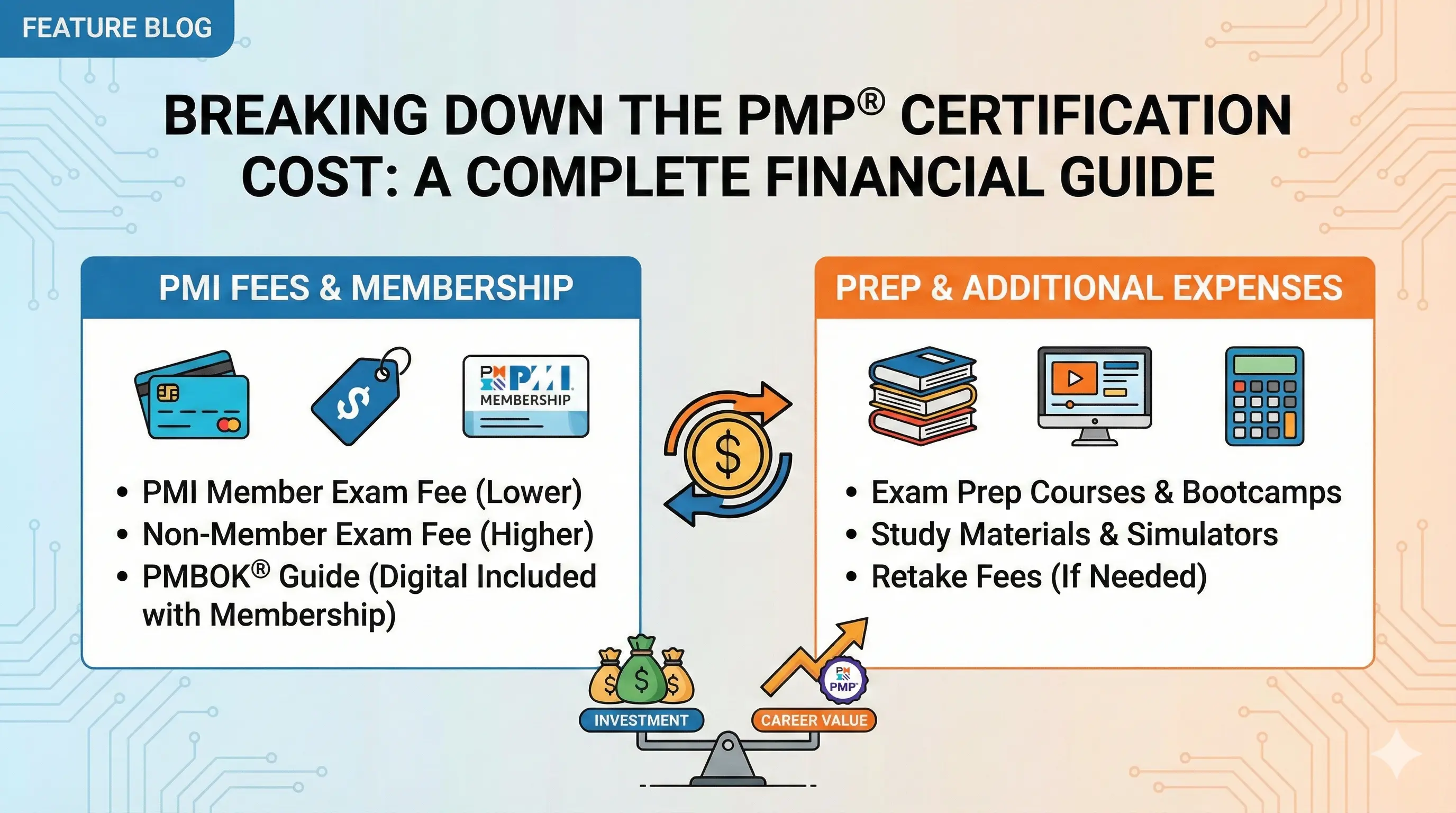
The PMP certification is an investment—in exam fees, study materials, education requirements, and your time. Understanding the full cost picture helps you budget appropriately and make smart decisions that can save you hundreds of dollars.
This guide breaks down every expense you'll encounter, from exam fees to study resources, with practical advice on optimizing your investment. For a complete overview of the certification, see our PMP Certification Guide.
PMP Exam Fees
The exam fee is your largest single expense, and it varies significantly based on PMI membership status.
PMI member exam fee: $405
Non-member exam fee: $555
The difference: $150
That $150 gap makes PMI membership a no-brainer for most candidates. We'll cover why in the next section.
Retake fees:
If you don't pass on your first attempt, retake fees are identical to your original exam fee:
- PMI members: $405 per retake
- Non-members: $555 per retake
You can retake the exam up to three times within your one-year eligibility period. After three attempts, you must wait one year before reapplying.
Payment details:
PMI accepts major credit cards. Payment is due when you submit your application. If you're selected for audit, your payment is held until you pass the audit process. If you fail the audit or withdraw, you receive a refund.
Exam fee validity:
Once approved, you have one year to schedule and pass your exam. If you don't pass within that window, you'll need to reapply and pay again.
PMI Membership: Definitely Worth It
Joining PMI before applying for the PMP exam is one of the easiest decisions you'll make. The math works out immediately.
PMI membership cost:
- Annual dues: $139
- One-time application fee (first year only): $10
- Total first year: $149
The instant ROI:
You save $150 on the exam fee by being a member. That means membership pays for itself before you even consider other benefits. You're essentially getting PMI membership free—plus $1 in savings.
Additional member benefits:
Free digital resources:
- PMBOK Guide 7th Edition (normally ~$100)
- Agile Practice Guide (normally ~$50)
- Full PMI standards library
- PM Network magazine and other publications
Discounts:
- Reduced rates on PMI courses and events
- Discounts on additional certifications
- Partner discounts on training programs
Career resources:
- Access to PMI job board
- Networking through local chapters
- Professional development webinars
The recommendation:
Join PMI before you start your application. You'll save money on the exam, get free access to essential study materials, and benefit from member resources throughout your preparation.
Renewal considerations:
PMI membership renews annually at $139. Whether to renew after passing depends on your situation. If you're pursuing additional PMI certifications or want ongoing access to resources, it's worth continuing. If not, you can let it lapse—your PMP certification remains valid regardless of membership status.
Education Costs: The 35-Hour Requirement
You must complete 35 contact hours of project management education before applying. This is where costs vary most dramatically based on your choices.
Free and very low-cost options:
Truly free options for the full 35 hours are limited, but they exist:
- Some employers offer internal PM training that qualifies
- Occasional free courses from PMI chapters or educational promotions
- Limited free content on platforms like Coursera (audit mode)
Realistically, most candidates spend at least something on education.
Budget options ($15-150):
Udemy courses: Frequently on sale for $15-30. Look for courses specifically designed to meet PMI's 35-hour requirement with certificates of completion. Quality varies—check reviews and ensure the course covers both predictive and agile content.
LinkedIn Learning: Subscription-based (~$30/month). Offers PMP prep courses that qualify for contact hours. Good option if you can complete within a month or two, or if your employer provides access.
Other online platforms: Coursera, edX, and similar platforms offer PM courses ranging from free (audit) to $50-100 for certificates.
Mid-range options ($300-700):
Online bootcamps and prep courses: Companies like Simplilearn, PMI itself, and various training providers offer structured programs in this range. These typically include:
- 35 hours of instruction
- Practice questions and mock exams
- Study guides and materials
- Instructor support
This range often provides the best value—structured enough to guide your learning, affordable enough not to strain your budget.
Premium options ($1,000-3,000+):
In-person bootcamps: Intensive multi-day programs, often 4-5 days. High engagement and structured learning, but expensive and requires time off work.
University certificate programs: Some universities offer PM certificate programs that satisfy the 35-hour requirement. Prestigious but costly.
Corporate training programs: If your employer sponsors training, they may select premium providers. Great if someone else is paying.
What level do you actually need?
For most self-motivated candidates, a quality mid-range course ($300-500) provides everything necessary. Premium options offer more hand-holding but don't guarantee better results.
The 35 hours fulfill an eligibility requirement—they're the starting point of your preparation, not the entirety of it. You'll spend far more time on self-study and practice questions regardless of which education option you choose.
Employer reimbursement:
Check if your employer offers professional development budgets or tuition reimbursement. Many companies cover certification costs, especially for credentials as recognized as the PMP. Some require you to pass before reimbursing; others pay upfront.
Study Material Costs
Beyond your 35-hour course, you'll need additional resources for effective preparation.
Free with PMI membership:
- PMBOK Guide 7th Edition — Essential reference
- Agile Practice Guide — Critical for current exam content
- PMI standards library — Supplementary reference materials
This is another reason membership pays off. These materials alone would cost $150+ if purchased separately.
Prep books ($30-60):
Popular options include:
- Rita Mulcahy's PMP Exam Prep
- Andrew Ramdayal's PMP Exam Prep Simplified
- Head First PMP
You don't need all of them. One quality prep book that matches your learning style is sufficient. Many candidates find video instruction plus PMBOK plus practice questions enough, skipping dedicated prep books entirely.
Practice question banks ($30-100):
This is where you should not cut corners. Quality practice questions with detailed explanations are the most valuable study resource beyond your core materials.
Options range from:
- Budget apps and question banks: $30-50
- Premium platforms with adaptive learning: $70-100
- Included with some prep courses
Look for question banks that:
- Cover all three domains proportionally
- Include various question formats (not just multiple choice)
- Provide thorough explanations for every answer
- Track your performance over time
Mock exams:
Full-length practice exams are often included with prep courses or question bank subscriptions. If not, expect to pay $20-50 for quality mock exams. You'll want access to at least 3-4 full simulations.
PM Drills:
A premium subscription to PM Drills gives you access to realistic PMP practice questions across all domains, with detailed explanations and progress tracking.
Total Investment Breakdown
Let's put it all together for three different budget scenarios.
Budget Path (~$700-900)
- PMI membership (first year): $149
- PMP exam fee (member rate): $405
- 35-hour course (Udemy/budget): $30-100
- Practice questions (budget): $30-50
- Prep book (optional): $0-40
Typical Path (~$1,000-1,400)
- PMI membership (first year): $149
- PMP exam fee (member rate): $405
- 35-hour course (mid-range): $300-500
- Practice questions (quality): $70-100
- Prep book: $40-50
Premium Path (~$2,000-3,500+)
- PMI membership (first year): $149
- PMP exam fee (member rate): $405
- 35-hour course (bootcamp/premium): $1,000-2,500
- Practice questions (premium): $100
- Additional resources: $100-200
Hidden costs to consider:
Time investment: 150-200+ hours of study time over 2-4 months. If you value your time at any rate, this is a significant investment beyond dollars.
Retake fees: Budget mentally for the possibility. Passing on your first attempt saves $405.
Opportunity cost: Time spent studying is time not spent on other activities. Not a dollar figure, but real nonetheless.
Is the PMP Worth the Cost?
The short answer: almost certainly yes, if you're committed to a project management career.
Salary impact:
PMI's own salary surveys consistently show PMP holders earning 20-25% more than non-certified peers. In the United States, that premium translates to $10,000-20,000+ annually for many roles.
Even at the conservative end, a $10,000 annual increase means your entire PMP investment pays back within the first two months of higher salary.
Break-even analysis:
$1,000 investment with $10,000 annual salary increase: Break-even in ~5 weeks
$1,000 investment with $15,000 annual salary increase: Break-even in ~3.5 weeks
$1,500 investment with $10,000 annual salary increase: Break-even in ~8 weeks
$1,500 investment with $20,000 annual salary increase: Break-even in ~4 weeks
The ROI is compelling even under conservative assumptions.
Career impact beyond salary:
- Access to roles that require or strongly prefer PMP
- Credibility with stakeholders and leadership
- Competitive advantage in job searches
- Foundation for additional PMI certifications
- Global recognition that travels with you
Comparison to alternatives:
An MBA costs $50,000-150,000+ and takes 1-2 years. The PMP delivers significant career value for 1-2% of that investment in 2-4 months of part-time study.
Employer sponsorship tips:
Many employers will cover PMP costs if you ask. When making the case:
- Emphasize the credential's industry recognition
- Connect certification to specific job responsibilities
- Highlight how it benefits the organization, not just you
- Offer to share knowledge with colleagues afterward
- Propose a retention agreement if they're concerned about investment
Making the Most of Your Investment
A few final tips to optimize your PMP spending:
Join PMI first. Always. The exam fee savings alone justify membership.
Don't overbuy resources. One good prep course, one quality question bank, and the free PMI materials are sufficient. Buying five different prep books doesn't make you five times more prepared.
Use employer benefits. Professional development budgets, tuition reimbursement, and training allowances exist to be used. Ask before paying out of pocket.
Pass the first time. The best way to minimize cost is avoiding retake fees. Invest adequately in preparation rather than rushing to the exam unprepared.
Consider timing. PMI occasionally runs promotions. Membership drives sometimes include discounts. If you're flexible on timing, watch for opportunities.
For details on what you need before applying, see our PMP Requirements guide. When you're ready to submit your application, follow our step-by-step How to Apply for PMP guide.
Ready to start preparing without breaking the bank? Practice PMP questions on PM Drills and build exam confidence.