PMP Requirements: Everything You Need to Qualify in 2026
The PMP certification has strict eligibility requirements—and for good reason. PMI designed this credential for experienced project managers who can demonstrate they've actually led and directed projects, not just participated in them.
This guide breaks down every requirement in detail, including both eligibility pathways, how to document your experience effectively, and what happens if you're selected for an audit. For a complete overview of the certification, see our PMP Certification Guide.
PMP Eligibility Overview
Unlike entry-level certifications, the PMP requires a combination of education, hands-on project leadership experience, and formal project management training. PMI offers two pathways based on your educational background, but both require substantial real-world experience.
The three core requirements are:
- A secondary degree (high school diploma, associate's degree, or global equivalent) OR a four-year degree (bachelor's or global equivalent)
- Project management experience leading and directing projects
- 35 contact hours of project management education
The experience requirement is where most candidates spend the most time—both accumulating the hours and documenting them properly for the application.
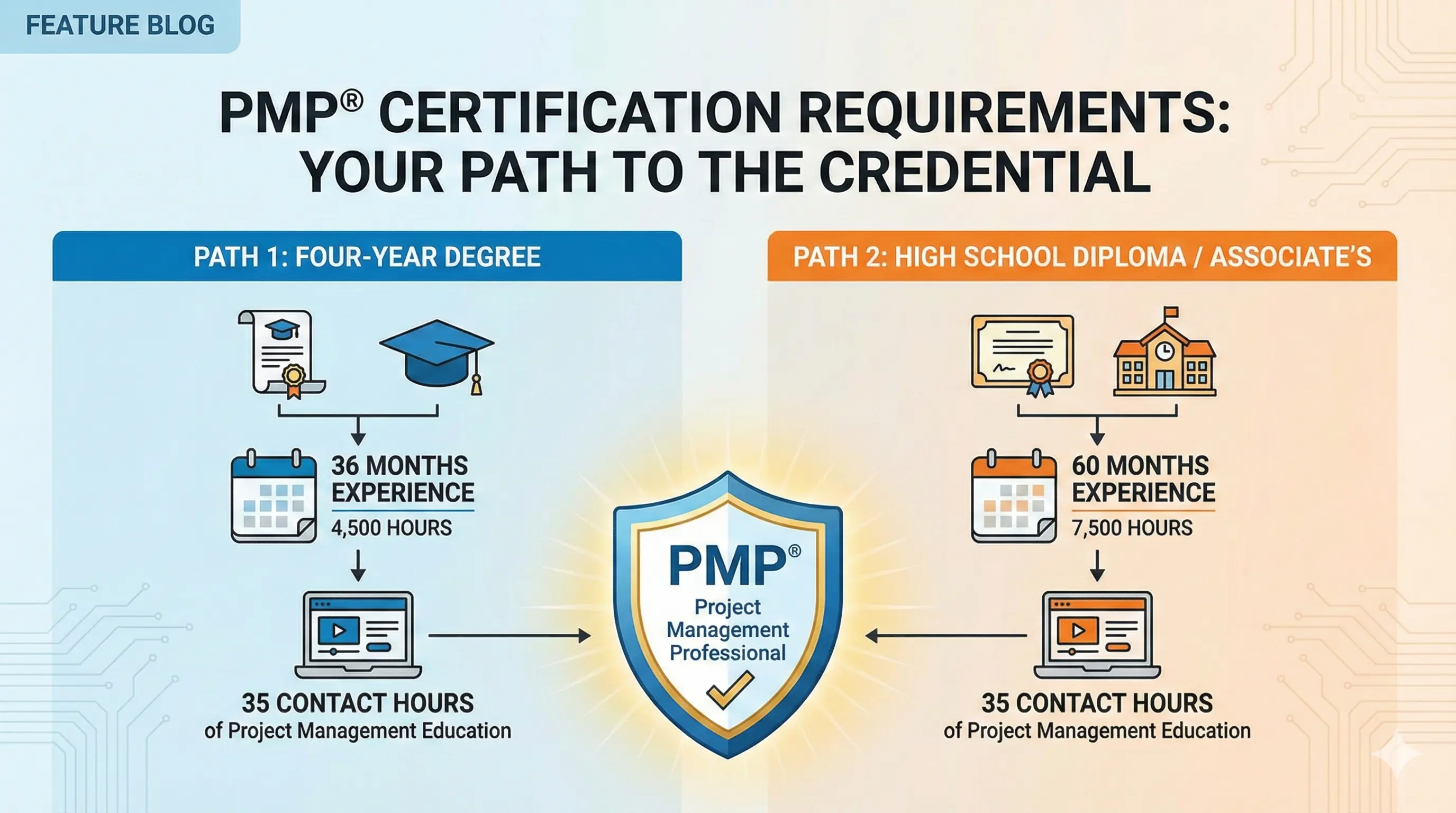
Path 1: Bachelor's Degree Route
If you have a four-year degree from an accredited institution, you'll follow the more streamlined pathway.
Requirements:
- Four-year degree (bachelor's or global equivalent)
- 36 months leading and directing projects
- 35 contact hours of project management education
The 36 months of experience doesn't need to be consecutive. You can combine multiple projects across different roles and employers, as long as you were leading and directing the work—not just contributing as a team member.
What counts as "leading and directing"?
PMI is specific about this. You need to demonstrate that you were responsible for:
- Making decisions about the project's direction
- Managing project deliverables and outcomes
- Leading the project team (even if informally)
- Communicating with stakeholders
- Controlling project elements like scope, schedule, cost, or quality
You don't need "Project Manager" in your title. Many candidates qualify through roles like team lead, technical lead, operations manager, consultant, or coordinator—as long as they were genuinely directing project work.
Calculating your months:
PMI counts months, not hours. If you worked on a project part-time (at least 8 hours per week), that time counts toward your total. However, overlapping projects don't double-count. If you led two projects simultaneously for 12 months, that's still 12 months of experience—not 24.
Path 2: High School or Associate's Degree Route
If you don't have a four-year degree, you can still qualify—you'll just need more experience.
Requirements:
- Secondary degree (high school diploma, associate's degree, or global equivalent)
- 60 months leading and directing projects
- 35 contact hours of project management education
The definition of "leading and directing" is identical to Path 1. The only difference is the experience threshold: 60 months instead of 36.
This pathway recognizes that extensive hands-on experience can substitute for formal education. Many successful project managers built their careers through work experience rather than traditional degree programs, and PMI accommodates that path.
Important note on international credentials:
If your education was completed outside the United States, PMI accepts global equivalents. You may need to have your credentials evaluated by a recognized agency if there's any question about equivalency. This is especially relevant during an audit.
The 35-Hour Education Requirement
Both pathways require 35 contact hours of project management education. This is non-negotiable and must be completed before you submit your application.
What qualifies as PM education:
- Formal courses from PMI Registered Education Providers (REPs)
- University or college courses in project management
- Corporate training programs covering PM topics
- Online courses and bootcamps
- Workshops and seminars
The education must cover project management topics specifically—general business or leadership courses don't count unless they're explicitly focused on project management methodologies, tools, and techniques.
PMI-approved options:
Courses from PMI Registered Education Providers (REPs) are the safest choice. These providers have been vetted by PMI, and their courses are guaranteed to meet the requirements. You can search for REPs on PMI's website.
Budget-friendly options:
- Online platforms like Udemy, LinkedIn Learning, and Coursera offer PMP prep courses that qualify for contact hours, often for under $100
- Some employers offer internal PM training that counts
- PMI chapters occasionally offer educational events
Premium options:
- In-person bootcamps ($1,000–$3,000+)
- University certificate programs
- Intensive prep courses with live instruction
How to document your hours:
Keep certificates of completion for every course. Your documentation should include:
- Course title
- Provider name
- Completion date
- Number of contact hours
- Topics covered
You'll enter these details in your PMI application, and you'll need to produce certificates if you're audited.
Documenting Your Project Experience
The experience section is the most time-consuming part of the PMP application. You'll need to describe individual projects with enough detail to demonstrate that you were genuinely leading and directing the work.
What PMI asks for:
For each project, you'll provide:
- Project title
- Organization
- Your role/title
- Start and end dates
- Hours spent on the project
- A description of your responsibilities mapped to process groups
The five process groups:
PMI wants to see that your experience spans the project lifecycle. For each project, you'll indicate hours spent in:
- Initiating: Defining the project, identifying stakeholders, securing authorization
- Planning: Developing the project plan, defining scope, creating schedules and budgets
- Executing: Directing work, managing the team, implementing the plan
- Monitoring and Controlling: Tracking progress, managing changes, controlling quality
- Closing: Finalizing deliverables, closing contracts, documenting lessons learned
You don't need equal hours in each area, but your total experience should demonstrate breadth across the lifecycle.
Writing effective project descriptions:
Your descriptions should be specific and action-oriented. Avoid vague statements like "managed the project" or "worked with the team."
Instead, write statements like:
- "Led a cross-functional team of 8 to implement a new CRM system, managing a $250K budget and 6-month timeline"
- "Directed requirements gathering sessions with stakeholders, developed the project charter, and secured executive sponsorship"
- "Controlled project scope through a formal change management process, evaluating 15+ change requests"
Use PMI terminology where natural. Words like "stakeholder," "deliverables," "scope," "risk," and "lessons learned" signal that you understand the discipline.
Common mistakes to avoid:
- Describing what the project was rather than what you did
- Using passive language ("the project was completed" vs. "I led the team to complete")
- Claiming hours you can't verify if audited
- Listing projects where you were a contributor, not a leader
The PMI Audit Process
A percentage of applications are randomly selected for audit—estimates suggest around 10-15%. Selection is random and doesn't indicate PMI suspects any problems with your application.
What happens if you're audited:
PMI will notify you after you submit payment. You'll have 90 days to provide supporting documentation:
- Education verification: Copies of transcripts or diplomas
- PM education verification: Certificates of completion for your 35 hours
- Experience verification: Contact information and signatures from supervisors who can verify your project descriptions
Preparing proactively:
Even if you're not audited, prepare as if you will be:
- Keep copies of all education certificates
- Save course completion records
- Maintain contact information for supervisors from each project
- Write project descriptions accurately—don't exaggerate
If a supervisor is no longer available (company closed, deceased, lost contact), PMI may accept alternative verification. Explain the situation and provide whatever documentation you can.
Timeline impact:
An audit typically adds 2-4 weeks to your timeline. If you pass the audit, you'll proceed to scheduling your exam. If you fail, your payment is refunded, but you'll need to reapply.
What If You Don't Qualify Yet?
If you're short on experience, you have a few options.
Continue building experience:
Keep leading projects and documenting your hours. Many candidates take 1-2 years to accumulate enough qualifying experience.
Start with CAPM:
The Certified Associate in Project Management (CAPM) has no experience requirement—just 23 hours of PM education. It's a legitimate credential that demonstrates PM knowledge and can help you get more project leadership opportunities.
Audit your current role:
You might have qualifying experience you haven't recognized. Think about projects you've led, even informally. Did you direct a software implementation? Lead an office move? Manage a product launch? These can count.
Next Steps
Once you've confirmed you meet the requirements, the next step is applying for the PMP exam. The application process is detailed, so give yourself 1-2 weeks to complete it properly.
Understanding the full cost of PMP certification can also help you plan your investment and decide whether to join PMI for the exam fee discount.
Ready to start preparing? Practice with PMP questions on PM Drills and build confidence before your exam.