The PMP exam is a marathon, not a sprint. At nearly four hours with 180 questions, knowing exactly what you're walking into helps you prepare strategically and manage your energy on test day.
This guide covers everything about the exam structure—question types, timing, breaks, scoring, and testing options. For a complete overview of the certification, see our PMP Certification Guide.
Exam Overview
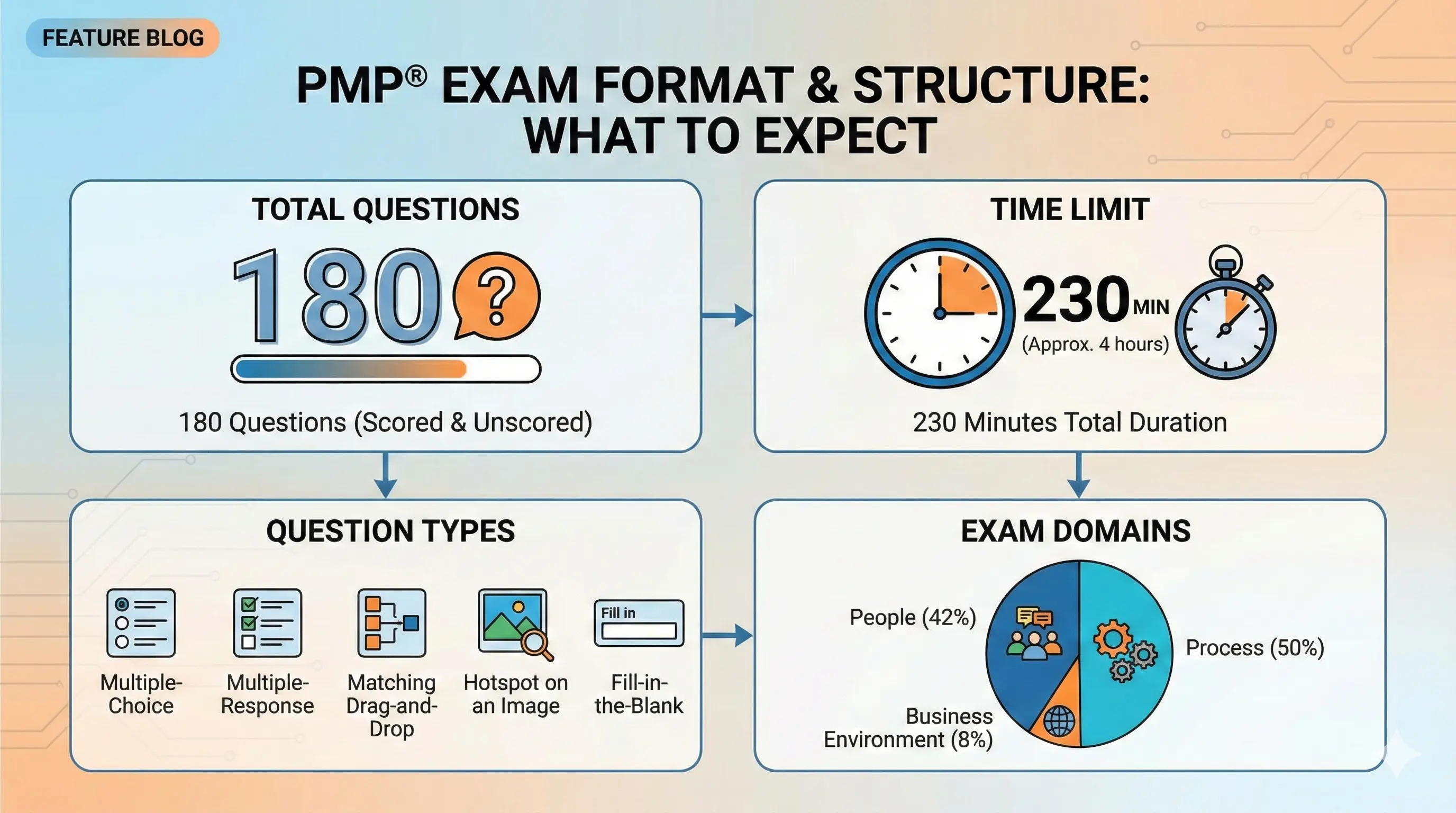
The PMP exam tests your ability to apply project management knowledge to real-world scenarios. Here are the key numbers:
- 180 questions total
- 230 minutes (3 hours and 50 minutes) of testing time
- Two optional 10-minute breaks (after questions 60 and 120)
- Computer-based testing at a test center or via online proctoring
The exam is not computer-adaptive. Every question is weighted equally, and the difficulty doesn't adjust based on your performance. You'll face the same exam structure regardless of how you're doing.
Important note about breaks:
The two breaks divide the exam into three sections of 60 questions each. When you finish a section and take your break, you cannot go back to questions from previous sections. This means you need to be confident in your answers before moving on—or comfortable letting flagged questions go.
The break timer starts automatically. If you don't take the full 10 minutes, you can resume early and bank that time mentally, but it doesn't add to your testing time.
Question Types
The PMP exam uses several question formats, though traditional multiple choice remains the most common.
Multiple choice (single answer)
The majority of questions present four answer options where only one is correct. These often involve scenarios where you need to identify the best course of action or the most appropriate response.
Multiple response
Some questions ask you to select two or three correct answers from a list. The question will specify exactly how many to choose. You must select the correct number to receive credit—partial credit isn't awarded.
Matching (drag and drop)
These questions ask you to match items from one list to another. For example, matching project management processes to their knowledge areas, or matching stakeholder engagement strategies to stakeholder types.
Hotspot
Hotspot questions present a diagram, chart, or image and ask you to click on the correct area. You might need to identify where something falls on a matrix or select the appropriate phase on a process diagram.
Fill-in-the-blank
A small number of questions require you to type a numerical answer, typically for calculations. The on-screen calculator is available for these.
Scenario-based questions
Regardless of format, expect long question stems. Many questions present a detailed scenario—sometimes several paragraphs—before asking what you should do. Reading comprehension and the ability to identify relevant information quickly are essential skills.
Tips for different formats:
- For multiple choice, eliminate obviously wrong answers first
- For multiple response, treat each option as a true/false decision
- For matching, start with the pairings you're most confident about
- For scenarios, identify the core problem before looking at answers
Exam Content Mix
The current PMP exam reflects how project management is actually practiced—with a blend of predictive, agile, and hybrid approaches.
The methodology split:
Approximately half the exam covers predictive (traditional/waterfall) approaches, and half covers agile and hybrid approaches. This is a significant shift from older versions of the exam, which were heavily weighted toward predictive methods.
You won't see questions labeled "this is an agile question." Instead, the scenario will describe a situation, and you'll need to recognize which approach applies and respond accordingly.
Predictive questions typically involve:
- Detailed upfront planning
- Formal change control processes
- Earned value management calculations
- Sequential phase gates
Agile questions typically involve:
- Iterative delivery and feedback loops
- Self-organizing teams
- Servant leadership
- Continuous improvement
Hybrid questions describe environments using elements of both—which is increasingly common in real organizations.
The key is situational awareness. Read each scenario carefully to understand the context before selecting your answer. The "right" answer in a predictive environment might be wrong in an agile one.
Scoring
The PMP exam is pass/fail, but PMI doesn't publish a specific passing score.
How scoring works:
PMI uses psychometric analysis to determine the passing threshold. This means the passing score is statistically calculated based on question difficulty and overall exam performance data—not a fixed percentage.
What you'll see on your score report:
Your results show performance levels for each of the three domains:
- Above Target: Strong performance
- Target: Adequate performance
- Below Target: Weak performance
- Needs Improvement: Significant gaps
You can pass the exam while scoring "Below Target" in one domain if your other domains are strong enough. The overall pass/fail decision considers your combined performance.
No penalty for guessing:
There's no penalty for wrong answers. Never leave a question blank. If you're stuck, eliminate what you can, make your best guess, and move on.
What to aim for in practice:
Since there's no published passing score, most prep experts recommend targeting 70-75% or higher on practice exams before scheduling. If you're consistently scoring 80%+ on quality mock exams, you're likely ready.
Test Center vs. Online Proctoring
You can take the PMP exam at a Pearson VUE test center or from home via OnVUE online proctoring. Both options deliver the same exam—the choice depends on your preferences and situation.
Test center experience:
- Professional, controlled environment
- No concerns about technical issues on your end
- Lockers provided for personal items
- Bathroom breaks available (time continues)
- Potential distractions from other test-takers
- Requires travel to the location
Online proctoring experience:
- Test from home or office
- Requires a private, quiet room with closed door
- Webcam and microphone monitoring throughout
- Strict workspace requirements (clear desk, no dual monitors)
- System check required before exam day
- Technical issues can disrupt your exam
For a four-hour exam, consider:
The length of the PMP exam makes the decision more consequential than for shorter tests. At a test center, you can use the restroom during your breaks without issue. With online proctoring, bathroom breaks are more complicated—you may need to go through a re-check-in process.
If you have a reliable, private workspace and good internet, online proctoring offers convenience. If you're worried about distractions at home, kids or pets interrupting, or technical reliability, the test center provides peace of mind.
Time Management Strategy
With 230 minutes for 180 questions, you have approximately 77 seconds per question on average. That sounds reasonable, but scenario-based questions with long stems can eat through time quickly.
Segment your approach:
Think of the exam as three 60-question sections:
- Questions 1-60, then optional break
- Questions 61-120, then optional break
- Questions 121-180, then finish
Aim to complete each section in about 75 minutes, leaving buffer time for review within each section.
Flag and move:
Don't get stuck on difficult questions. If you've spent more than two minutes on a question without confidence, flag it and move on. You can return to flagged questions before ending each section.
The psychological benefit matters too. Answering questions you know builds confidence and momentum. Struggling on a tough question early can shake your focus for easier questions that follow.
When to take breaks:
Take both breaks unless you're running significantly behind on time. A four-hour mental marathon requires recovery periods. Use breaks to:
- Use the restroom
- Drink water and have a snack (test center rules permitting)
- Rest your eyes
- Reset mentally for the next section
Even if you feel fine, the break helps prevent fatigue from compounding in the final section—which is when many candidates struggle.
Pacing checkpoints:
- After 30 questions: ~38 minutes elapsed
- After 60 questions: ~75 minutes elapsed (break time)
- After 90 questions: ~115 minutes elapsed
- After 120 questions: ~150 minutes elapsed (break time)
- After 150 questions: ~190 minutes elapsed
- Finish with 10-15 minutes buffer for final review
Preparing for the Format
Understanding the format is the first step. Practicing under realistic conditions is what builds readiness.
Take full-length mock exams to build stamina for nearly four hours of concentration. Get comfortable with all question types, especially drag-and-drop and hotspot formats that might feel unfamiliar.
For detailed guidance on test day logistics, see our PMP Exam Day guide. To understand what content you'll be tested on, review our breakdown of PMP Exam Domains.
Ready to practice? Start with PMP questions on PM Drills and build the stamina and confidence you need.