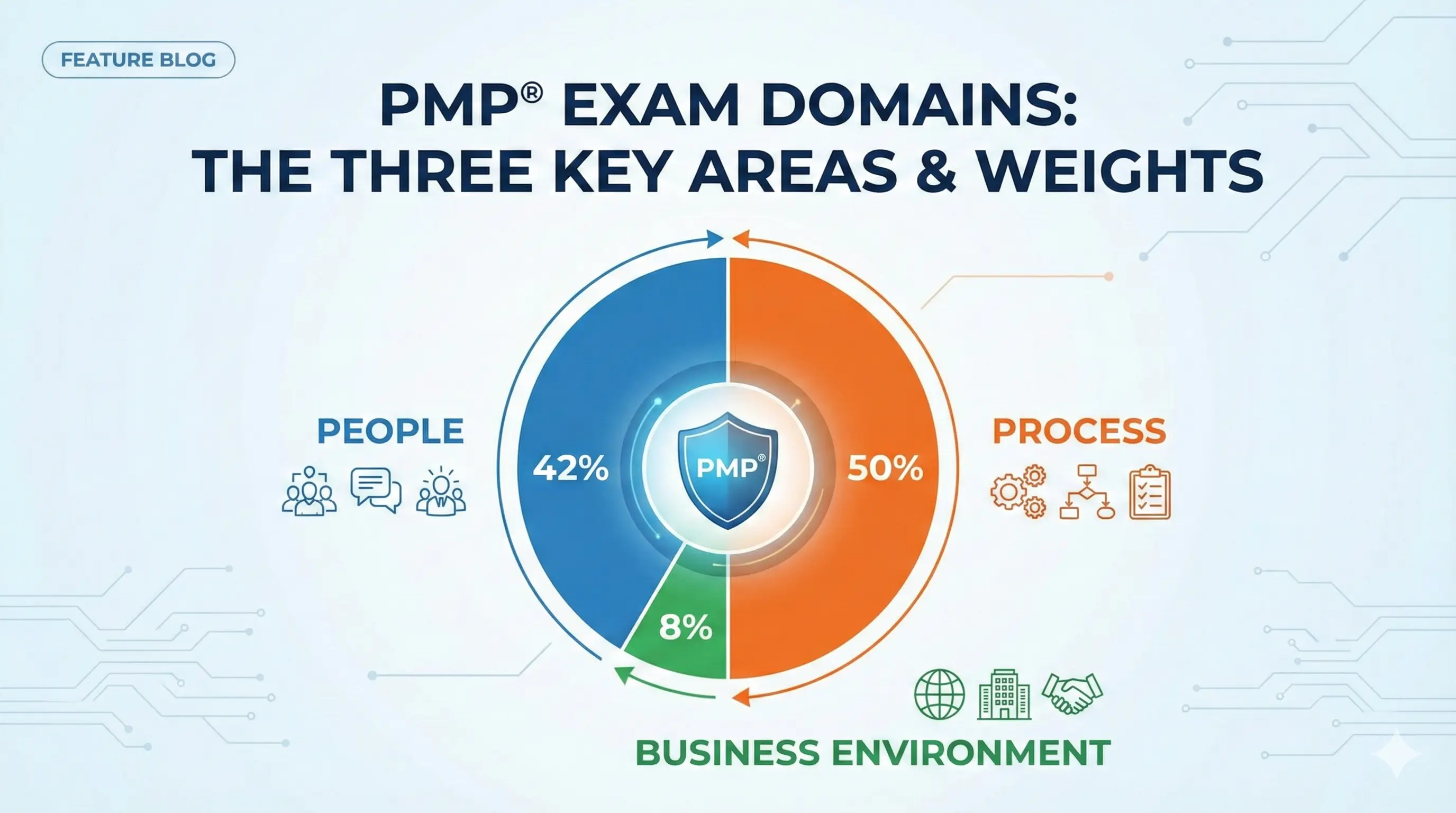
The PMP exam tests three core domains—People, Process, and Business Environment. Understanding what each domain covers and how they're weighted is essential for focused, efficient preparation. You can't study everything equally when half the exam comes from one domain.
This guide breaks down the Examination Content Outline (ECO), explains what each domain covers, and helps you prioritize your study time effectively. For a complete overview of the certification, see our PMP Certification Guide.
The Examination Content Outline (ECO)
PMI publishes the Examination Content Outline to tell you exactly what the PMP exam tests. It's the official blueprint—every question on your exam maps back to tasks defined in this document.
The current ECO:
The ECO was significantly updated in 2021, shifting from the traditional knowledge area structure to three performance domains. This change reflects how project management is actually practiced and emphasizes the human side of leading projects alongside technical execution.
The three domains and their weights:
- People: 42% of exam
- Process: 50% of exam
- Business Environment: 8% of exam
These percentages matter. Process is half your exam. People is nearly as important. Business Environment, while smallest, still represents roughly 14-15 questions you can't afford to ignore.
Predictive, agile, and hybrid throughout:
The ECO doesn't separate predictive and agile into different sections. Instead, both approaches are woven throughout all three domains. Any question might present a scenario using waterfall, Scrum, Kanban, or a hybrid approach. Your job is to recognize the context and apply the appropriate principles.
The shift from PMBOK 6 to PMBOK 7:
If you studied for an older version of the PMP, you'll notice the change. The exam no longer tests the 49 processes from PMBOK 6 directly. Instead, it focuses on principles and performance—how you lead projects and deliver value, not whether you can recite inputs, tools, techniques, and outputs.
That said, understanding process groups and knowledge areas still helps. Many concepts carry forward, just tested differently.
People Domain — 42% of the Exam
The People domain focuses on leading and managing the project team. It recognizes that project success depends heavily on your ability to work with and through people—not just manage tasks and timelines.
What this domain covers:
The People domain includes tasks related to:
- Managing conflict and navigating disagreements
- Leading the project team and setting direction
- Supporting team member performance and development
- Empowering team members and delegating appropriately
- Ensuring team members receive necessary training
- Building high-performing teams
- Addressing obstacles and removing impediments
- Negotiating project agreements
- Collaborating with stakeholders
- Building shared understanding of the project
Key concepts to master:
Emotional intelligence — Understanding and managing your own emotions while recognizing and influencing others' emotions. Expect questions about handling difficult team dynamics, stressed stakeholders, or interpersonal conflicts.
Servant leadership — Particularly important for agile contexts. The servant leader focuses on removing obstacles, providing resources, and enabling the team to succeed—rather than directing every action. Know when to step back and let the team self-organize.
Team development stages — Tuckman's model (forming, storming, norming, performing, adjourning) still appears. Understand what each stage looks like and how a project manager should respond at each phase.
Conflict management — Know the different approaches (collaborating, compromising, accommodating, avoiding, forcing) and when each is appropriate. PMI generally favors collaborative, problem-solving approaches.
Motivation theories — Maslow's hierarchy, Herzberg's two-factor theory, McGregor's Theory X and Y. You don't need deep expertise, but recognize how these concepts apply to motivating project teams.
Agile team dynamics:
Many People domain questions will present agile scenarios. Understand:
- Self-organizing teams and what that means in practice
- The Scrum Master role as facilitator, not manager
- How agile teams handle conflict internally
- Servant leadership in action
- Coaching vs. directing
Study tips for People domain:
Don't underestimate this domain because it seems "soft." At 42%, it's nearly half your exam. Many candidates over-focus on Process and underperform in People.
Practice scenario questions that involve:
- A team member underperforming
- Conflict between team members
- Stakeholder resistance or disengagement
- Team morale issues
- Resource constraints affecting the team
Ask yourself: what would a thoughtful, people-focused project leader do here?
Process Domain — 50% of the Exam
The Process domain covers the technical aspects of managing a project. This is where traditional project management knowledge—planning, executing, monitoring, controlling—lives.
What this domain covers:
The Process domain includes tasks related to:
- Executing project work and managing deliverables
- Managing communications across stakeholders
- Engaging stakeholders throughout the project
- Creating and managing project artifacts
- Managing changes appropriately
- Planning and managing scope, schedule, budget, resources, quality, risk, and procurement
- Establishing project governance
- Integrating project planning activities
- Managing project knowledge and lessons learned
Key concepts to master:
Planning fundamentals — Work breakdown structures, schedule development, cost estimating and budgeting, resource planning. Know how these activities connect and build on each other.
Risk management — Identifying, analyzing, prioritizing, and responding to risks. Understand qualitative vs. quantitative analysis, risk response strategies (avoid, mitigate, transfer, accept for threats; exploit, enhance, share, accept for opportunities).
Change management — How changes are evaluated, approved, and implemented. The integrated change control process. Why changes should go through a formal process even when they seem minor.
Quality management — The difference between quality planning, quality assurance, and quality control. Cost of quality concepts. Continuous improvement.
Procurement — Contract types (fixed price, cost reimbursable, time and materials), when each is appropriate, procurement processes from planning through closure.
Earned Value Management — PV, EV, AC, SV, CV, SPI, CPI, EAC, ETC, VAC, TCPI. Know the formulas and—more importantly—how to interpret the results. See our PMP Formulas guide for detailed coverage.
Integration of predictive and agile:
Process domain questions will test your ability to apply the right approach based on context:
Predictive scenarios might involve:
- Detailed project plans created upfront
- Formal change control boards
- Earned value calculations
- Phase gate reviews
Agile scenarios might involve:
- Iterative delivery with frequent feedback
- Product backlog management and prioritization
- Sprint planning and retrospectives
- Continuous integration and delivery
- Burndown charts and velocity
Hybrid scenarios combine elements:
- Agile development within a predictive overall framework
- Rolling wave planning
- Incremental delivery with milestone-based funding
Study tips for Process domain:
This is the largest domain at 50%. You need solid foundational knowledge, but focus on application over memorization.
Don't just learn what earned value is—practice interpreting EVM scenarios. Don't just memorize risk response strategies—practice selecting the right response for specific situations.
Process questions often have multiple "correct-sounding" answers. The key is identifying the most appropriate action given the specific scenario context.
Business Environment Domain — 8% of the Exam
The Business Environment domain connects projects to organizational strategy. It's the smallest domain but represents real exam questions you need to get right.
What this domain covers:
The Business Environment domain includes tasks related to:
- Planning and managing project compliance with regulations and standards
- Evaluating and delivering project benefits and value
- Evaluating and addressing internal and external business environment changes
- Supporting organizational change management
- Enabling knowledge transfer for business continuity
Key concepts to master:
Benefits realization — Projects exist to deliver value and benefits. Understand how benefits are identified, tracked, and realized. Know the difference between outputs, outcomes, and benefits.
Organizational change management — Projects often require people to change how they work. Understand resistance to change, communication strategies, training needs, and how to sustain changes after the project ends.
Compliance — Projects operate within regulatory and organizational constraints. Know how to identify compliance requirements and ensure the project meets them.
Business environment factors — Enterprise environmental factors and organizational process assets. How internal and external factors influence project decisions.
Knowledge management — Capturing and sharing lessons learned, enabling organizational learning, ensuring knowledge transfers appropriately when projects close or team members leave.
Why this domain matters despite the small percentage:
Eight percent sounds insignificant, but that's roughly 14-15 questions. Getting them wrong because you ignored this domain entirely is an unnecessary risk.
More importantly, Business Environment concepts often appear embedded in People and Process questions. Understanding why projects exist (to deliver value) and how they connect to strategy helps you answer questions across all domains.
Study tips for Business Environment domain:
Don't spend 8% of your study time here—that's not enough. But don't skip it entirely either. Dedicate focused time to understanding:
- How projects connect to organizational strategy
- Benefits management lifecycle
- Compliance considerations
- Change management beyond just project scope changes
Predictive vs. Agile vs. Hybrid
The modern PMP exam tests your ability to recognize context and apply the appropriate approach. This isn't about choosing sides—it's about situational awareness.
Recognizing predictive contexts:
Scenarios describing detailed upfront planning, fixed requirements, formal change processes, phase gates, or highly regulated environments typically call for predictive approaches.
Recognizing agile contexts:
Scenarios describing iterative delivery, evolving requirements, self-organizing teams, servant leadership, or continuous feedback typically call for agile approaches.
Recognizing hybrid contexts:
Many real-world scenarios blend approaches. A project might use agile for development but predictive for compliance documentation. Or start with extensive upfront planning but deliver in iterations.
Common traps:
- Applying rigid change control when the scenario describes an agile team
- Suggesting the project manager should direct a self-organizing team
- Recommending detailed upfront planning when requirements are uncertain
- Ignoring stakeholder needs because "the team decides"
The PMI mindset:
When in doubt, PMI values:
- Communication and stakeholder engagement
- Proactive problem-solving over reactive responses
- Collaboration over command-and-control
- Adaptation based on context over rigid adherence to methodology
- Value delivery over process compliance
Prioritizing Your Study Time
Given the domain weights, here's a practical allocation approach:
Process (50%): Allocate about 40-45% of your study time. It's the largest domain and covers the broadest range of topics. Build solid foundational knowledge, then practice application through questions.
People (42%): Allocate about 35-40% of your study time. Many candidates underinvest here and regret it. People questions require judgment and emotional intelligence—skills that develop through practice and reflection.
Business Environment (8%): Allocate about 15-20% of your study time. Yes, that's more than proportional, but this domain contains concepts that support the others. Understanding benefits realization and organizational context helps you answer People and Process questions too.
Balance, not isolation:
In reality, the domains overlap. A question about managing stakeholder resistance involves People skills, Process knowledge, and Business Environment awareness. Study the domains systematically, but practice questions that blend them.
For detailed study schedules, see our PMP Study Plan guide. To understand how questions are structured and timed, review the PMP Exam Format.
Ready to practice domain-specific questions? Start with PM Drills and track your performance across People, Process, and Business Environment.
Post Summary:
The PMP exam tests three domains: People (42%), Process (50%), and Business Environment (8%). People covers leadership, team management, conflict resolution, and emotional intelligence—with heavy emphasis on servant leadership for agile contexts. Process covers technical project management: planning, execution, risk, quality, procurement, and earned value management across predictive, agile, and hybrid approaches. Business Environment connects projects to organizational strategy through benefits realization, compliance, and change management. Predictive and agile aren't separate sections—both approaches appear throughout all domains. Allocate study time proportionally but don't neglect Business Environment, as its concepts support questions across the exam.