
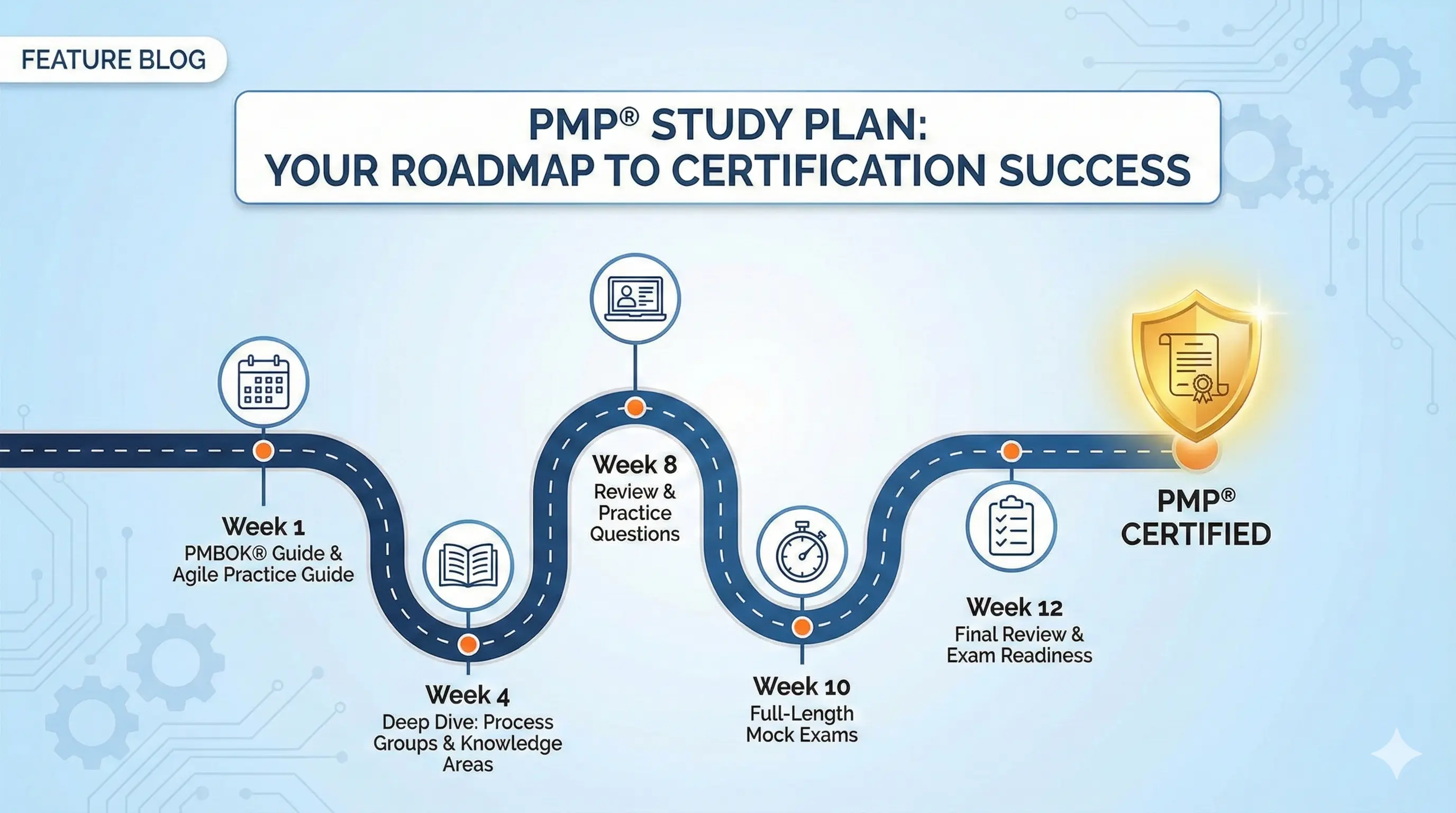
Passing the PMP requires more than just reading a book. It demands a strategic, disciplined approach over several months—one that builds genuine understanding, not just memorization. The candidates who pass on their first attempt typically share one thing in common: they followed a structured study plan.
This guide provides three different study schedules based on your available time, plus guidance on resources and how to know when you're actually ready. For a complete overview of the certification, see our PMP Certification Guide.
How Long Should You Study?
Most successful candidates spend 150-200+ hours studying over 2-4 months. That's significantly more than entry-level certifications like the CAPM, reflecting the PMP's depth and complexity.
Your ideal timeline depends on several factors:
Your PM experience level:If you've been managing projects for years and already think in PMI terms, you might need less time to absorb concepts. If your experience is more informal or you're less familiar with structured methodologies, budget extra time.
Your familiarity with agile:The current exam is roughly half agile/hybrid content. If you've worked primarily in predictive (waterfall) environments, you'll need dedicated time to learn agile principles, Scrum, Kanban, and servant leadership concepts.
Your available study time:Be realistic. If you can only study one hour per day, an 8-week plan won't work. Choose a timeline that fits your life, then protect that time ruthlessly.
Why cramming doesn't work:
The PMP tests application, not recall. You'll face scenario after scenario asking "what should you do?" Answering correctly requires internalized understanding of how project management principles apply in different contexts. That kind of learning takes repetition and reflection over time—not a weekend of intensive reading.
8-Week Intensive Plan
Best for: Candidates with flexible schedules, those who can dedicate significant daily time, or experienced PMs who need a structured refresher.
Time commitment: 3-4 hours per day, 6-7 days per week (~170-200 hours total)
Week 1-2: Foundation
- Complete your 35-hour PM education course (if not already done)
- Read PMBOK Guide 7th Edition—focus on understanding principles, not memorizing
- Take a diagnostic practice test to identify baseline and weak areas
- Create your study schedule and environment
Week 3-4: Deep Dive into Content
- Study the Agile Practice Guide thoroughly
- Work through each of the three exam domains systematically
- Take notes on concepts that don't click immediately
- Begin daily practice questions (30-50 per day)
- Review explanations for every question—right or wrong
Week 5-6: Intensive Practice
- Increase daily practice to 50-75 questions
- Take your first full-length mock exam (180 questions, timed)
- Analyze results by domain—identify patterns in mistakes
- Deep dive into weak areas with targeted study
- Take second full-length mock exam at end of week 6
Week 7: Refinement
- Focus exclusively on weak areas identified in mock exams
- Review formulas and ensure you can apply them in scenarios
- Take third full-length mock exam
- Create a "brain dump" sheet of key concepts to review on exam day
- Begin tapering intensity—avoid burnout
Week 8: Final Prep
- Light review only—no new material
- Take final mock exam early in the week
- Review your brain dump sheet daily
- Focus on rest, nutrition, and mental preparation
- Schedule exam for mid-to-late week if not already scheduled
12-Week Balanced Plan
Best for: Working professionals balancing study with full-time jobs and personal commitments.
Time commitment: 1.5-2 hours per day on weekdays, 3-4 hours on weekend days (~150-180 hours total)
Week 1-2: Setup and Foundation
- Complete 35-hour PM education course (may extend into week 3 if needed)
- Set up study environment and gather resources
- Take diagnostic test to establish baseline
- Begin reading PMBOK Guide—aim for one principle domain per week
Week 3-4: PMBOK and Principles
- Finish PMBOK Guide 7th Edition
- Start Agile Practice Guide
- Begin daily practice questions (15-20 per day)
- Focus on understanding "why" behind each concept
Week 5-6: Agile Deep Dive
- Complete Agile Practice Guide
- Study Scrum, Kanban, and hybrid approaches
- Increase practice to 25-30 questions daily
- Start tracking performance by domain
Week 7-8: Domain Focus
- Systematic review of People domain (42% of exam)
- Systematic review of Process domain (50% of exam)
- Don't neglect Business Environment (8%)
- Take first full-length mock exam at end of week 8
Week 9-10: Weak Area Targeting
- Analyze mock exam results
- Create targeted study plan for weak domains
- Increase practice to 40-50 questions daily
- Take second full-length mock exam at end of week 10
Week 11: Integration and Practice
- Focus on scenario-based question strategies
- Review formulas and calculations
- Take third full-length mock exam
- Identify any remaining gaps
Week 12: Final Preparation
- Light review of weak areas
- Final mock exam early in week
- Mental preparation and logistics planning
- Exam scheduled for late in the week
- Rest and confidence building
16-Week Extended Plan
Best for: Those with limited daily time, candidates starting with less PM background, or anyone who prefers a less intense pace.
Time commitment: 1 hour per day on weekdays, 2-3 hours on weekend days (~130-160 hours total)
Week 1-3: Education Requirement
- Complete 35-hour PM education course
- This is your primary focus—don't rush it
- Take notes and engage actively with material
Week 4-6: PMBOK Foundation
- Read PMBOK Guide 7th Edition at a comfortable pace
- Focus on one section per week
- Begin light practice questions (10-15 per day)
- Build the habit of daily study
Week 7-9: Agile Learning
- Study Agile Practice Guide
- Supplement with videos or additional agile resources if needed
- Continue daily practice questions (15-20 per day)
- Start connecting predictive and agile concepts
Week 10-11: First Assessment Phase
- Take first full-length mock exam
- Don't panic at the score—this is diagnostic
- Analyze results and identify weak domains
- Create prioritized list of topics to review
Week 12-13: Targeted Review
- Focus study time on weak areas
- Increase practice to 25-30 questions daily
- Take second full-length mock exam
- Measure improvement
Week 14: Intensive Practice
- Increase practice to 40+ questions daily
- Focus on question-taking strategies
- Take third full-length mock exam
- Review formulas and key concepts
Week 15: Refinement
- Target remaining weak spots
- Take fourth mock exam
- Build brain dump sheet
- Begin reducing study intensity
Week 16: Final Week
- Light review only
- Final mock exam early in week
- Rest and mental preparation
- Exam at end of week
Essential Study Resources
You don't need to buy everything available. Here's what actually matters:
Required:
35-hour PM education course — You need this for eligibility anyway. Choose a reputable provider that covers both predictive and agile content. This will likely be your most significant expense.
PMBOK Guide 7th Edition — Free with PMI membership. The current edition focuses on principles rather than processes, aligning with how the exam tests application over memorization.
Agile Practice Guide — Also free with PMI membership. Essential given the exam's agile content. Read it thoroughly, not as an afterthought.
Practice question bank — Non-negotiable. You need hundreds of quality practice questions with detailed explanations. This is where you'll spend most of your study time in later weeks.
Highly recommended:
Full-length mock exams — Different from question banks. These simulate the real exam experience with 180 questions under timed conditions. Plan to take 3-5 throughout your preparation.
Optional but helpful:
Supplementary prep books — Authors like Rita Mulcahy, Andrew Ramdayal, and others offer different perspectives that can clarify confusing concepts. Useful if the primary materials aren't clicking.
Video courses — Some people learn better through video. Platforms like Udemy and LinkedIn Learning offer PMP prep courses that complement reading.
How to Use Practice Questions Effectively
Practice questions are the core of PMP preparation. But simply answering hundreds of questions won't help if you're doing it wrong.
Quality over quantity:
Twenty questions with thorough review beats 100 questions rushed through. After each question, read the full explanation—even for questions you got right. Understanding why the correct answer is correct (and why the others aren't) builds the judgment you need for exam day.
Review explanations religiously:
The learning happens in the explanations. For every question:
- Understand why the correct answer is correct
- Understand why each wrong answer is wrong
- Identify the concept being tested
- Note if this reveals a knowledge gap
Track your performance:
Keep a simple log of your scores by domain. Over time, patterns emerge. Maybe you're strong in Process but weak in People. Maybe agile scenarios trip you up. This data drives your targeted review.
Don't memorize questions:
If you're seeing the same questions repeatedly, you risk memorizing answers rather than learning concepts. Use multiple question sources, and focus on understanding the underlying principles.
Progress benchmarks:
- Weeks 1-4: Don't worry about scores—focus on learning
- Weeks 5-8: Aim for 60-65% and improving
- Weeks 9-12: Target 70-75% consistently
- Final weeks: 75-80%+ indicates readiness
Signs You're Ready to Schedule
Scheduling your exam is a commitment. Here's how to know you're genuinely ready:
Consistent mock exam performance:You're scoring 75% or higher on full-length, timed mock exams from reputable sources. One good score might be luck; three in a row indicates readiness.
Comfort across all domains:You don't have glaring weak spots. You might be slightly stronger in some areas, but you're not bombing any single domain.
You can explain concepts:If someone asked you to explain servant leadership, earned value, or hybrid project approaches, you could do it clearly. Recognition isn't enough—you need understanding.
You understand "PMI-isms":You've internalized how PMI thinks about project management. You know that PMI values communication, stakeholder engagement, and proactive risk management. When you read a scenario, you instinctively consider what PMI would recommend.
Scenario questions don't panic you:Long, complex scenarios used to be intimidating. Now you can read them, identify the core issue, and eliminate wrong answers confidently.
You're not improving much anymore:Your scores have plateaued at a passing level. More study time is yielding diminishing returns. This is actually a good sign—it means you've absorbed what you need.
When to Schedule
Once you're ready, don't delay unnecessarily. Schedule your exam 1-2 weeks out to maintain momentum while giving yourself time for final review. Waiting too long risks losing your edge.
For detailed guidance on test day logistics and execution, see our PMP Exam Day guide. To understand exactly what you'll be tested on, review our breakdown of PMP Exam Domains.
Ready to start building your question practice habit? Start with PMP questions on PM Drills and track your progress across all three domains.