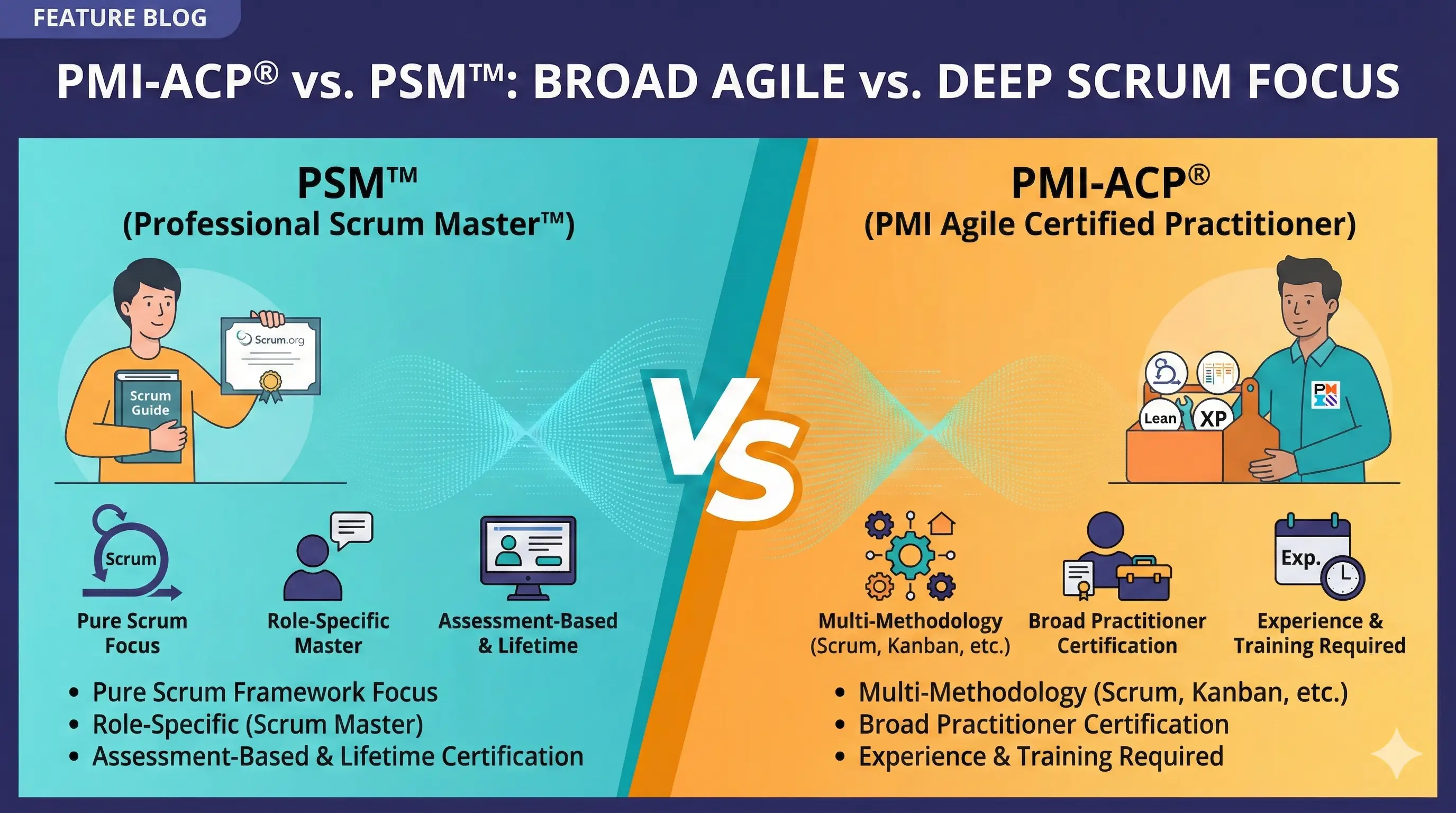
PMI-ACP and PSM are both respected agile certifications, but they serve different purposes and test different things. PMI-ACP covers multiple agile methodologies and requires documented experience. PSM focuses exclusively on Scrum and has no prerequisites beyond passing the exam.
This guide compares both certifications across requirements, exam format, cost, and career impact to help you choose the right path. For a complete overview of PMI's agile certification, see our PMI-ACP Certification Guide.
Quick Comparison
PMI-ACP (PMI Agile Certified Practitioner)
- Issuing body: Project Management Institute (PMI)
- Methodology focus: Multiple (Scrum, Kanban, Lean, XP, and more)
- Experience required: Yes (2,000 hours general + 1,500 hours agile)
- Education required: 21 contact hours
- Exam questions: 120
- Exam time: 3 hours
- Exam fee: $435 (member) / $495 (non-member)
- Renewal: 30 PDUs every 3 years
- Certification expires: Yes, if not renewed
PSM I (Professional Scrum Master I)
- Issuing body: Scrum.org
- Methodology focus: Scrum only
- Experience required: No
- Education required: No (training recommended but not required)
- Exam questions: 80
- Exam time: 60 minutes
- Exam fee: $200
- Renewal: None required
- Certification expires: Never
What Is PMI-ACP?
PMI-ACP is the Project Management Institute's agile certification, designed for practitioners who work with agile methodologies in their projects. It's part of PMI's credential family that includes PMP and CAPM.
What it proves:
PMI-ACP demonstrates broad knowledge of agile principles across multiple methodologies. Holders understand not just Scrum, but also Kanban, Lean, XP, and other agile approaches—and know when to apply each.
Who it's designed for:
- Experienced practitioners working in agile environments
- PMP holders adding agile expertise to their credentials
- Professionals who work with multiple agile approaches
- Those whose organizations value PMI certifications specifically
The certification process:
PMI-ACP requires documented experience before you can apply. You must show 2,000 hours of general project experience, 1,500 hours of agile-specific experience, and 21 hours of agile education. After approval, you take a 120-question exam covering seven domains. For complete eligibility details, see PMI-ACP Requirements.
Maintaining the credential:
PMI-ACP requires 30 Professional Development Units (PDUs) every three years to maintain. If you don't earn and report your PDUs, your certification lapses.
What Is PSM?
PSM is Scrum.org's Professional Scrum Master certification, created by Ken Schwaber—one of Scrum's co-creators. It exists in three levels: PSM I, PSM II, and PSM III, with increasing depth and difficulty.
What it proves:
PSM demonstrates knowledge of Scrum as defined in the Scrum Guide. PSM I validates foundational understanding. PSM II tests application of Scrum in complex situations. PSM III (the most difficult) assesses deep mastery and coaching ability.
Who it's designed for:
- Scrum Masters seeking validation of their Scrum knowledge
- Anyone wanting to demonstrate Scrum understanding without prerequisites
- Professionals who work primarily within Scrum (not multiple methodologies)
- Those who prefer a certification that never expires
The certification process:
PSM has no prerequisites. Anyone can attempt the exam without experience documentation or mandatory training. You pay $200, take the 80-question exam online (unproctored), and receive your result immediately. A score of 85% or higher passes PSM I.
Training is recommended but not required. Scrum.org offers official courses, but you can also self-study using the Scrum Guide (free) and other resources.
Maintaining the credential:
PSM never expires. Once you pass, you're certified for life with no renewal requirements, no PDUs to track, and no ongoing fees.
Key Differences
Methodology Scope
This is the most fundamental difference between the two certifications.
PMI-ACP tests multiple agile methodologies. You need to understand Scrum, Kanban, Lean, XP, and other approaches—plus know when each applies. The exam may present scenarios where you must identify which methodology fits or apply principles from different frameworks.
PSM tests Scrum exclusively. Every question relates to Scrum as defined in the Scrum Guide. You won't see questions about Kanban WIP limits, Lean waste elimination, or XP's pair programming.
Implication: Choose PMI-ACP if you work with multiple agile approaches or want to demonstrate breadth. Choose PSM if you work primarily in Scrum and want deep framework expertise.
Experience Requirements
PMI-ACP requires substantial documented experience:
- 2,000 hours of general project experience (last 5 years)
- 1,500 hours of agile project experience (last 3 years)
- 21 contact hours of agile education
This creates a barrier to entry but also ensures PMI-ACP holders have real-world agile experience.
PSM requires nothing beyond passing the exam. A student with no professional experience could theoretically earn PSM I by studying the Scrum Guide and passing the assessment.
Implication: If you don't yet have the experience for PMI-ACP, PSM offers an immediate path to an agile credential. If you have the experience, PMI-ACP's requirements actually add value—they signal that you've applied agile in practice.
Exam Format and Difficulty
PMI-ACP Exam
- 120 questions
- 3 hours (180 minutes)
- Multiple choice, multiple response, matching, hotspot
- Proctored (test center or online)
- Pass/fail with no published passing score
- Scenario-based questions common
PSM I Exam
- 80 questions
- 60 minutes
- Multiple choice and true/false
- Unproctored (take from anywhere)
- 85% passing score (68/80 correct)
- Mix of knowledge recall and application
PSM I's shorter time creates pressure—you have 45 seconds per question on average versus 90 seconds for PMI-ACP. However, PSM I questions are generally more straightforward if you know the Scrum Guide well.
PMI-ACP questions tend to be more complex, with longer scenarios requiring you to apply judgment across multiple methodologies. The three-hour duration reflects this complexity.
Implication: Neither exam is "easy," but they test differently. PSM I rewards precise knowledge of Scrum. PMI-ACP rewards broader understanding and application ability.
Cost Comparison
PMI-ACP Total Investment
- PMI membership: $149 (first year)
- Exam fee: $435 (member rate)
- Required education: $100–500+
- Study materials: $50–150
- Total: $700–1,200+
- Ongoing: Renewal fees every 3 years
PSM I Total Investment
- Exam fee: $200
- Training: $0 (optional, but courses cost $1,000+ if taken)
- Study materials: $0–50 (Scrum Guide is free)
- Total: $200–250 (self-study path)
- Ongoing: None
PSM I is significantly cheaper, especially if you self-study. PMI-ACP's required education and membership add substantial cost.
Implication: If budget is a primary concern, PSM I offers an agile credential at a fraction of PMI-ACP's cost. If your employer covers certification expenses, cost may be less relevant.
Renewal and Maintenance
PMI-ACP requires 30 PDUs every three years to maintain. PDUs come from continuing education, professional activities, and giving back to the profession. You must also pay a renewal fee.
PSM never expires. Pass once, certified forever. No PDUs, no renewal fees, no tracking requirements.
Implication: PSM's lifetime validity is appealing if you dislike tracking continuing education. However, PMI-ACP's renewal requirement ensures holders stay current—which some employers value.
Industry Recognition
Both certifications are well-recognized, but in different contexts.
PMI-ACP carries PMI's global brand recognition. Organizations that value PMP often value PMI-ACP as a complementary credential. Government contractors, large enterprises, and traditional industries frequently specify PMI certifications.
PSM carries Scrum.org's credibility as a Scrum authority. Tech companies, startups, and organizations deeply committed to Scrum often recognize PSM. The connection to Ken Schwaber (Scrum co-creator) adds legitimacy.
Implication: Research what your target employers or industry values. In some contexts, PMI credentials carry more weight. In others, Scrum.org certifications are preferred.
Which Should You Choose?
Choose PMI-ACP if:
- You work with multiple agile methodologies, not just Scrum
- You want your certification to complement PMP
- Your organization or industry specifically values PMI credentials
- You have the required experience and can document it
- You want a credential that signals real-world agile experience
Choose PSM if:
- You work primarily within Scrum
- You don't yet meet PMI-ACP's experience requirements
- You want a lower-cost certification path
- You prefer a certification that never expires
- You want to validate Scrum knowledge quickly without prerequisites
Choose both if:
Some practitioners hold both certifications. This makes sense if:
- You want to demonstrate both breadth (PMI-ACP) and Scrum depth (PSM)
- Your career spans environments that value different credentials
- You're building toward senior agile roles that benefit from multiple certifications
If pursuing both, PSM I first is often practical—it's faster and cheaper, providing an immediate credential while you build toward PMI-ACP eligibility.
If you already have CSM:
If you hold CSM (Certified ScrumMaster from Scrum Alliance), adding PMI-ACP makes more sense than PSM. CSM already demonstrates Scrum knowledge. PMI-ACP adds multi-methodology breadth and a PMI credential—differentiation that PSM wouldn't provide.
For a detailed comparison of CSM and PMI-ACP, see CSM vs PMI-ACP. For CSM versus PSM specifically, see CSM vs PSM.
Career Implications
Job market recognition:
Both certifications appear in job postings for agile roles. PMI-ACP often appears alongside PMP in project management-focused positions. PSM often appears in Scrum Master and agile team-focused roles.
Neither certification guarantees employment, but both signal commitment to agile practice and validated knowledge.
Combining with other certifications:
PMP + PMI-ACP: This combination is powerful for project managers in hybrid environments. It shows traditional PM expertise plus agile capability—valuable in organizations balancing both approaches. For more on this pairing, see PMP vs PMI-ACP.
PSM I + PSM II: Progressing through Scrum.org's levels demonstrates deepening Scrum mastery. PSM II requires application, not just knowledge—it's significantly harder than PSM I.
CSM + PMI-ACP: Combines Scrum Alliance's Scrum credential with PMI's multi-methodology certification. Shows both focused Scrum training and broad agile knowledge.
Salary impact:
Certification alone doesn't determine salary, but certified professionals often earn more than non-certified peers in similar roles. Both PMI-ACP and PSM holders report salary premiums, though specific numbers vary by region, industry, and experience level.
Career progression:
For Scrum Master career paths, PSM (especially PSM II and III) signals deepening expertise in that specific role.
For broader agile leadership—agile coach, agile program manager, PMO roles—PMI-ACP's multi-methodology scope often aligns better with responsibilities that span frameworks.
Next Steps
Both PMI-ACP and PSM are valuable credentials—the right choice depends on your experience, goals, and context. Consider what your target employers value, what methodologies you work with, and whether you meet PMI-ACP's prerequisites.
If PMI-ACP is your path, start with understanding the full requirements and costs. Review PMI-ACP Requirements and PMI-ACP Cost to plan your certification journey.
Ready to start preparing for PMI-ACP? Practice with exam-style questions covering all seven domains and multiple methodologies, or download the PM Drills app to study anywhere.